There is a real Vatican-linked telescope in Arizona, and there really was an instrument nicknamed LUCIFER. But the internet version of this story, where the Vatican secretly funded a scope called Lucy to watch a mysterious light source coming and going from Earth, does not match the facts. Here is what actually exists on that mountain, what the instruments do, and why the conspiracy version keeps spreading.
What Exists on Mount Graham
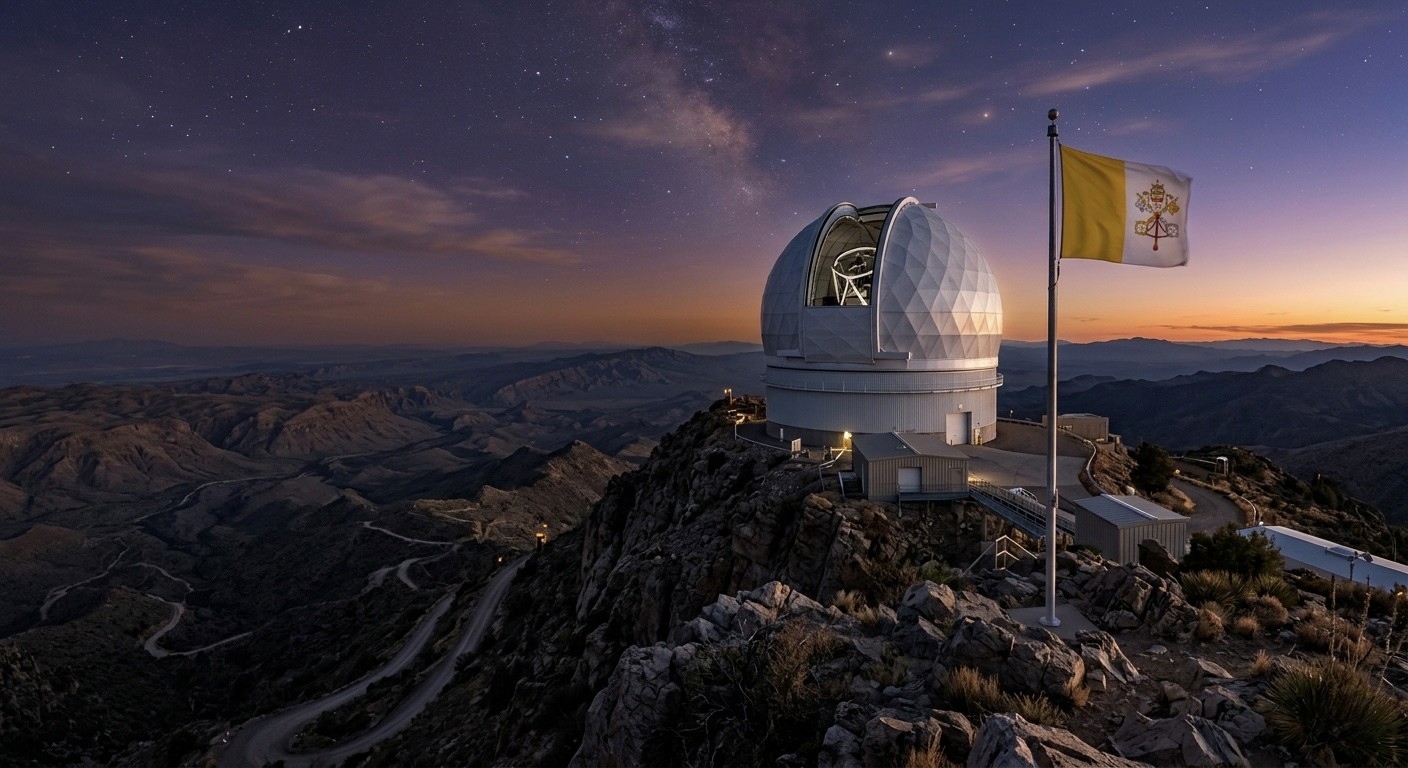
The site is Mount Graham International Observatory in southeastern Arizona, a high, dark-sky mountain used by several major astronomy projects. On that mountain there are three main facilities: the Vatican Advanced Technology Telescope, a 1.8-meter research telescope operated by the Vatican Observatory; the Large Binocular Telescope, a huge twin-mirror telescope run by a consortium of universities and institutes including the University of Arizona, Italian observatories, and German institutions; and the Heinrich Hertz Submillimeter Telescope. So yes, the Vatican does have a telescope on a dark Arizona mountain, but it shares that mountaintop with other big-science partners.
What LUCIFER Actually Is
LUCIFER was never the name of the Vatican telescope. It was the nickname for a near-infrared instrument built by German institutions for the Large Binocular Telescope next door to the Vatican's scope. The acronym originally stood for Large Binocular Telescope Near-infrared Utility with Camera and Integral Field Unit for Extragalactic Research. After predictable backlash over the name, the instrument was officially renamed LUCI around 2012 and now exists as LUCI-1 and LUCI-2. It is a camera and spectrograph used to study distant galaxies, star formation, and other deep-space objects in the near-infrared, not a custom system to monitor some specific light source near Earth. Crucially, LUCI is not owned or run by the Vatican, and it does not a
Why Mount Graham and the Sacred Land Controversy
Astronomers pick sites for very dark, dry, stable air at high elevation. Mount Graham came out of a survey of hundreds of mountains as one of the clearest, darkest, and most stable locations in the continental U.S. The Vatican had already been forced to move its observatory once because the skies outside Rome got too bright, so when the University of Arizona invited them into the Mount Graham project, they saw it as a long-term dark-sky solution. What makes it feel eerie is not a stated secret mission but the context: Mount Graham, known as Dzil Nchaa Si An, is a sacred mountain for the San Carlos Apache, and tribal leaders have fought the telescopes for decades, saying the project violates a living religious site. Environmental groups also opposed the build because the summit is habitat for the endangered Mount Graham red squirrel. So you end up with an ancient Christian institution, a cutting-edge telescope, on a remote high-altitude mountain that Indigenous people consider sacred, shoved through over years of legal and political fighting. That is an extremely atmospheric setting, but it does not match the online claim that the Vatican picked the spot to monitor a particular light source near Earth.ttach to the Vatican's telescope.
STAY IN THE KNOW
The stories shaping culture, delivered straight to your inbox.
Get exclusive editorial coverage on the events, brands, and trends that matter most. No spam, just substance.