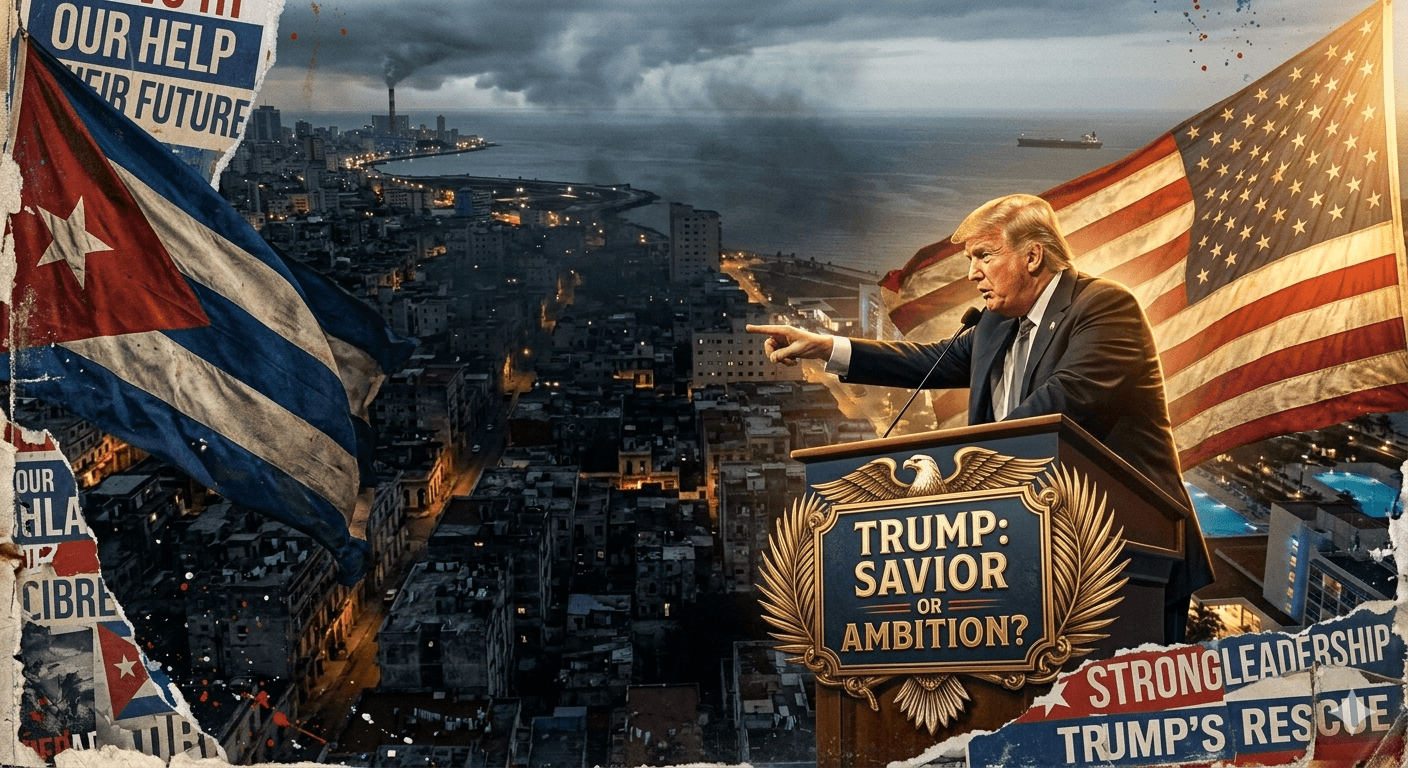
When President Donald Trump told reporters on March 16, 2026, that he believed he would have the honor of taking Cuba, the phrase landed like a depth charge in diplomatic waters that were already churning. Whether he meant liberating the island, absorbing it into the American orbit, or simply applying enough pressure to force regime change, the ambiguity was the point. Trump has built an entire foreign policy brand on statements that mean different things to different audiences, and his Cuba rhetoric is no exception. For Cuban Americans in Miami, the words carried the weight of decades of exile, hope, and frustration. For Havana, they sounded like a threat dressed in the language of charity. And for the rest of the world watching from the sidelines, the question was straightforward: what exactly does the United States want to do with an island that is running out of fuel, running out of patience, and running out of time?
The Quote That Launched a Thousand Headlines
The timeline of Trump's Cuba commentary reads like an escalating series of provocations, each one calibrated to push the conversation a little further without committing to a specific action. On March 5, 2026, he told CNN that Cuba was going to fall soon, signaling that the administration saw the island's collapse as imminent rather than hypothetical. By March 16, standing in the White House, he used the phrase that would define the news cycle for weeks. On March 27, speaking at the Future Investment Initiative forum in Miami, he declared that Cuba was next, placing the island squarely behind Iran on the administration's priority list. The escalation was deliberate, methodical, and aimed at multiple audiences simultaneously.
The language matters because it straddles two completely different narratives. To supporters, taking Cuba means rescuing eleven million people from a failed government that has left them without reliable electricity, fuel, or food. To critics, it sounds like the vocabulary of imperialism, a superpower eyeing a ninety-mile-away island the way a real estate developer eyes a distressed property. The Cuban American community in South Florida, one of the most politically active diaspora groups in the country, has been waiting for this kind of rhetoric for decades. Republican Congressman Carlos Gimenez, a Cuban American from Florida, responded on social media that there would be no investment from the United States unless there was major political change on the island. The sentiment captured the conditional nature of the promise: help is coming, but only if Cuba bends first.
An Island Running on Fumes
To understand why Trump's words carry so much weight, you have to understand the island's current condition. Cuba has not received a regularly scheduled oil tanker since late January 2026, when the administration invoked the International Emergency Economic Powers Act to impose punishing tariffs on any nation sending oil to Havana. The effect was immediate and devastating. Power plants that were already decades past their operational lifespan began shutting down in sequence. Rolling blackouts that had been an inconvenience became a permanent feature of daily life. Food spoiled without refrigeration. Water pumps stopped working. Public transit ground to a halt. Hospitals operated by flashlight.
The intervention from Venezuela, which had been Cuba's primary oil supplier for years, was severed when the United States conducted military operations there earlier in 2026. That left Russia as the only major power willing to challenge the blockade, and even Moscow hesitated for months before finally sending the tanker Anatoly Kolodkin, loaded with over 700,000 barrels of crude, to Cuban waters in late March. It was the first fuel delivery the island had received all year. The crisis was not theoretical. It was happening in real time, and Trump's rhetoric about taking Cuba landed in the middle of it.
Charity or Regime Change: The Framing Battle
The central tension in Trump's Cuba strategy is the gap between what it looks like and what it does. On one hand, the administration has framed its approach as humanitarian concern. Trump himself said on March 30 that he had no problem with Russia delivering oil to Cuba because the people were suffering. On the other hand, the suffering is largely a consequence of the administration's own oil blockade, which was designed to apply maximum economic pressure on the Cuban government. The contradiction is not accidental. It is the strategy.
The playbook mirrors what the administration has done in other theaters. Apply crushing economic pressure, wait for the target to buckle, then offer relief as a gesture of goodwill that also happens to come with conditions. In Cuba's case, those conditions appear to include the removal of President Miguel Diaz-Canel and a fundamental restructuring of the island's political system. Reports from multiple outlets indicate the administration wants regime change in Havana, even as it avoids using those exact words in public.
What Cuban Americans Are Actually Hearing
For the Cuban American community concentrated in South Florida, Trump's rhetoric does not sound like imperialism. It sounds like hope. Generations of families who fled the island after the 1959 revolution have built their lives around the expectation that Cuba would eventually change. Every previous American president made promises about Cuba and failed to deliver meaningful results. Trump's willingness to use direct, unfiltered language about taking or freeing the island registers differently with this community than it does with foreign policy analysts in Washington.
That does not mean the community speaks with one voice. Younger Cuban Americans, many of whom were born in the United States and have never set foot on the island, tend to have more nuanced views. Some support Trump's confrontational approach while questioning whether it will actually improve conditions for the people still living there. Others worry that the blockade is punishing ordinary Cubans more than the government it is meant to pressure. The diaspora is united in wanting change but divided on what that change should look like and how much suffering is acceptable in pursuit of it.
The Strategy Behind the Noise
Strip away the headlines and the social media reactions, and what emerges is a coherent if controversial strategy. The administration appears to be running a sequenced campaign across multiple fronts: Venezuela first to cut off Cuba's oil supply, Iran to demonstrate military willingness, and Cuba as the next domino. Trump's March 27 speech at the Miami investment forum was not casual. It was a signal to investors, to the Cuban government, and to the international community that the administration considers Cuba a solvable problem once the Iran situation stabilizes.
Secretary of State Marco Rubio, himself a Cuban American with deep personal and political connections to the issue, has been tasked with leading the Cuba portfolio. Trump publicly stated that he planned to put Rubio on the case, adding that the administration was really focused on it now. The appointment carries symbolic weight. Rubio has spent his entire career advocating for a harder line on Cuba, and placing him at the center of the effort signals that the administration is not interested in the kind of incremental engagement that characterized the Obama era.
What Comes Next
The most honest assessment of the situation is that nobody knows. Trump's language about Cuba has been deliberately open-ended, leaving room for everything from a diplomatic grand bargain to a prolonged economic siege. The Russian oil delivery bought the island a few weeks of breathing room, but it did not solve the underlying crisis. Cuba's power grid remains fragile. Its economy is in freefall. Its government is weaker than it has been at any point since the revolution. And the United States, ninety miles away, is simultaneously the cause of much of the current misery and the only power capable of ending it quickly.
For ordinary Cubans walking dark streets, riding bicycles because buses have no fuel, and burning trash because collection trucks cannot operate, the geopolitical chess match is secondary to the immediate reality of survival. Whether Trump's gambit ultimately leads to liberation, annexation, or simply more of the same depends on decisions that have not been made yet, by leaders in Havana, Moscow, and Washington who are all calculating their next move while eleven million people wait in the dark.
Sources: Reuters, CNN, Fox News, The New York Times, Associated Press, Politico
STAY IN THE KNOW
The stories shaping culture, delivered straight to your inbox.
Get exclusive editorial coverage on the events, brands, and trends that matter most. No spam, just substance.