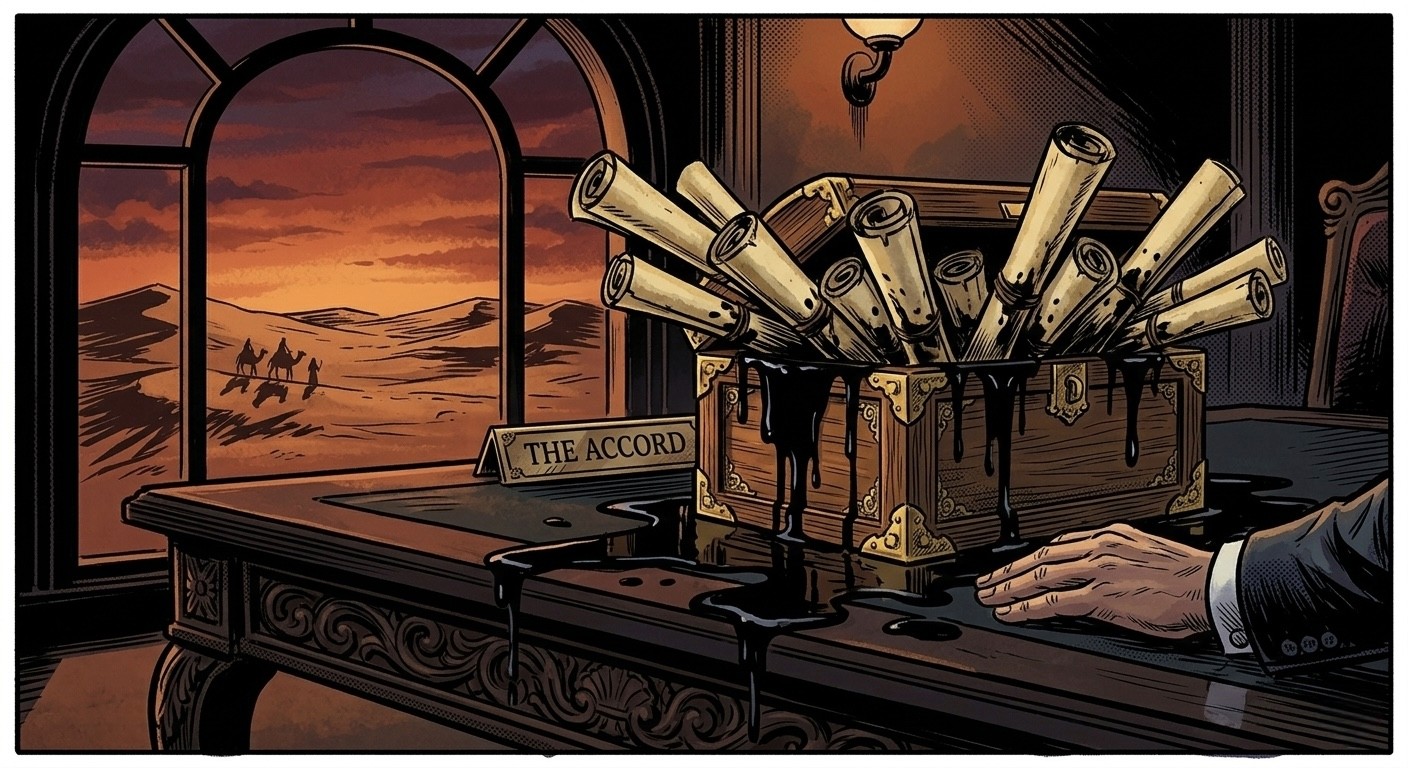
On March 26, 2026, President Donald Trump made an announcement that read more like a plot twist than a policy update. Iran, the country his administration had been bombing for nearly a month, had allowed ten oil tankers to pass through the Strait of Hormuz as what Trump publicly described as a present. The imagery was striking: one of the world's most contested waterways, a chokepoint through which roughly twenty percent of global oil flows, suddenly reopened not through a formal ceasefire but through a gesture that the president framed as a goodwill offering from an adversary the United States was actively striking. Whether this was diplomacy, desperation, or theater depended entirely on who was doing the interpreting.
The Ultimatum That Started It All
The tanker story cannot be understood without rewinding to the weekend of March 21, when Trump issued what amounted to a public ultimatum on Truth Social. He warned that if Iran did not immediately open the Strait of Hormuz to international shipping, the United States would blow up and completely obliterate Iranian energy infrastructure, including electric plants, oil wells, and Kharg Island, the country's primary oil export terminal. The language was not subtle. It was designed to be heard in Tehran, in global oil markets, and by every country that depends on Persian Gulf energy supplies.
Kharg Island processes roughly ninety percent of Iran's crude exports. Threatening to destroy it was the equivalent of threatening to erase the country's primary revenue stream overnight. The fact that Trump specifically named the target in a public social media post signaled that the administration had moved past the stage of strategic ambiguity. This was not a leak or a background briefing. It was the president of the United States telling Iran and the world exactly what he was prepared to destroy.
The "Present" and What Iran Was Actually Saying
Iran's response came not through official diplomatic channels but through action. According to Trump's own account on March 26, Iranian intermediaries contacted American negotiators and said they wanted to demonstrate that they were real and solid by allowing eight oil tankers through the strait. The number eventually grew to ten. Trump described the gesture as a present, a word he repeated multiple times in public remarks, framing the tanker movement as evidence that Iran was ready to deal.
The framing was characteristically Trumpian: transactional, personal, and stripped of the procedural language that typically surrounds international negotiations. But beneath the branding, the tanker movement carried real strategic weight. Allowing commercial vessels through the strait after weeks of disruption signaled that someone inside the Iranian power structure, whether the surviving government, the Revolutionary Guard, or a combination of both, had decided that continued escalation was not in their interest. The question was whether this represented a genuine opening or a tactical pause designed to buy time.
What the Strait of Hormuz Actually Controls
For anyone outside the energy industry, the significance of the Strait of Hormuz can be difficult to grasp in concrete terms. It is a narrow waterway between Iran and Oman, roughly twenty-one miles wide at its narrowest point, through which approximately twenty percent of all globally traded oil passes every day. When the strait is closed or contested, oil prices spike within hours and the economic tremors reach gas stations, shipping companies, and manufacturing floors on every continent.
Iran has used the threat of closing Hormuz as leverage for decades. It is the country's most powerful non-nuclear card: the ability to disrupt the global economy by simply parking naval vessels in a stretch of water that the entire world depends on. The Trump administration's military campaign in Iran, which began in late February 2026, added a new dimension to this calculation. Airstrikes had already targeted military installations and command structures across the country. The implicit message was clear: if Iran closed the strait, the response would not be sanctions or diplomatic protests. It would be the physical destruction of the infrastructure that makes Iranian oil exports possible.
Iran's Public Stance vs. Private Calculations
Publicly, Iran has maintained that it is not surrendering and that the tanker passage should not be interpreted as capitulation. Surviving government officials have emphasized that Iran retains the sovereign right to control access to its territorial waters and that any arrangement regarding the strait is temporary and conditional. The Revolutionary Guard, which controls much of Iran's naval capacity in the Persian Gulf, has issued statements insisting that Iran's military posture remains intact despite the ongoing American air campaign.
Privately, the calculations are almost certainly different. The Trump administration's willingness to name specific infrastructure targets, including Kharg Island, represents a level of escalation that previous administrations avoided. The Iranian leadership, whatever remains of it after weeks of targeted strikes, faces a straightforward choice: continue resisting and risk losing the ability to export oil entirely, or make concessions that can be framed domestically as strategic patience rather than defeat.
The Strategic Picture: What Is Actually Changing
The ten tankers moving through Hormuz represent more than an oil story. They are a signal about the emerging shape of American foreign policy in the Middle East under Trump's second term. The administration has demonstrated that it is willing to use military force not as a last resort but as a primary negotiating tool, applied simultaneously across multiple theaters. The sequencing matters: Venezuela first, then Iran, with Cuba positioned as the next target. Each conflict is connected to the others through energy markets, geopolitical alliances, and the administration's stated goal of reshaping the global order.
For global oil markets, the tanker passage provided immediate but temporary relief. Crude prices, which had spiked dramatically during the weeks of strait disruption, eased slightly on the news. But traders and analysts remain cautious. A gesture is not a treaty. Ten tankers is not a permanent reopening. And the underlying conflict between the United States and Iran remains unresolved, with no formal negotiations underway and no clear path to a comprehensive agreement.
What Comes Next
The most dangerous aspect of the current situation is the gap between the theatrical framing and the operational reality. Trump described the tanker movement as a present, suggesting a personal dynamic between leaders. But the Strait of Hormuz is not a gift that can be wrapped and delivered. It is a strategic asset controlled by a country that is under active military attack. The tankers passed through because someone in Iran decided it was better to let oil flow than to risk the destruction of Kharg Island. That is not generosity. It is coercion producing compliance, dressed in the language of diplomacy.
Whether the tanker passage leads to broader negotiations depends on variables that neither side fully controls. The Iranian power structure is fractured. The American military campaign continues. Oil markets remain volatile. And the administration has already signaled that its attention is shifting toward Cuba, meaning that the Iran situation may be deprioritized before it is resolved. For the countries and companies that depend on Persian Gulf oil, the only certainty is that the strait will remain a flashpoint for as long as the underlying conflict persists, regardless of how many tankers pass through in the meantime.
Sources: Fox News, Politico, Reuters, YouTube (Trump statements), Truth Social posts
On March 26, 2026, President Donald Trump made an announcement that read more like a plot twist than a policy update. Iran, the country his administration had been bombing for nearly a month, had allowed ten oil tankers to pass through the Strait of Hormuz as what Trump publicly described as a present. The imagery was striking: one of the world's most contested waterways, a chokepoint through which roughly twenty percent of global oil flows, suddenly reopened not through a formal ceasefire but through a gesture that the president framed as a goodwill offering from an adversary the United States was actively striking. Whether this was diplomacy, desperation, or theater depended entirely on who was doing the interpreting.
The Ultimatum That Started It All
The tanker story cannot be understood without rewinding to the weekend of March 21, when Trump issued what amounted to a public ultimatum on Truth Social. He warned that if Iran did not immediately open the Strait of Hormuz to international shipping, the United States would blow up and completely obliterate Iranian energy infrastructure, including electric plants, oil wells, and Kharg Island, the country's primary oil export terminal. The language was not subtle. It was designed to be heard in Tehran, in global oil markets, and by every country that depends on Persian Gulf energy supplies.
Kharg Island processes roughly ninety percent of Iran's crude exports. Threatening to destroy it was the equivalent of threatening to erase the country's primary revenue stream overnight. The fact that Trump specifically named the target in a public social media post signaled that the administration had moved past the stage of strategic ambiguity. This was not a leak or a background briefing. It was the president of the United States telling Iran and the world exactly what he was prepared to destroy.
The "Present" and What Iran Was Actually Saying
Iran's response came not through official diplomatic channels but through action. According to Trump's own account on March 26, Iranian intermediaries contacted American negotiators and said they wanted to demonstrate that they were real and solid by allowing eight oil tankers through the strait. The number eventually grew to ten. Trump described the gesture as a present, a word he repeated multiple times in public remarks, framing the tanker movement as evidence that Iran was ready to deal.
The framing was characteristically Trumpian: transactional, personal, and stripped of the procedural language that typically surrounds international negotiations. But beneath the branding, the tanker movement carried real strategic weight. Allowing commercial vessels through the strait after weeks of disruption signaled that someone inside the Iranian power structure, whether the surviving government, the Revolutionary Guard, or a combination of both, had decided that continued escalation was not in their interest. The question was whether this represented a genuine opening or a tactical pause designed to buy time.
What the Strait of Hormuz Actually Controls
For anyone outside the energy industry, the significance of the Strait of Hormuz can be difficult to grasp in concrete terms. It is a narrow waterway between Iran and Oman, roughly twenty-one miles wide at its narrowest point, through which approximately twenty percent of all globally traded oil passes every day. When the strait is closed or contested, oil prices spike within hours and the economic tremors reach gas stations, shipping companies, and manufacturing floors on every continent.
Iran has used the threat of closing Hormuz as leverage for decades. It is the country's most powerful non-nuclear card: the ability to disrupt the global economy by simply parking naval vessels in a stretch of water that the entire world depends on. The Trump administration's military campaign in Iran, which began in late February 2026, added a new dimension to this calculation. Airstrikes had already targeted military installations and command structures across the country. The implicit message was clear: if Iran closed the strait, the response would not be sanctions or diplomatic protests. It would be the physical destruction of the infrastructure that makes Iranian oil exports possible.
Iran's Public Stance vs. Private Calculations
Publicly, Iran has maintained that it is not surrendering and that the tanker passage should not be interpreted as capitulation. Surviving government officials have emphasized that Iran retains the sovereign right to control access to its territorial waters and that any arrangement regarding the strait is temporary and conditional. The Revolutionary Guard, which controls much of Iran's naval capacity in the Persian Gulf, has issued statements insisting that Iran's military posture remains intact despite the ongoing American air campaign.
Privately, the calculations are almost certainly different. The Trump administration's willingness to name specific infrastructure targets, including Kharg Island, represents a level of escalation that previous administrations avoided. The Iranian leadership, whatever remains of it after weeks of targeted strikes, faces a straightforward choice: continue resisting and risk losing the ability to export oil entirely, or make concessions that can be framed domestically as strategic patience rather than defeat.
The Strategic Picture: What Is Actually Changing
The ten tankers moving through Hormuz represent more than an oil story. They are a signal about the emerging shape of American foreign policy in the Middle East under Trump's second term. The administration has demonstrated that it is willing to use military force not as a last resort but as a primary negotiating tool, applied simultaneously across multiple theaters. The sequencing matters: Venezuela first, then Iran, with Cuba positioned as the next target. Each conflict is connected to the others through energy markets, geopolitical alliances, and the administration's stated goal of reshaping the global order.
For global oil markets, the tanker passage provided immediate but temporary relief. Crude prices, which had spiked dramatically during the weeks of strait disruption, eased slightly on the news. But traders and analysts remain cautious. A gesture is not a treaty. Ten tankers is not a permanent reopening. And the underlying conflict between the United States and Iran remains unresolved, with no formal negotiations underway and no clear path to a comprehensive agreement.
What Comes Next
The most dangerous aspect of the current situation is the gap between the theatrical framing and the operational reality. Trump described the tanker movement as a present, suggesting a personal dynamic between leaders. But the Strait of Hormuz is not a gift that can be wrapped and delivered. It is a strategic asset controlled by a country that is under active military attack. The tankers passed through because someone in Iran decided it was better to let oil flow than to risk the destruction of Kharg Island. That is not generosity. It is coercion producing compliance, dressed in the language of diplomacy.
Whether the tanker passage leads to broader negotiations depends on variables that neither side fully controls. The Iranian power structure is fractured. The American military campaign continues. Oil markets remain volatile. And the administration has already signaled that its attention is shifting toward Cuba, meaning that the Iran situation may be deprioritized before it is resolved. For the countries and companies that depend on Persian Gulf oil, the only certainty is that the strait will remain a flashpoint for as long as the underlying conflict persists, regardless of how many tankers pass through in the meantime.
Sources: Fox News, Politico, Reuters, YouTube (Trump statements), Truth Social posts
STAY IN THE KNOW
The stories shaping culture, delivered straight to your inbox.
Get exclusive editorial coverage on the events, brands, and trends that matter most. No spam, just substance.


