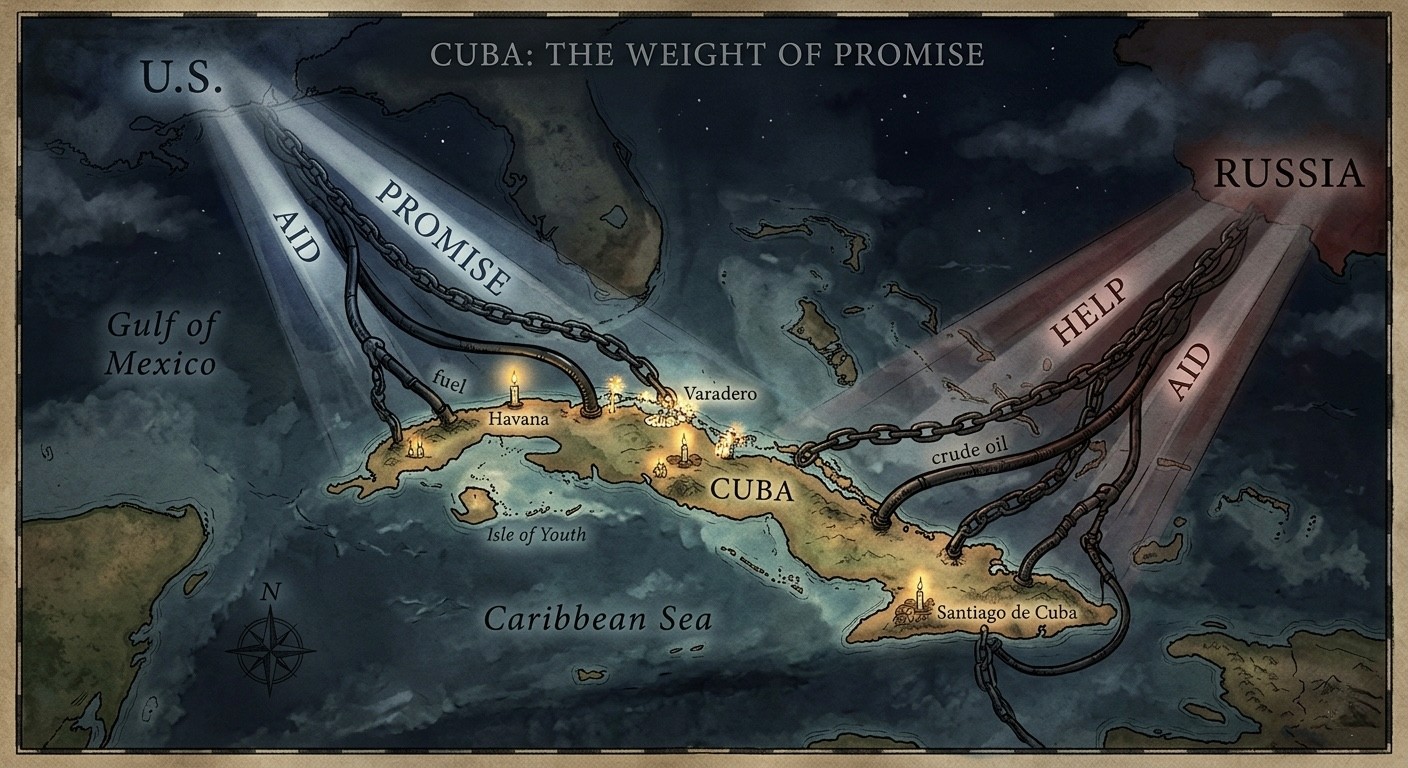
A Russian oil tanker broke through the American blockade of Cuba on March 30, 2026, delivering fuel to a nation on the verge of total energy collapse. The White House called it a humanitarian exception. Moscow called it a duty to an ally. And Cuba, caught between two nuclear powers arguing over who gets to decide its future, called it survival. The tanker's arrival crystallized a three-way geopolitical contest that has been escalating for months, one in which the island's sovereignty is simultaneously invoked and ignored by everyone claiming to defend it.
The Blockade That Built the Crisis
The roots of Cuba's current emergency trace back to January 2026, when President Trump signed an executive order declaring Cuba a national security threat and imposing secondary sanctions on any country providing oil to the island. The order was sweeping in scope, authorizing tariffs on goods from nations that continued fuel deliveries and directing the U.S. Navy to enforce compliance in Caribbean waters. Venezuela, Cuba's primary oil supplier for two decades, had already been cut off following the American intervention in Caracas. The result was immediate and devastating. Cuba's power grid, already fragile from decades of underinvestment, began failing within weeks. Blackouts stretched from hours to days. Hospitals operated on emergency generators. Public transportation ground to a halt in Havana.
Russia's Calculated Lifeline
Moscow's decision to send a tanker was not charity. Russia has spent over two decades rebuilding its relationship with Cuba, a process that began when Vladimir Putin visited Havana in 2000 and laid the groundwork for what has become a multi-sector strategic partnership. The reopening of the Lourdes signals intelligence facility, a massive listening post capable of monitoring communications across the Gulf of Mexico, was one of the most significant developments of that partnership. Russia ratified a formal military cooperation agreement with Cuba in October 2025, establishing a legal framework for joint defense activities that neither side has publicly detailed. When the American blockade began strangling Cuba's economy, Moscow had both the motive and the infrastructure to respond. The tanker was carrying approximately 700,000 barrels of crude oil, enough to keep Cuba's grid functional for roughly two weeks. The message was clear: Russia would not allow the United States to starve its ally into submission without a response.
Trump's Contradictory Signals
The most puzzling aspect of the tanker's arrival is that the Trump administration allowed it. After weeks of enforcing a strict blockade, the White House quietly permitted a sanctioned Russian vessel to reach Cuban waters, framing the decision as a case-by-case humanitarian exception rather than a policy shift. Administration officials emphasized that future violations would still result in vessel seizures. But the contradiction was obvious. The same government that had imposed the blockade to pressure Cuba into political reform was now letting Russia be the one to deliver relief. For critics, this suggested that the blockade was never purely about Cuba. It was about demonstrating American dominance in the Caribbean, and when that demonstration risked a direct confrontation with Russia, the administration blinked. For supporters, it was pragmatic, avoiding a naval incident with a nuclear power while maintaining the broader pressure campaign.
What Cuba Actually Wants
Cuban officials have maintained a careful public posture throughout the crisis. Deputy Foreign Minister Carlos Fernandez de Cossio stated that Cuba's military was on alert for possible American aggression while emphasizing that Havana remained open to respectful dialogue. Cuban Foreign Minister Bruno Rodriguez, meeting with Russian Foreign Minister Sergey Lavrov in February 2026, affirmed that Cuba would honor its agreements with Moscow while seeking economic solutions. The reality behind the diplomatic language is stark. Cuba does not want to be a battleground for U.S.-Russia competition. What it needs is fuel, food, and the economic breathing room that sanctions have systematically eliminated. The island's leadership faces the same impossible calculus that small nations caught between empires have always faced: accept help from whoever offers it, knowing that every lifeline comes with strings.
The Bigger Game in the Western Hemisphere
Cuba is not an isolated case. It is one piece of a broader American strategy to eliminate what the latest National Security Strategy describes as hostile foreign influences in the Western Hemisphere. The pattern is consistent. Venezuela was first, with direct military intervention. Iran is under sustained bombardment. Cuba is being economically strangled. And throughout each of these campaigns, Russia and China have been positioned as the opposing force, offering diplomatic support, military cooperation, and energy supplies to governments that Washington wants to change. For Moscow, losing Cuba would be more than a symbolic defeat. It would mean losing a listening post, a military foothold, and a negotiating chip that has been valuable since the Cold War. Russia's willingness to challenge the blockade, even with a single tanker, signals that it intends to fight for its position in the Caribbean. For Beijing, which reaffirmed its support for Cuban sovereignty following Trump's warning that Cuba is next, the stakes are similar. Every American success in the hemisphere makes it harder for China to maintain its own network of economic and diplomatic relationships in Latin America.
What Happens When the Oil Runs Out
The 700,000 barrels delivered by the Russian tanker will last approximately two weeks. After that, Cuba faces the same crisis it faced before, only with higher stakes. The White House has not indicated whether additional exceptions will be granted. Russia has not announced further shipments. And Cuba's domestic energy infrastructure is not capable of sustaining the country without regular oil imports. The blockade remains in place. The military cooperation agreement between Russia and Cuba remains active. And the administration's stated goal of cleaning hostile influences from the hemisphere remains unchanged. For Cuba, the question is not whether Russia or America gets to save the island. The question is whether anyone will, or whether the island will be allowed to suffer indefinitely as a strategic bargaining chip in a conflict that has very little to do with Cuban welfare and everything to do with great power competition.
Sources: Reuters, Al Jazeera, The Moscow Times, White House Fact Sheets, Democracy Now, CNN
STAY IN THE KNOW
The stories shaping culture, delivered straight to your inbox.
Get exclusive editorial coverage on the events, brands, and trends that matter most. No spam, just substance.