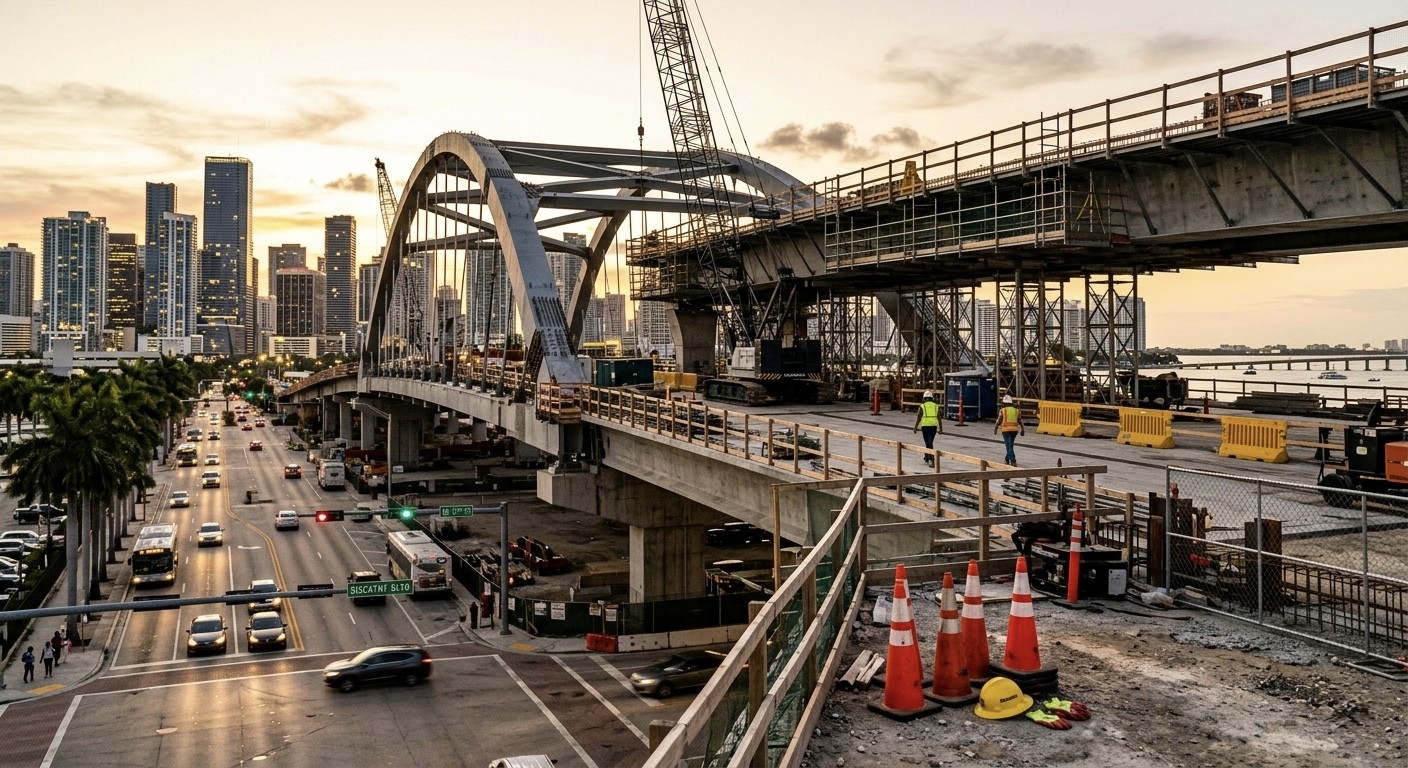
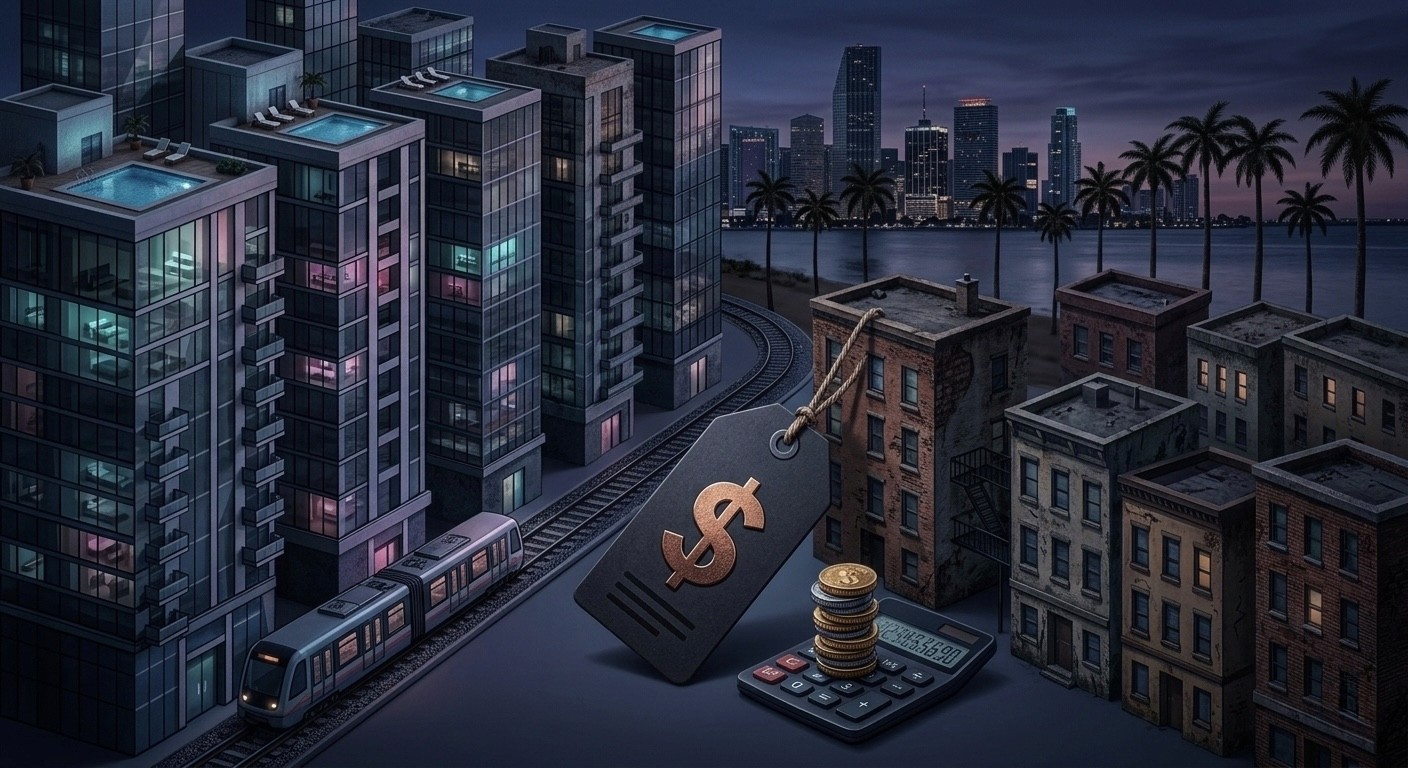
Miami has long been marketed as a sun-soaked paradise where ambition meets opportunity. But beneath the glossy skyline and waterfront condos, a harder truth is settling in: the Magic City is becoming a place built for the few, not the many. From record-breaking traffic congestion to rents that outpace most American cities by double digits, everyday life in Miami is getting more expensive, more exhausting, and more exclusionary with each passing year.
The numbers tell a stark story. According to the Texas A&M Transportation Institute's 2025 Urban Mobility Report, the average Miami motorist lost 93 hours to traffic congestion in 2024. That is not a typo. Ninety-three hours behind the wheel going nowhere, up from 74 hours in 2019, the last full year before the pandemic reshuffled commuting patterns. Nationally, the average was 63 hours, itself an all-time record. Miami ranks among the worst metro areas in the country for time wasted in gridlock, trailing only Los Angeles, which clocked in at a staggering 137 hours.
The congestion is not just an inconvenience. It is a tax on time, productivity, and mental health that falls hardest on people who cannot afford to live close to where they work. The Texas A&M report also noted a nationwide shift in when traffic occurs. Traditional rush hours are back to pre-pandemic levels, but midday congestion has surged, driven by remote and hybrid work schedules, delivery trucks, and shifts in daily routines. In Miami, where infrastructure has never kept pace with population growth, these overlapping patterns create bottlenecks that stretch from early morning well into the evening.
But traffic is only one dimension of a much broader affordability crisis. Housing costs in Miami have reached levels that would have been unthinkable a decade ago. As of March 2026, the average rent in Miami is approximately $2,211 per month according to Apartments.com, which is 36 percent higher than the national average of $1,627. Trulia puts the figure even higher at $3,129 when factoring in larger units. A one-bedroom apartment now averages between $2,600 and $2,978 depending on the source, while two-bedroom units hover around $3,200 to $4,000. These are not luxury penthouse figures. These are what ordinary families are paying to keep a roof over their heads.
The wage picture adds another layer of frustration. On the surface, Miami's compensation numbers look strong. The U.S. Bureau of Labor Statistics reported in February 2026 that compensation costs for private industry workers in the Miami-Fort Lauderdale area increased 4.7 percent for the year ending December 2025, outpacing the national rate of 3.4 percent. Wages and salaries specifically grew at the same 4.7 percent clip, ahead of every other major Southern metro area measured. But context matters. Much of that wage growth is concentrated in finance, tech, and corporate sectors that cater to the transplant economy. For service workers, hospitality staff, teachers, and healthcare aides, the gains are far more modest and rarely enough to offset a rent increase that can wipe out months of raises in a single lease renewal.
The result is a city that is economically booming on paper but hollowing out in practice. The influx of wealthy transplants from New York, California, and Latin America, along with a wave of corporate relocations in finance and tech, has reshaped Miami's real estate landscape at breakneck speed. Luxury towers continue to rise along Brickell, Edgewater, and the Design District, while high-end restaurants and boutique hotels multiply. But these developments serve a narrow slice of the population. Long-time residents in neighborhoods like Little Haiti, Overtown, Allapattah, and Liberty City are watching their communities transform around them, often without benefiting from the changes. Displacement is not a hypothetical risk here. It is an ongoing process.
Consider what a typical working family faces. A household earning the area median income of roughly $65,000 per year brings home around $4,500 after taxes. A modest two-bedroom apartment at $3,200 per month consumes more than 70 percent of that income before a single grocery run, utility bill, or car payment enters the equation. The standard financial guideline suggests spending no more than 30 percent of income on housing. In Miami, that threshold has become a fantasy for a growing share of residents. The math simply does not work for teachers, nurses, restaurant workers, or the thousands of other people who keep the city running daily.
Transportation compounds the housing problem in ways that are hard to overstate. Miami-Dade County's public transit system, while slowly expanding, remains woefully inadequate for a metro area of nearly six million people. The Metrorail covers a single north-south corridor. The Metromover loops through downtown but does not extend into the neighborhoods where most workers live. Bus routes are often slow, infrequent, and unreliable, which means car ownership is not optional for most residents. That car comes with its own costs: insurance rates in South Florida are among the highest in the nation, gas prices routinely exceed national averages, and the wear and tear of sitting in 93 hours of annual gridlock adds up in maintenance bills and depreciation.
The political response has been mixed at best. City and county leaders regularly tout Miami's economic growth, its appeal to international investors, and its emergence as a tech hub. And those things are real. But they exist alongside a parallel reality where working-class families are being priced out of the only city they have ever called home. Affordable housing initiatives exist on paper, but the pace of construction has never matched the scale of demand. Zoning battles, NIMBYism, and the sheer profitability of luxury development make it extremely difficult to build the kind of workforce housing the city desperately needs.
Climate risk adds yet another pressure point. Miami sits at the front lines of sea-level rise, and flood insurance costs are climbing steadily. For homeowners, this means higher carrying costs on properties that may lose value over time. For renters, it means landlords passing those costs through in the form of higher rents. The irony is hard to miss: the very environmental threats that should be slowing Miami's real estate frenzy are instead accelerating the squeeze on people who can least afford to absorb the risk.
None of this means Miami is failing. The city's energy, cultural diversity, and entrepreneurial spirit remain genuinely remarkable. Its food scene is world-class. Its art and music communities continue to punch above their weight. And for people with the financial means to participate, Miami offers an extraordinary quality of life. The problem is that the city's success is increasingly gated. The vibrant, accessible, multicultural Miami that drew people here in the first place is being replaced by something shinier but far less inclusive.
For now, Miami remains a city of two realities. One is the glossy, Instagram-ready version: the rooftop pools, the Art Basel parties, the waterfront brunches. The other is the daily grind of sitting in traffic for nearly two hours, coming home to an apartment that costs most of your paycheck, and wondering how much longer you can afford to stay. Both versions are real. The question is which one the city chooses to build for. If the answer continues to be the few, the many will eventually leave, and they will take the soul of the city with them.
Sources: Texas A&M Transportation Institute 2025 Urban Mobility Report, Axios Miami, U.S. Bureau of Labor Statistics, Apartments.com, Trulia
STAY IN THE KNOW
The stories shaping culture, delivered straight to your inbox.
Get exclusive editorial coverage on the events, brands, and trends that matter most. No spam, just substance.