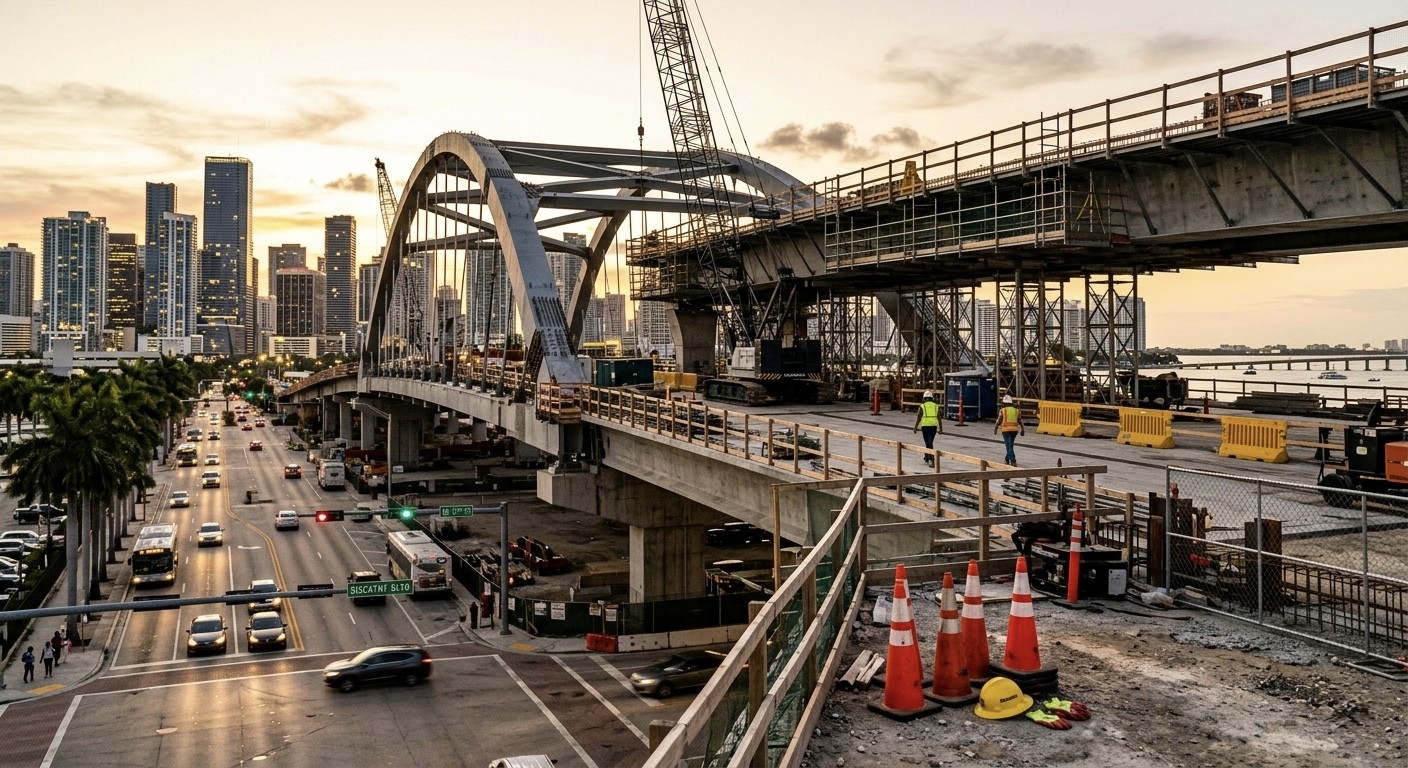
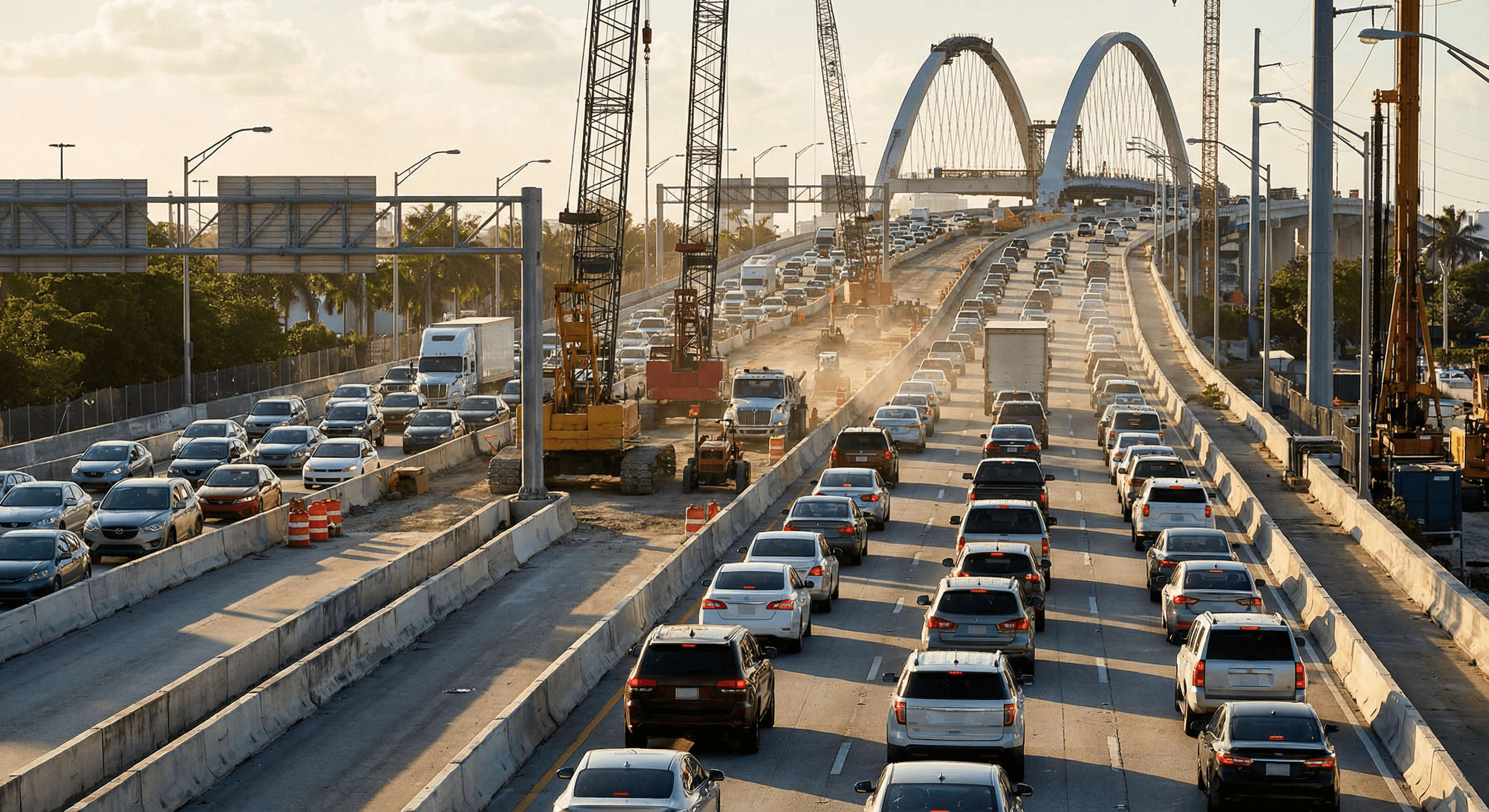
If you have driven across the MacArthur Causeway recently, you already know the feeling: three lanes compressed into two, concrete barriers rising on both sides, and the unsettling sense that the road itself is being rebuilt beneath your tires. That feeling is not going away anytime soon. The MacArthur Causeway construction is part of the $866 million I-395/SR 836/I-95 Connecting Miami project, and the finish line is still years away.
The Connecting Miami project is a partnership between FDOT and the Greater Miami Expressway Agency. Construction spans from SR 836 at NW 17th Avenue through the Midtown Interchange to the MacArthur Causeway Bridge, with I-95 work running from NW 8th Street to NW 29th Street. The Archer Western-de Moya Group Joint Venture is building the project, which is expected to reach completion in late 2029 at a total cost of $866 million, up from the original $818 million estimate when ground broke in 2019. Multiple delays have already pushed the timeline from a projected 2024 completion to 2027, then to the current 2029 target.
The scope of the work is staggering. The project includes complete reconstruction of I-395, the creation of a new double-decked section of SR 836, pavement reconstruction on both directions of I-95, and the construction of the Signature Bridge, an architectural centerpiece that will feature six towering arches over Biscayne Boulevard with the tallest reaching 330 feet above ground.
The Signature Bridge: Miami's Architectural Gamble
The crown jewel of the Connecting Miami project is the Signature Bridge, a structure designed to be as much a piece of public art as it is a piece of infrastructure. When completed, the bridge will feature six soaring arches spanning over Biscayne Boulevard, with the tallest arch reaching approximately 330 feet. As of early 2025, crews have completed one arch over Northeast Second Avenue and are working on erecting all 41 precast, 90-ton arch segments for a second. The construction is visible from miles away, a daily reminder that the city is in the middle of a generational transformation.
But the bridge has also become a symbol of the project's growing pains. COVID-19 disrupted supply chains, causing delays in the delivery of essential materials like steel and concrete. Labor shortages compounded the problem, and the tropical climate of South Florida brought its own weather-related setbacks. In mid-2025, FDOT quietly updated the project's website to reflect a new 2029 completion date and an $866 million price tag, up from an earlier estimate of $840 million. Transit Alliance Miami executive director Cathy Dos Santos was among those who criticized the delay, noting that the project had ballooned into a decade-long bottleneck.
Traffic Chaos: What Drivers Are Dealing With
For the roughly 450,000 vehicles that pass through this corridor every day, the construction has been a years-long headache. Lane closures are frequent, both during the day and at night. Ramps have been narrowed or temporarily shut down, and detours have become a permanent feature of the daily commute. In early 2025, the eastbound SR 836 ramp to southbound I-95 was reduced from two lanes to one for ramp widening, a restriction expected to last months.
Residents and businesses in downtown Miami, Overtown, and the surrounding neighborhoods have felt the impact most acutely. Noise from nighttime construction, full closures of Biscayne Boulevard for arch work, and constant shifts in access routes have disrupted daily life. For those living near the construction zone, the promise of a better highway system can feel distant when the sound of pile driving starts before dawn.
What Drivers Need to Know Right Now
FDOT urges drivers to plan for delays and use alternate routes where possible. The project's official website, i395-miami.com, provides weekly construction updates with details on lane closures, ramp shutdowns, and detour routes. Drivers heading to Biscayne Boulevard and the MacArthur Causeway from the west should be prepared to follow detour signs, as access points shift regularly depending on the phase of construction.
One bright spot: a new northbound I-95 to eastbound I-395 ramp has already opened, improving flow through one of downtown Miami's most congested interchange areas. Additional ramp openings are planned before full project completion, including a westbound I-395 to southbound I-95 connection expected in early 2026. These phased openings are designed to provide incremental relief even as the larger project continues.
Looking Ahead: Is It Worth the Wait?
When the dust finally settles, the Connecting Miami project promises to deliver a fundamentally better highway system for South Florida. The double-decked SR 836 will provide a direct connection to the MacArthur Causeway without local entry and exit points slowing traffic. The rebuilt I-395 will be wider and better designed for modern traffic volumes. And the Signature Bridge, with its six arches rising over Biscayne Boulevard, is poised to become one of Miami's most recognizable landmarks.
But for now, the reality is concrete barriers, lane shifts, and years more of construction noise. The MacArthur Causeway may be the most visible reminder of the disruption, but the entire corridor from NW 17th Avenue to Miami Beach is a construction zone. Until 2029 at the earliest, patience is not optional for anyone driving through downtown Miami. The question is no longer whether the project will be worth it. The question is whether Miami can endure the wait.
STAY IN THE KNOW
The stories shaping culture, delivered straight to your inbox.
Get exclusive editorial coverage on the events, brands, and trends that matter most. No spam, just substance.