
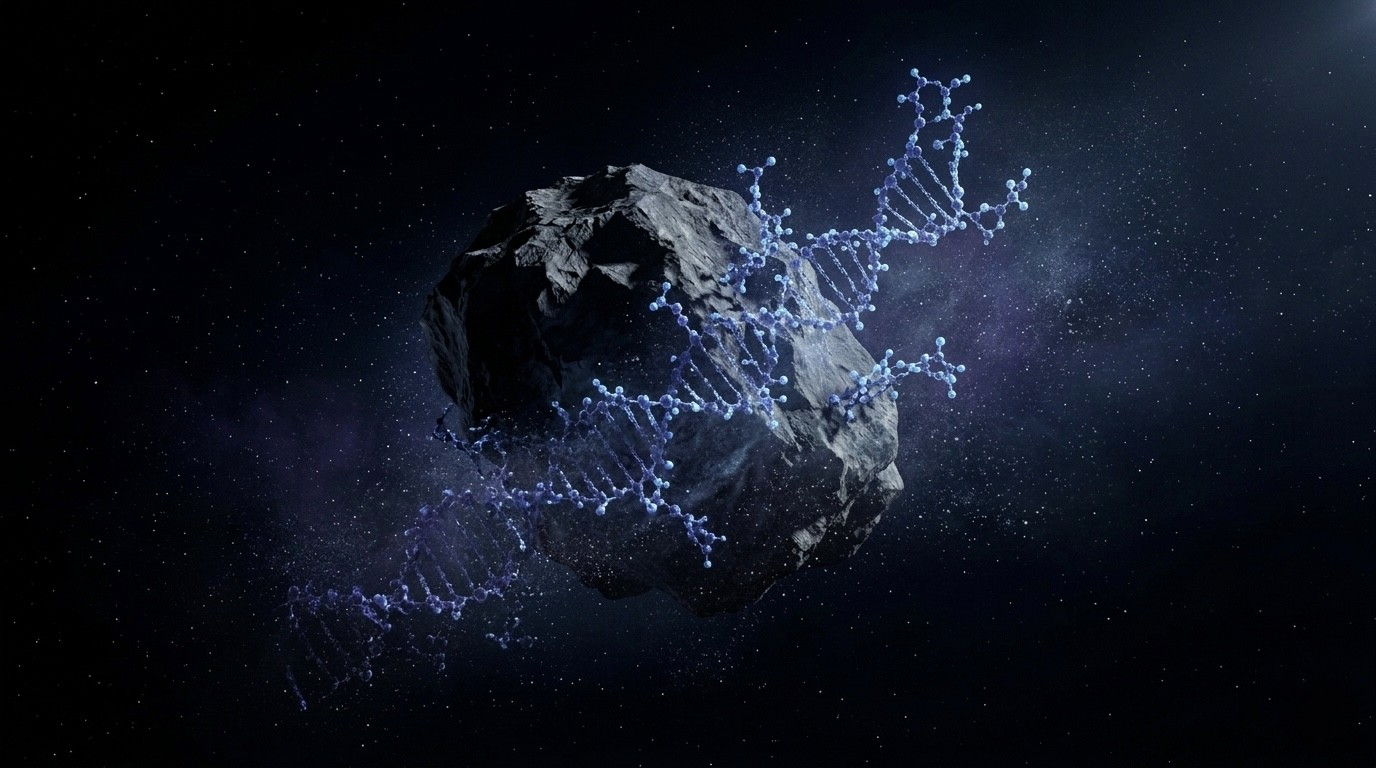
In a landmark discovery that deepens our understanding of how life may have originated on Earth, scientists have confirmed that all five nucleobases essential to DNA and RNA exist on the carbonaceous asteroid Ryugu. The findings, published in the peer-reviewed journal Nature Astronomy in March 2026, represent the first time a complete set of genetic building blocks has been identified in pristine samples returned directly from an asteroid, rather than from meteorites that may have been contaminated by contact with Earth.
The research team, led by Toshiki Koga of Japan, analyzed material collected by JAXA's Hayabusa2 spacecraft, which returned just 5.4 grams of rock and dust from Ryugu in December 2020. Using advanced mass spectrometry techniques, the scientists detected adenine, guanine, cytosine, thymine, and uracil in both surface dust and subsurface fragments. These five molecules form the base pairs of DNA's double helix and RNA's single-strand structure, making them fundamental to how all known life stores and transmits genetic information.
While previous research in 2023 had already identified uracil in Ryugu's samples, this latest analysis is the first to confirm the presence of all five canonical nucleobases together. The distinction is significant because it demonstrates that the complete molecular toolkit required for the construction of DNA and RNA can form in space, independent of any biological process. Lead author Koga was careful to note that this does not mean life existed on Ryugu, but rather that the raw chemical ingredients necessary for life are present on asteroids.
The discovery strengthens a long-standing scientific hypothesis known as panspermia, which suggests that some of life's essential ingredients may have been delivered to early Earth by asteroids and meteorites during the planet's formative years billions of years ago. Ryugu is not the first space rock to show signs of organic chemistry. The Murchison meteorite, which fell in Australia in 1969, contained amino acids and nucleobases. More recently, NASA's OSIRIS-REx mission found similar molecules on asteroid Bennu. However, Ryugu stands apart for having a balanced mix of all five nucleobases present in similar amounts within a single sample.
One of the study's most intriguing findings is a previously unrecognized correlation between the ratios of nucleobases and the concentration of ammonia in the samples. According to Koga, no known formation mechanism predicts such a relationship, suggesting that an entirely new chemical pathway for nucleobase formation may have been active in the early solar system. Morgan Cable, a scientist at Victoria University of Wellington who was not involved in the research, described this particular finding as unique and worthy of further investigation.
Scientists believe asteroids like Ryugu likely formed from a larger, water-rich parent body where chemical reactions could occur over long periods. Subtle differences in the chemistry of various asteroids, possibly influenced by compounds like ammonia, may explain why some favor certain molecules over others. The universal detection of all five nucleobases in samples from both Ryugu and Bennu, as the study's authors note, highlights the potential contribution of these extraterrestrial molecules to the organic inventory that supported prebiotic molecular evolution and ultimately enabled the emergence of RNA and DNA on early Earth.
The implications of this research extend well beyond astrobiology. If the chemistry needed for life is widespread across the solar system, as these findings suggest, it raises the probability that similar building blocks exist on other celestial bodies, including the icy moons of Jupiter and Saturn that are already targets for future exploration missions. The study does not claim that life exists elsewhere, but it removes one of the key objections to the possibility by demonstrating that the molecular prerequisites are not unique to our planet.
Asteroid Ryugu, formally designated 162173, is a near-Earth carbonaceous asteroid approximately 900 meters in diameter. Japan's Hayabusa2 mission launched in December 2014, arrived at Ryugu in June 2018, and spent more than a year conducting observations and collecting samples before departing in November 2019. The spacecraft executed two separate touchdowns on the asteroid's surface, including one that involved detonating an explosive charge to expose subsurface material for collection. The samples were sealed in a capsule that landed in the Australian outback in December 2020 and have since been distributed to research institutions worldwide for analysis.
For the broader scientific community and for anyone who has ever looked up at the night sky and wondered whether we are alone, the Ryugu findings offer a profound answer to at least one part of that question. The chemistry required for life is not rare. It is not confined to Earth. It may, in fact, be woven into the very fabric of the solar system itself, carried from star to star on ancient rocks that predate our planet by billions of years. What remains unknown is how those molecules first assembled into the self-replicating systems we call life, but with each new discovery, the distance between chemistry and biology grows a little shorter.
STAY IN THE KNOW
The stories shaping culture, delivered straight to your inbox.
Get exclusive editorial coverage on the events, brands, and trends that matter most. No spam, just substance.