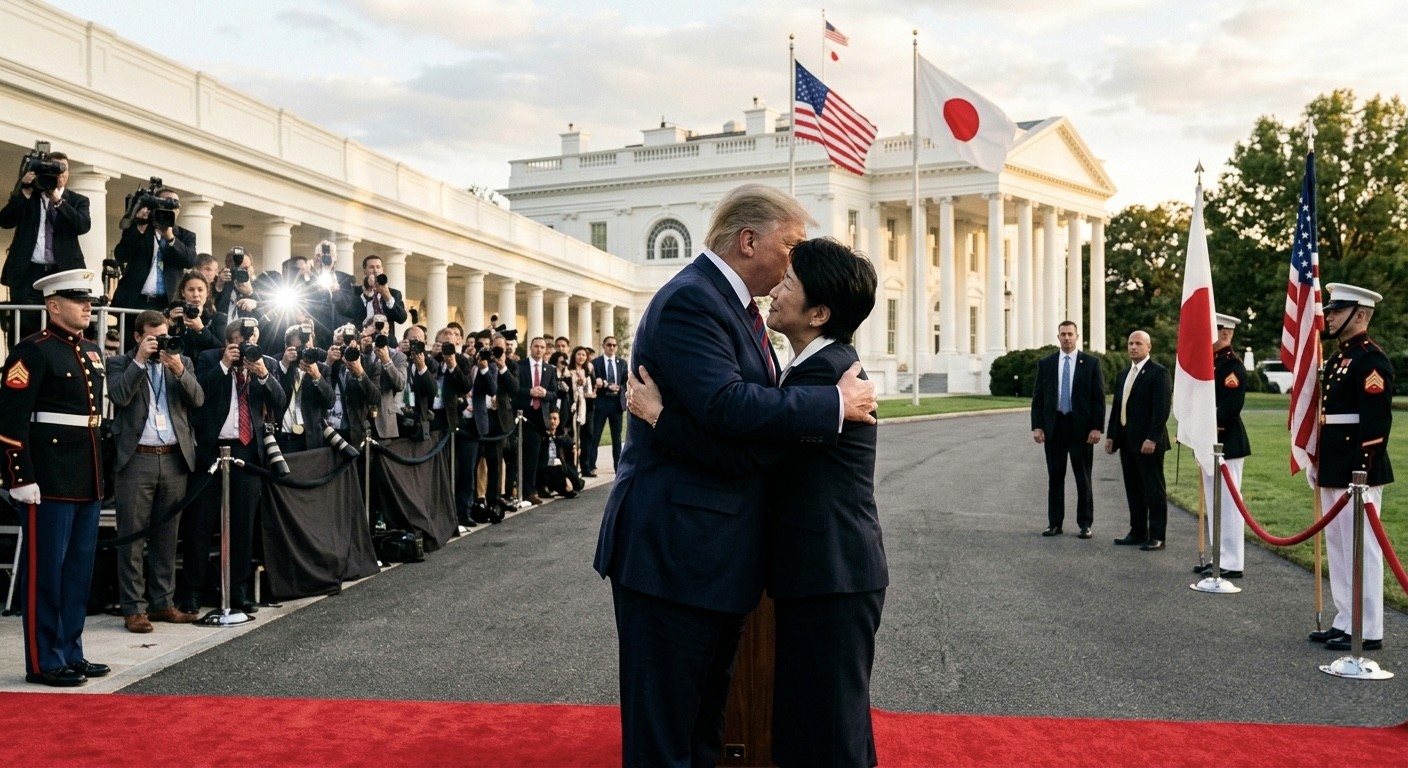
On most state visits, the choreography is predictable. The motorcade pulls up, the doors open, the leaders meet on the White House driveway with a firm handshake and a photo-ready smile. Cameras click. Flags wave. Everyone moves inside. When Japan's Prime Minister Sanae Takaichi arrived in Washington on March 19, 2026, for her first official visit to the White House, the opening seconds followed that familiar script. Then she broke it.
As President Donald Trump stepped forward to greet her, Takaichi went in for a full hug. It was quick, genuine, and strikingly un-Japanese by the standards of traditional diplomatic protocol. In a culture where physical contact between leaders is rare even in private, initiating an embrace on the White House driveway with the world watching was a statement in itself. The clip went instantly viral, shared millions of times across Instagram Reels, TikTok, and X within hours.
This was not AI-generated content or a fan edit. The footage appeared on official White House feeds, was broadcast by Fox News, PBS, and CNBC, and was shared by Japan's Prime Minister's Office on Instagram. The clip showed two leaders greeting each other like old friends rather than stiff heads of government engaged in calculated diplomacy. Commentators in both countries immediately noted how unusual the moment was. Japanese political analysts remarked that seeing a sitting prime minister initiate that level of physical contact, especially in such a formal setting, was virtually unprecedented in modern Japanese diplomacy.
The hug reads as a deliberate choice, not an accident. Takaichi is Japan's first female prime minister and a protege of the late Shinzo Abe, who famously cultivated a close personal rapport with Trump during his presidency. Abe understood that Trump values personal relationships over institutional formalities, and Takaichi appears to have internalized that lesson. By greeting Trump with warmth rather than the customary bow or handshake, she sent a visual shorthand to audiences in both countries: the alliance is strong, the relationship is personal, and this is not just business.
The context of the visit makes the gesture even more significant. Takaichi arrived in Washington at a moment of considerable geopolitical tension. The United States was engaged in military operations against Iran, and Trump had publicly called on allies, including Japan, to send warships to help secure the Strait of Hormuz, through which the majority of Japan's energy imports flow. Tokyo had resisted, citing legal and constitutional constraints on deploying its Self-Defense Forces to a combat zone. The atmosphere heading into the summit was described by Takaichi herself as potentially very difficult.
Against that backdrop, the hug served a dual purpose. For Japanese domestic audiences, it signaled that Takaichi could manage the most unpredictable leader in the world through personal connection rather than confrontation. For American audiences, it reinforced the narrative that the U.S.-Japan alliance remains the cornerstone of Pacific security. The visit itself produced tangible results: Trump and Takaichi signed a $40 billion nuclear reactor agreement involving GE Vernova and Hitachi to build advanced small modular reactors in Tennessee and Alabama. They discussed cooperation on critical minerals, energy security, semiconductors, and the growing challenge posed by China's military posture toward Taiwan.
But the dinner that evening may have been even more telling than the arrival. Trump hosted Takaichi at the White House and praised her publicly, calling her a spectacular woman. Through an interpreter, Takaichi referred to the two leaders as best buddies and declared in English, "Japan is back." The warmth was mutual and clearly choreographed for cameras on both sides. Japan also announced the donation of 250 additional cherry trees to the United States ahead of America's 250th anniversary, a gesture that tied the relationship to something deeper than trade deals and defense pacts.
The Brookings Institution had previewed the visit as a highwire act for Takaichi, noting that she arrived with the strongest domestic mandate of any Japanese leader in decades, having won the biggest electoral victory for her party in 70 years. She came prepared with investment packages, energy proposals, and security commitments designed to showcase Japan's value as a partner under the demanding terms of Trump's America First foreign policy. The hug, in that context, was not just a personal touch. It was the opening move in a carefully planned diplomatic performance.
What makes the moment resonate beyond policy circles is how perfectly it maps onto the way most people now consume international news. In a world where geopolitics is experienced through 10-second reels, a hug between two leaders carries more emotional weight than any joint communique. The image of Japan's prime minister embracing Trump on the White House driveway lands as reassurance: despite war headlines and trade disputes, the U.S.-Japan relationship is personal, warm, and stable. For many viewers, that clip is the only piece of the visit they will ever see, and it was carefully tailored to send exactly that message.
The visit was not without friction, however. During the Oval Office press session, Trump made an awkward reference to Pearl Harbor when asked why the U.S. had not consulted Japan before launching strikes on Iran. That moment, covered in a companion article, created an entirely different viral narrative. But the hug came first, and first impressions tend to stick. The sequencing was almost certainly intentional: lead with warmth, absorb the harder conversations behind closed doors, and let the softer image define the visit in public memory.
Diplomacy has always been partly theater. What has changed is the stage. A single gesture caught on camera and circulated through social media now reaches more people in an hour than a diplomatic cable ever could. Takaichi understood that, and the hug was her way of controlling the narrative before anyone else could. Whether it changes anything substantive about the alliance is debatable. But in the currency of modern diplomacy, where perception often outweighs policy, it was a masterclass.
Sources: White House Official Gallery, PBS NewsHour, AP News, CNBC, The Japan Times, Brookings Institution, DW News, NPR, Fox News
STAY IN THE KNOW
The stories shaping culture, delivered straight to your inbox.
Get exclusive editorial coverage on the events, brands, and trends that matter most. No spam, just substance.