
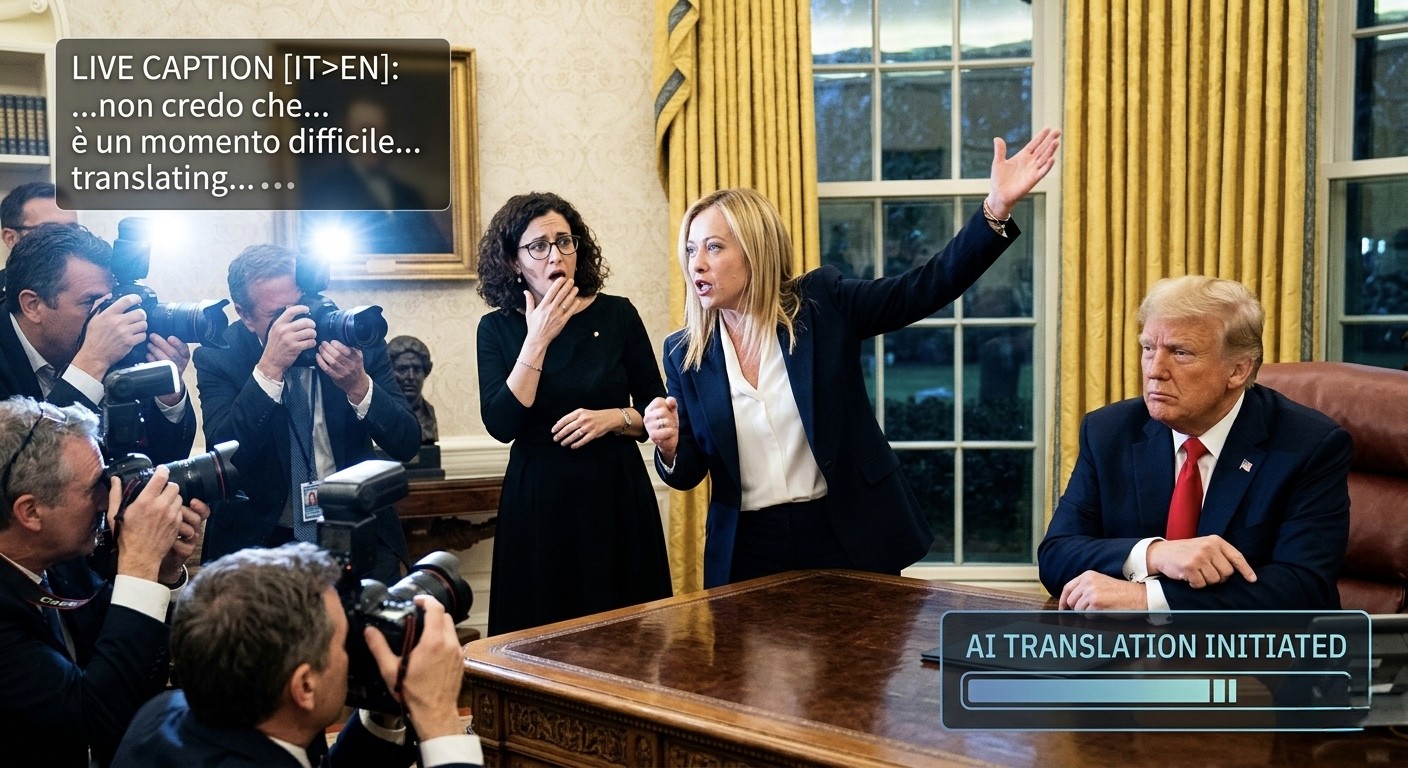
It was supposed to be a tightly controlled Oval Office moment. Cameras rolling, flags perfectly spaced, Italy's Prime Minister Giorgia Meloni sitting across from President Donald Trump as they navigated the weighty topics of war, trade, and transatlantic power. Instead, what the world got was a translator freezing on the spot and Meloni stepping in to rescue her own message in real time. Those thirty seconds told us more about the fragility of modern diplomacy than any joint statement ever could.
The Thirty Seconds That Broke the Script
The viral clip from the April 17 White House meeting plays out like a scene from a political satire. Trump looks to Meloni, a question is put on the table about NATO spending and Ukraine, and everyone turns to interpreter Valentina Majolini-Rothbach to deliver the English. For a beat too long, nothing coherent comes out. The interpreter hesitates, stumbles, visibly swallowed by the gravity of the moment. Meloni cuts in with a firm directive, essentially telling the room she will handle this herself, and begins translating her own answer directly to Trump.
The stakes in that instant were not trivial. This was not a casual photo op but a high-stakes bilateral visit built around looming tariffs on European goods, NATO defense spending commitments, and an active war in Ukraine. Yet the global narrative reduced an entire day of diplomacy down to a few seconds of dead air, some awkward body language, and an Italian leader forced to do someone else's job on live television.
Inside the Room: Serious Topics, Messy Optics
Behind that awkward clip was a loaded agenda. Meloni came to Washington as Europe braced for Trump's threats to impose steeper tariffs on EU goods, with Italian officials describing the trip as a kind of commercial peace mission. At the same time, Trump was pressing his familiar line on NATO defense spending, making clear he wanted allies like Italy to boost budgets and demonstrate they take collective security seriously.
Ukraine also sat heavily on the table. Both sides signaled they wanted the war to end, both framed Trump as the figure capable of pushing a ceasefire and a lasting peace, and both tried to project alignment in front of the cameras. The irony is that one small communication glitch ended up overshadowing the core message they were trying to deliver: competence, coordination, and control. Trump, in response to Meloni's comments once she made them herself, said he did not hold Ukrainian President Volodymyr Zelenskyy responsible for the war but added that he was not thrilled it started in the first place.
The Human Error No One Plans For
What happened in that room was not a policy failure. It was a performance failure. High-level interpreting is one of the most demanding cognitive tasks in any professional setting: you are live, on global broadcast, surrounded by the most powerful people on the planet, and every word feels like it carries a price tag. Valentina Majolini-Rothbach, the interpreter who stumbled, later told Italian newspaper Corriere della Sera that the moment was the worst thing that can happen to a translator, calling it a terrible failure. She said nothing like it had ever happened to her before in a career spanning decades, including work at the G20.
Meloni's move to cut in and handle her own translation was a control move, not an ego play. It protected the flow of the conversation, protected the message she came to deliver, and protected the room from spiraling further into awkwardness on a global stage. But the damage was already done for the cameras. A moment meant to project strength ended up revealing how fragile the entire choreography of high-level diplomacy really is when one human being freezes at the wrong time. Majolini-Rothbach acknowledged that Meloni was right to interrupt, saying it was a very important meeting and every word carried great weight.
Optics, Frustration, and the Instinct to Tighten Control
Consider Trump's perspective for a moment. He thrives on dominance, despises dead air, and understands better than most how quickly a five-second clip can drown out a five-hour meeting. Watching an interpreter lock up in front of him is not just awkward; in his framework, it is an operational failure, the kind of thing that makes a leader want to overhaul the entire system and ensure it never happens again on camera.
That instinct to strip out variables, to reduce the chances that a nervous human will hijack the moment, is exactly where technology starts to creep into the conversation. If your biggest vulnerability is a person freezing under pressure, the obvious question becomes: why not bring in tools that do not get stage fright? The next day, Meloni met with US Vice President J.D. Vance in Rome, and the bilateral relationship continued without further incident. But the clip had already done its damage, becoming the defining image of the visit.
The AI Safety Net: Where Diplomacy Meets Technology
We are at a point where AI translation for major language pairs like Italian and English is already remarkably strong, especially in structured settings. It is not difficult to imagine a near-future Oval Office where the human interpreter still sits between the leaders, but an AI system quietly feeds live transcripts into a tablet, an earpiece, or a screen. If a person stalls, the text is still there. The leader can glance down, repeat the line, and keep it moving.
This does not mean machines replace people in diplomacy. It means they become the safety net, the invisible backup behind the soloist. The Meloni moment is a perfect advertisement for that hybrid model: one nervous pause, one leader forced to improvise, and suddenly you can see how a simple AI caption feed could have kept the entire moment from blowing up online. The technology exists today. The question is whether the political will exists to deploy it in rooms where tradition still carries more weight than efficiency.
What It All Means
The Meloni translator incident exposed a fault line that runs through modern diplomacy: power is no longer just about what leaders sign behind closed doors. It is about how cleanly they can execute under the relentless pressure of cameras, markets, and social media. Human nerves, human fumbles, human misreads are the weak spots. Tightly scripted operations and technological safety nets are the attempted fixes.
For Meloni, the episode was a minor embarrassment that she handled with poise. For Trump, it was another data point in a presidency defined by the obsession with controlling every frame. And for the rest of us watching from the outside, it was a thirty-second reminder that the most powerful rooms in the world are still vulnerable to the most human of failures: stage fright, bad timing, and the unbearable weight of a moment that refuses to go according to plan.
It was supposed to be a tightly controlled Oval Office moment. Cameras rolling, flags perfectly spaced, Italy's Prime Minister Giorgia Meloni sitting across from President Donald Trump as they navigated the weighty topics of war, trade, and transatlantic power. Instead, what the world got was a translator freezing on the spot and Meloni stepping in to rescue her own message in real time. Those thirty seconds told us more about the fragility of modern diplomacy than any joint statement ever could.
The Thirty Seconds That Broke the Script
The viral clip from the April 17 White House meeting plays out like a scene from a political satire. Trump looks to Meloni, a question is put on the table about NATO spending and Ukraine, and everyone turns to interpreter Valentina Majolini-Rothbach to deliver the English. For a beat too long, nothing coherent comes out. The interpreter hesitates, stumbles, visibly swallowed by the gravity of the moment. Meloni cuts in with a firm directive, essentially telling the room she will handle this herself, and begins translating her own answer directly to Trump.
The stakes in that instant were not trivial. This was not a casual photo op but a high-stakes bilateral visit built around looming tariffs on European goods, NATO defense spending commitments, and an active war in Ukraine. Yet the global narrative reduced an entire day of diplomacy down to a few seconds of dead air, some awkward body language, and an Italian leader forced to do someone else's job on live television.
Inside the Room: Serious Topics, Messy Optics
Behind that awkward clip was a loaded agenda. Meloni came to Washington as Europe braced for Trump's threats to impose steeper tariffs on EU goods, with Italian officials describing the trip as a kind of commercial peace mission. At the same time, Trump was pressing his familiar line on NATO defense spending, making clear he wanted allies like Italy to boost budgets and demonstrate they take collective security seriously.
Ukraine also sat heavily on the table. Both sides signaled they wanted the war to end, both framed Trump as the figure capable of pushing a ceasefire and a lasting peace, and both tried to project alignment in front of the cameras. The irony is that one small communication glitch ended up overshadowing the core message they were trying to deliver: competence, coordination, and control. Trump, in response to Meloni's comments once she made them herself, said he did not hold Ukrainian President Volodymyr Zelenskyy responsible for the war but added that he was not thrilled it started in the first place.
The Human Error No One Plans For
What happened in that room was not a policy failure. It was a performance failure. High-level interpreting is one of the most demanding cognitive tasks in any professional setting: you are live, on global broadcast, surrounded by the most powerful people on the planet, and every word feels like it carries a price tag. Valentina Majolini-Rothbach, the interpreter who stumbled, later told Italian newspaper Corriere della Sera that the moment was the worst thing that can happen to a translator, calling it a terrible failure. She said nothing like it had ever happened to her before in a career spanning decades, including work at the G20.
Meloni's move to cut in and handle her own translation was a control move, not an ego play. It protected the flow of the conversation, protected the message she came to deliver, and protected the room from spiraling further into awkwardness on a global stage. But the damage was already done for the cameras. A moment meant to project strength ended up revealing how fragile the entire choreography of high-level diplomacy really is when one human being freezes at the wrong time. Majolini-Rothbach acknowledged that Meloni was right to interrupt, saying it was a very important meeting and every word carried great weight.
Optics, Frustration, and the Instinct to Tighten Control
Consider Trump's perspective for a moment. He thrives on dominance, despises dead air, and understands better than most how quickly a five-second clip can drown out a five-hour meeting. Watching an interpreter lock up in front of him is not just awkward; in his framework, it is an operational failure, the kind of thing that makes a leader want to overhaul the entire system and ensure it never happens again on camera.
That instinct to strip out variables, to reduce the chances that a nervous human will hijack the moment, is exactly where technology starts to creep into the conversation. If your biggest vulnerability is a person freezing under pressure, the obvious question becomes: why not bring in tools that do not get stage fright? The next day, Meloni met with US Vice President J.D. Vance in Rome, and the bilateral relationship continued without further incident. But the clip had already done its damage, becoming the defining image of the visit.
The AI Safety Net: Where Diplomacy Meets Technology
We are at a point where AI translation for major language pairs like Italian and English is already remarkably strong, especially in structured settings. It is not difficult to imagine a near-future Oval Office where the human interpreter still sits between the leaders, but an AI system quietly feeds live transcripts into a tablet, an earpiece, or a screen. If a person stalls, the text is still there. The leader can glance down, repeat the line, and keep it moving.
This does not mean machines replace people in diplomacy. It means they become the safety net, the invisible backup behind the soloist. The Meloni moment is a perfect advertisement for that hybrid model: one nervous pause, one leader forced to improvise, and suddenly you can see how a simple AI caption feed could have kept the entire moment from blowing up online. The technology exists today. The question is whether the political will exists to deploy it in rooms where tradition still carries more weight than efficiency.
What It All Means
The Meloni translator incident exposed a fault line that runs through modern diplomacy: power is no longer just about what leaders sign behind closed doors. It is about how cleanly they can execute under the relentless pressure of cameras, markets, and social media. Human nerves, human fumbles, human misreads are the weak spots. Tightly scripted operations and technological safety nets are the attempted fixes.
For Meloni, the episode was a minor embarrassment that she handled with poise. For Trump, it was another data point in a presidency defined by the obsession with controlling every frame. And for the rest of us watching from the outside, it was a thirty-second reminder that the most powerful rooms in the world are still vulnerable to the most human of failures: stage fright, bad timing, and the unbearable weight of a moment that refuses to go according to plan.
STAY IN THE KNOW
The stories shaping culture, delivered straight to your inbox.
Get exclusive editorial coverage on the events, brands, and trends that matter most. No spam, just substance.