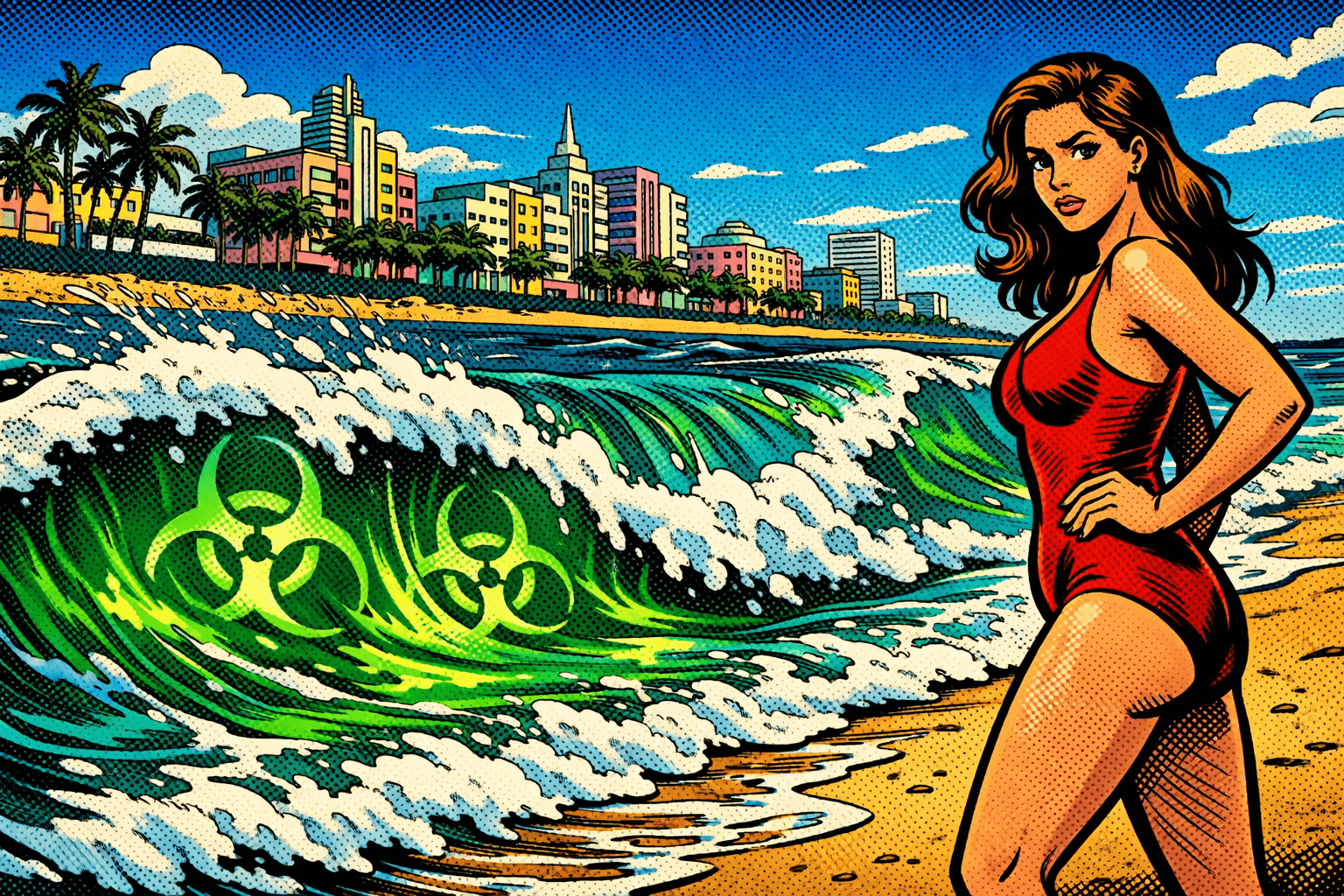
You're Posting "#BeachVibes" While Floating in What, Exactly?
Go ahead -- scroll through your Instagram feed. Somewhere between a sunset dinner reel and a resort towel flat-lay, you'll find a perfectly curated photo of someone standing in "crystal-clear" Miami Beach water, golden hour lighting, caption reading: "Paradise found." What that caption really should read? "Paradise found. With a side of fecal bacteria."
That's not hyperbole. That's water quality science. And if you're planning to swim, wade, or let your toddler splash around in Miami Beach waters this season, you need to know what's actually in there before you get in.
This isn't a scare piece. It's a survival guide. Let's talk about what the data actually says.
Myth-Bust: "Miami Beach Water Is Always Safe to Swim In"
Here's the myth that keeps getting a golden-hour filter slapped on it: Miami Beach water is pristine, monitored, and safe.
The reality? During Spring Break 2026, the Blue Water Task Force flagged toxic fecal bacteria at multiple Miami Beach locations, adding Miami to the growing list of supposedly glamorous beach destinations with a serious contamination problem.
And Spring Break wasn't an anomaly. As recently as January 23, 2026, the Florida Department of Health in Miami-Dade County issued a formal swim advisory for North Shore -- 73rd Street after water sampling revealed enterococci bacteria levels exceeding safe thresholds.
Under Florida DOH guidelines, a reading of 70 or more enterococci per 100 mL of water is considered unsafe for human contact. At that point, swimming is not just discouraged -- it is a genuine public health risk. The data says so. The advisory said so. The crystal-clear water said nothing, because it never does.
What's Actually in the Water (and Why It Matters)
Enterococci are fecal indicator bacteria -- microorganisms that live in the intestinal tracts of humans and warm-blooded animals. When water tests positive for elevated enterococci, it's a signal that the water has been contaminated with sewage overflows, stormwater runoff, or animal waste. The bacteria themselves aren't necessarily the direct threat; they're the canary in the coal mine, indicating that far worse pathogens -- viruses, parasites, harmful bacteria -- may also be present.
Swimming in contaminated water exposes you to a range of health risks that most beachgoers never connect to their beach day: gastrointestinal illness, skin rashes and infections, ear infections (swimmer's ear is no joke), eye irritation, and, in higher-exposure cases, respiratory issues.
The Florida Department of Health uses the EPA's 2012 Recreational Water Quality Criteria to classify beach water: 0-35 enterococci per 100 mL = Good (safe to swim); 36-70 = Moderate (use caution); 71+ = Poor (advisory issued, avoid contact).
The uncomfortable truth: Miami Beach water regularly exceeds that moderate threshold, and not just at obscure canal access points. High-traffic, well-photographed, heavily visited locations have failed these tests. The beach looks the same whether the count is 10 or 200. Your body will know the difference after the fact.
Which Miami Beaches to Avoid Right Now
As of April 2026, Miami Waterkeeper and Swim Guide monitoring data flag the following locations as showing unsafe bacteria levels: Deering Point (Palmetto Bay), East Greynolds Park (North Miami Beach), Jose Marti Park (Miami), Manatee Bend Park (Miami), Margaret Pace Park (Miami), and Peacock Park (Coconut Grove).
Notice a pattern? The majority of these are bay-side locations -- and that's not a coincidence. Biscayne Bay receives significantly more stormwater runoff and is more susceptible to sewage overflow impacts than ocean-facing beaches. The bay looks serene. That serenity is misleading.
South Point Park (South Beach) is currently showing outdated data -- last sampled on March 2nd -- meaning there is no current reliable reading for that site. When data is absent, assume nothing is safe.
And speaking of South Beach: on April 15, 2026, Miami Beach Ocean Rescue raised double red flags and purple flags across all 7+ miles of Miami Beach coastline -- signaling dangerous conditions and the presence of jellyfish and Portuguese Man-O-War. Some days, the ocean is sending a very clear message. Listen to it.
The Cleanest Miami Beaches Right Now
Not all Miami water is a health gamble. As of April 2026, Swim Guide data consistently shows Key Biscayne locations as the cleanest in the greater Miami area: Darwin Beach (Rosenstiel School of Marine and Atmospheric Science), Key Biscayne Yacht Club, Mariner Drive, Miami Marine Stadium, and Oceana Key Biscayne.
If you want to swim and you want data to back up that decision, Key Biscayne is where the numbers are currently in your favor. These ocean-facing, less-urbanized spots benefit from better water circulation and less direct runoff exposure.
Accountability: Who's Responsible for This?
Fair question. The short answer is: everyone, and therefore no one is held accountable.
Miami-Dade County's aging sewage infrastructure has a documented history of overflows -- raw sewage entering waterways during and after heavy rain events. Rapid urban development increases impervious surface area, meaning rainwater can't soak into the ground and instead rushes into storm drains and directly into waterways, carrying with it everything it picks up along the way: pet waste, fertilizers, industrial pollutants, and worse.
Here's where accountability gets particularly murky: the Florida DOH requires two consecutive failed water quality tests before issuing a formal swim advisory. That means a beach can test dangerously contaminated on a Monday, and if the Thursday sample comes back lower, no advisory is ever issued. You swam on Tuesday and no one told you a thing.
Miami Waterkeeper operates on a more protective standard -- they flag a location as unsafe after just one failed test. That single-test approach is the reason their data is often more useful to the public than official DOH advisories.
Perhaps most alarming: many recreational water spots across Biscayne Bay aren't monitored by DOH at all. If a location isn't on the official sampling schedule, it receives no official rating -- not "safe," not "unsafe." Just silence. People swim there anyway.
How to Protect Yourself -- Practical Recommendations
The best move is the most unsexy one: check before you go. Here's how to do it effectively:
Use the Swim Guide app -- it aggregates water quality data and shows current advisories for Miami beaches. Free, mobile-friendly, and potentially the most important app on your phone this summer.
Follow Miami Waterkeeper on Instagram -- they publish updated water quality alerts and flag unsafe locations in near-real-time.
Know the sampling schedule: Miami-Dade monitoring sites are sampled on Wednesdays, with results posted Thursday afternoon. If you're planning a beach day Thursday morning, the results you're reading are a week old.
Avoid swimming within 48-72 hours after heavy rainfall -- stormwater runoff causes bacteria levels to spike dramatically, even at locations that were testing clean the week before.
Choose ocean-facing beaches over bay-side parks -- as the data consistently shows, bay-side locations carry significantly higher contamination risk.
Always swim near a lifeguard station, and save the Ocean Rescue Hotline at (305) 673-7714 in your phone. Conditions change fast.
If you feel sick after swimming -- gastrointestinal symptoms, skin rash, ear pain, eye irritation -- see a doctor promptly and specifically mention that you had contact with ocean or bay water. That information changes the clinical picture and the treatment approach.
The Bottom Line: Know Before You Go
Miami Beach is one of the most visually stunning coastlines in the world. It is also a coastline with measurable, documented, recurring water quality problems that the aesthetic does nothing to reveal. The same sparkling water that fills your camera roll can -- and statistically does, at certain locations and certain times -- contain fecal bacteria at levels that regulators classify as unsafe for human contact.
That's not a reason to never swim in Miami. It's a reason to swim smarter. Check the Swim Guide. Watch Miami Waterkeeper. Respect the red flags. Avoid the bay-side parks when bacteria levels are high. The ocean will still be beautiful when you choose the right day and the right spot.
Share this article -- because the best sunscreen is information, and your friends deserve to know what's actually in the water before they wade in.
Sources: Florida Department of Health -- Beach Water Quality | DOH-Miami-Dade Swim Advisory, January 2026 | Blue Water Task Force -- Spring Break 2026 Report | Swim Guide -- Miami Beaches | Miami Waterkeeper Water Quality Map | Miami Waterkeeper Water Quality Monitoring | Miami Beach Ocean Rescue -- Current Conditions
You're Posting "#BeachVibes" While Floating in What, Exactly?
Go ahead -- scroll through your Instagram feed. Somewhere between a sunset dinner reel and a resort towel flat-lay, you'll find a perfectly curated photo of someone standing in "crystal-clear" Miami Beach water, golden hour lighting, caption reading: "Paradise found." What that caption really should read? "Paradise found. With a side of fecal bacteria."
That's not hyperbole. That's water quality science. And if you're planning to swim, wade, or let your toddler splash around in Miami Beach waters this season, you need to know what's actually in there before you get in.
This isn't a scare piece. It's a survival guide. Let's talk about what the data actually says.
Myth-Bust: "Miami Beach Water Is Always Safe to Swim In"
Here's the myth that keeps getting a golden-hour filter slapped on it: Miami Beach water is pristine, monitored, and safe.
The reality? During Spring Break 2026, the Blue Water Task Force flagged toxic fecal bacteria at multiple Miami Beach locations, adding Miami to the growing list of supposedly glamorous beach destinations with a serious contamination problem.
And Spring Break wasn't an anomaly. As recently as January 23, 2026, the Florida Department of Health in Miami-Dade County issued a formal swim advisory for North Shore -- 73rd Street after water sampling revealed enterococci bacteria levels exceeding safe thresholds.
Under Florida DOH guidelines, a reading of 70 or more enterococci per 100 mL of water is considered unsafe for human contact. At that point, swimming is not just discouraged -- it is a genuine public health risk. The data says so. The advisory said so. The crystal-clear water said nothing, because it never does.
What's Actually in the Water (and Why It Matters)
Enterococci are fecal indicator bacteria -- microorganisms that live in the intestinal tracts of humans and warm-blooded animals. When water tests positive for elevated enterococci, it's a signal that the water has been contaminated with sewage overflows, stormwater runoff, or animal waste. The bacteria themselves aren't necessarily the direct threat; they're the canary in the coal mine, indicating that far worse pathogens -- viruses, parasites, harmful bacteria -- may also be present.
Swimming in contaminated water exposes you to a range of health risks that most beachgoers never connect to their beach day: gastrointestinal illness, skin rashes and infections, ear infections (swimmer's ear is no joke), eye irritation, and, in higher-exposure cases, respiratory issues.
The Florida Department of Health uses the EPA's 2012 Recreational Water Quality Criteria to classify beach water: 0-35 enterococci per 100 mL = Good (safe to swim); 36-70 = Moderate (use caution); 71+ = Poor (advisory issued, avoid contact).
The uncomfortable truth: Miami Beach water regularly exceeds that moderate threshold, and not just at obscure canal access points. High-traffic, well-photographed, heavily visited locations have failed these tests. The beach looks the same whether the count is 10 or 200. Your body will know the difference after the fact.
Which Miami Beaches to Avoid Right Now
As of April 2026, Miami Waterkeeper and Swim Guide monitoring data flag the following locations as showing unsafe bacteria levels: Deering Point (Palmetto Bay), East Greynolds Park (North Miami Beach), Jose Marti Park (Miami), Manatee Bend Park (Miami), Margaret Pace Park (Miami), and Peacock Park (Coconut Grove).
Notice a pattern? The majority of these are bay-side locations -- and that's not a coincidence. Biscayne Bay receives significantly more stormwater runoff and is more susceptible to sewage overflow impacts than ocean-facing beaches. The bay looks serene. That serenity is misleading.
South Point Park (South Beach) is currently showing outdated data -- last sampled on March 2nd -- meaning there is no current reliable reading for that site. When data is absent, assume nothing is safe.
And speaking of South Beach: on April 15, 2026, Miami Beach Ocean Rescue raised double red flags and purple flags across all 7+ miles of Miami Beach coastline -- signaling dangerous conditions and the presence of jellyfish and Portuguese Man-O-War. Some days, the ocean is sending a very clear message. Listen to it.
The Cleanest Miami Beaches Right Now
Not all Miami water is a health gamble. As of April 2026, Swim Guide data consistently shows Key Biscayne locations as the cleanest in the greater Miami area: Darwin Beach (Rosenstiel School of Marine and Atmospheric Science), Key Biscayne Yacht Club, Mariner Drive, Miami Marine Stadium, and Oceana Key Biscayne.
If you want to swim and you want data to back up that decision, Key Biscayne is where the numbers are currently in your favor. These ocean-facing, less-urbanized spots benefit from better water circulation and less direct runoff exposure.
Accountability: Who's Responsible for This?
Fair question. The short answer is: everyone, and therefore no one is held accountable.
Miami-Dade County's aging sewage infrastructure has a documented history of overflows -- raw sewage entering waterways during and after heavy rain events. Rapid urban development increases impervious surface area, meaning rainwater can't soak into the ground and instead rushes into storm drains and directly into waterways, carrying with it everything it picks up along the way: pet waste, fertilizers, industrial pollutants, and worse.
Here's where accountability gets particularly murky: the Florida DOH requires two consecutive failed water quality tests before issuing a formal swim advisory. That means a beach can test dangerously contaminated on a Monday, and if the Thursday sample comes back lower, no advisory is ever issued. You swam on Tuesday and no one told you a thing.
Miami Waterkeeper operates on a more protective standard -- they flag a location as unsafe after just one failed test. That single-test approach is the reason their data is often more useful to the public than official DOH advisories.
Perhaps most alarming: many recreational water spots across Biscayne Bay aren't monitored by DOH at all. If a location isn't on the official sampling schedule, it receives no official rating -- not "safe," not "unsafe." Just silence. People swim there anyway.
How to Protect Yourself -- Practical Recommendations
The best move is the most unsexy one: check before you go. Here's how to do it effectively:
Use the Swim Guide app -- it aggregates water quality data and shows current advisories for Miami beaches. Free, mobile-friendly, and potentially the most important app on your phone this summer.
Follow Miami Waterkeeper on Instagram -- they publish updated water quality alerts and flag unsafe locations in near-real-time.
Know the sampling schedule: Miami-Dade monitoring sites are sampled on Wednesdays, with results posted Thursday afternoon. If you're planning a beach day Thursday morning, the results you're reading are a week old.
Avoid swimming within 48-72 hours after heavy rainfall -- stormwater runoff causes bacteria levels to spike dramatically, even at locations that were testing clean the week before.
Choose ocean-facing beaches over bay-side parks -- as the data consistently shows, bay-side locations carry significantly higher contamination risk.
Always swim near a lifeguard station, and save the Ocean Rescue Hotline at (305) 673-7714 in your phone. Conditions change fast.
If you feel sick after swimming -- gastrointestinal symptoms, skin rash, ear pain, eye irritation -- see a doctor promptly and specifically mention that you had contact with ocean or bay water. That information changes the clinical picture and the treatment approach.
The Bottom Line: Know Before You Go
Miami Beach is one of the most visually stunning coastlines in the world. It is also a coastline with measurable, documented, recurring water quality problems that the aesthetic does nothing to reveal. The same sparkling water that fills your camera roll can -- and statistically does, at certain locations and certain times -- contain fecal bacteria at levels that regulators classify as unsafe for human contact.
That's not a reason to never swim in Miami. It's a reason to swim smarter. Check the Swim Guide. Watch Miami Waterkeeper. Respect the red flags. Avoid the bay-side parks when bacteria levels are high. The ocean will still be beautiful when you choose the right day and the right spot.
Share this article -- because the best sunscreen is information, and your friends deserve to know what's actually in the water before they wade in.
Sources: Florida Department of Health -- Beach Water Quality | DOH-Miami-Dade Swim Advisory, January 2026 | Blue Water Task Force -- Spring Break 2026 Report | Swim Guide -- Miami Beaches | Miami Waterkeeper Water Quality Map | Miami Waterkeeper Water Quality Monitoring | Miami Beach Ocean Rescue -- Current Conditions
STAY IN THE KNOW
The stories shaping culture, delivered straight to your inbox.
Get exclusive editorial coverage on the events, brands, and trends that matter most. No spam, just substance.
Related post


July 28, 2026
July 28, 2026

July 22, 2026
July 22, 2026