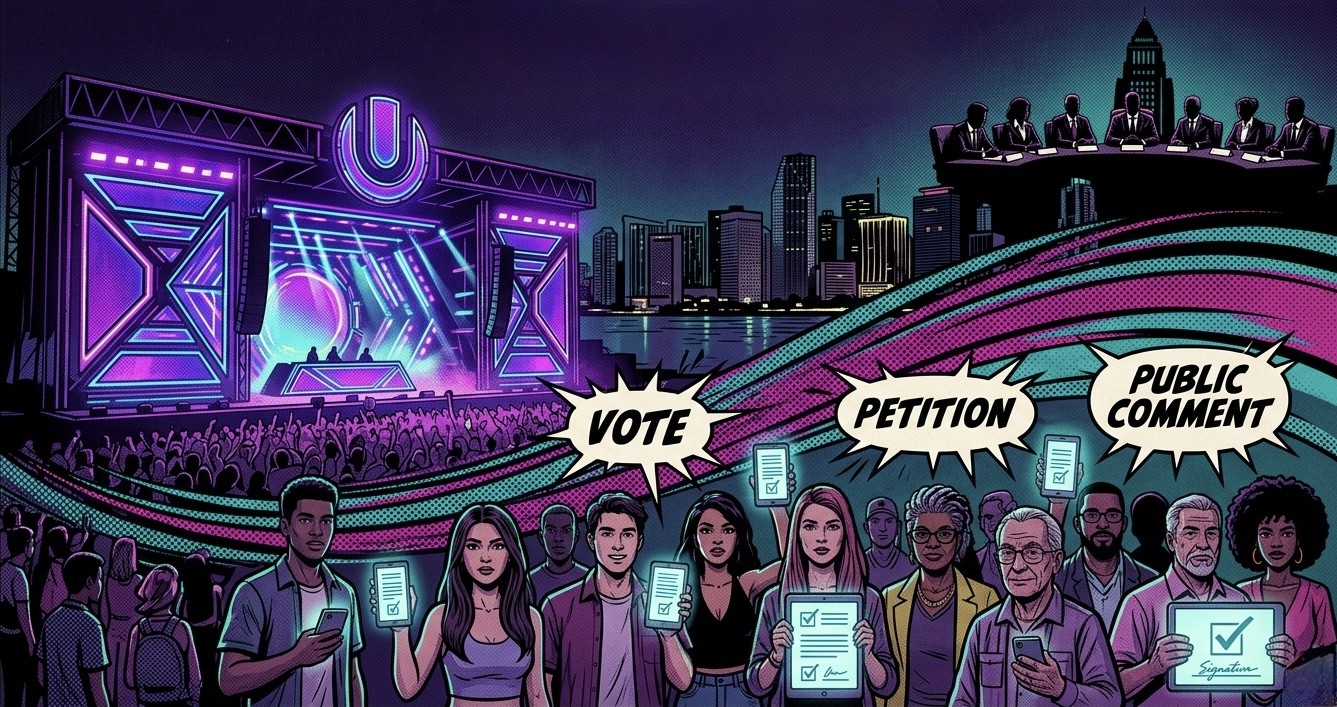
Every March, downtown Miami transforms into a pulsating epicenter of electronic music as Ultra Music Festival takes over Bayfront Park. The bass reverberates through luxury high-rises along Biscayne Boulevard. The traffic reroutes stretch for blocks. And for the 150,000 attendees who descend upon the city, it is three days of pure, unfiltered euphoria. But for the residents who call downtown Miami home year-round, Ultra has become something far more complicated than a weekend party. It has become a litmus test for how seriously Miami takes its own people.
The $207 Million Party Next Door
Let us be clear about the numbers. Ultra Music Festival generated a staggering $207 million in economic impact for Miami-Dade County in 2026 alone, according to the South Florida Business Journal. Over its 26-year history at Bayfront Park, the festival has contributed more than $3 billion to the local economy. It draws 150,000 attendees annually, with 75 percent traveling from outside the region. Those visitors spend an estimated $40 million at local restaurants and bars during Miami Music Week. The hotels fill up. The rideshares surge. The economic argument for Ultra is, by any reasonable measure, formidable.
But economics do not exist in a vacuum. And the people who live within earshot of the main stage are not line items on a balance sheet. They are families, professionals, retirees, and dog owners who chose downtown Miami for its waterfront beauty, its walkability, and yes, its 32-acre jewel of a public park. When that park is fenced off for weeks of setup and teardown, when sound readings near the festival hover between 80 and 85 decibels and when the glass windows of surrounding high-rises literally vibrate from the bass, the conversation shifts from revenue to rights.
When the City Canceled the Conversation
What makes the Ultra debate in 2026 so striking is not that residents are unhappy. It is that they were systematically prevented from being heard. In March, the City of Miami abruptly canceled its participation in a community meeting organized by the Downtown Neighbors Alliance (miamidna.org), a resident advocacy group that has been looking out for quality of life in the downtown core since 2013. The meeting was designed to address concerns about the proposed 20-year contract extension that would keep Ultra at Bayfront Park through the mid-2040s. Instead of showing up, the city withdrew.
James Torres, president of the Downtown Neighbors Alliance, called it a pattern of dismissing and undermining the voices of downtown families. Commissioner Damian Pardo, whose District 2 encompasses downtown, had reportedly requested that no additional community meetings be held beyond a single Sunshine Meeting. For the people living within walking distance of the stages, that felt less like coordination and more like a shutdown.
The residents of 50 Biscayne Boulevard, one of the most directly impacted buildings, eventually received a private meeting with city officials and Miami PD. But broader community engagement remained elusive until Commissioner Pardo hosted a public forum on April 2 at Miami Dade College, after the festival had already concluded. The timing spoke volumes.
The 20-Year Question
At the heart of this battle is a contract. Ultra is currently secured at Bayfront Park through 2027 under a five-year agreement that includes a $2 million base rent with four percent annual increases and allows for a 28-day closure of the park for setup and teardown. But the new proposal on the table is far more ambitious: a 20-year extension, structured as ten years upfront with an option for ten more. The Miami City Commission deferred the vote to April 23 to allow for community input.
For residents, this is not just about one festival weekend. It is about the next two decades of downtown life. It is about whether Bayfront Park will continue to be treated primarily as event revenue infrastructure or as the public park it was designed to be. The Change.org petition to save Bayfront Park from mega-concerts has been circulating since 2017, and the frustration it represents has only deepened as Ultra's footprint has grown alongside the surrounding residential population.
The Power of the Petition
Here is what most Miami residents do not realize: they have more power than they think. Petitions are not just symbolic gestures. No one is saying Ultra should leave Miami. Not the residents of 50 Biscayne. Not the Downtown Neighbors Alliance. Not the petition signers. The ask has always been remarkably simple: coexistence. Stricter noise controls. Better traffic mitigation. Shorter park closures. A genuine seat at the table before contracts are signed, not after the last DJ has packed up.
Ultra Music Festival is a cultural institution and an economic powerhouse. Downtown Miami is one of the fastest-growing residential neighborhoods in the country. The question before the city commission on April 23 is not whether one must yield to the other. It is whether Miami is willing to write a contract that respects both. Because a city that silences its residents to protect a music festival has its priorities backwards. And a festival that refuses to evolve alongside its neighborhood is not a good neighbor, no matter how many billions it generates.
But you do not need a constitutional amendment to make your voice heard. Miami residents can attend city commission meetings, submit public comments, and organize through neighborhood alliances like the DNA (miamidna.org). They can contact Commissioner Pardo's office through the City of Miami website (miami.gov). They can sign petitions on Change.org. They can attend community forums and demand that their input is recorded before votes are taken. The city launched an online survey open through April 22 to gather sentiment about Ultra. Whether that survey carries weight in the commission's decision remains to be seen, but the act of being counted is itself civic power.
Harmonizing the Beat with the Block
The solution is not to cancel Ultra or to ignore the residents who live in its shadow. The solution is a contract that reflects the reality of a neighborhood that has changed dramatically since the festival first arrived. That means enforceable noise limits measured at residential buildings, not just at the festival perimeter. It means traffic management plans developed in coordination with condo associations and local businesses. It means shorter setup and teardown windows that do not consume weeks of public park access. And it means a dedicated liaison between Ultra's organizers and the Downtown Neighbors Alliance, so that complaints do not vanish into voicemail boxes. Cities like Austin have navigated similar tensions with South by Southwest by creating structured agreements between festivals and neighborhoods. Barcelona imposed strict regulations on its Sonar festival after years of resident complaints. Miami can look to these models and build something better. The infrastructure is already there. What has been missing is the political will to use it.
Miami, the Bass Is Dropping
Miami, the bass is dropping. The question is whether anyone at City Hall is listening. The April 23 commission vote is not just a procedural checkbox. It is a referendum on whether this city values the people who live here as much as the tourists who visit. Sign the petition at Change.org. Email your commissioner through miami.gov. Show up to the meeting. Because democracy is not a spectator sport, and in Miami, the volume is about to get turned all the way up.
Every March, downtown Miami transforms into a pulsating epicenter of electronic music as Ultra Music Festival takes over Bayfront Park. The bass reverberates through luxury high-rises along Biscayne Boulevard. The traffic reroutes stretch for blocks. And for the 150,000 attendees who descend upon the city, it is three days of pure, unfiltered euphoria. But for the residents who call downtown Miami home year-round, Ultra has become something far more complicated than a weekend party. It has become a litmus test for how seriously Miami takes its own people.
The $207 Million Party Next Door
Let us be clear about the numbers. Ultra Music Festival generated a staggering $207 million in economic impact for Miami-Dade County in 2026 alone, according to the South Florida Business Journal. Over its 26-year history at Bayfront Park, the festival has contributed more than $3 billion to the local economy. It draws 150,000 attendees annually, with 75 percent traveling from outside the region. Those visitors spend an estimated $40 million at local restaurants and bars during Miami Music Week. The hotels fill up. The rideshares surge. The economic argument for Ultra is, by any reasonable measure, formidable.
But economics do not exist in a vacuum. And the people who live within earshot of the main stage are not line items on a balance sheet. They are families, professionals, retirees, and dog owners who chose downtown Miami for its waterfront beauty, its walkability, and yes, its 32-acre jewel of a public park. When that park is fenced off for weeks of setup and teardown, when sound readings near the festival hover between 80 and 85 decibels and when the glass windows of surrounding high-rises literally vibrate from the bass, the conversation shifts from revenue to rights.
When the City Canceled the Conversation
What makes the Ultra debate in 2026 so striking is not that residents are unhappy. It is that they were systematically prevented from being heard. In March, the City of Miami abruptly canceled its participation in a community meeting organized by the Downtown Neighbors Alliance (miamidna.org), a resident advocacy group that has been looking out for quality of life in the downtown core since 2013. The meeting was designed to address concerns about the proposed 20-year contract extension that would keep Ultra at Bayfront Park through the mid-2040s. Instead of showing up, the city withdrew.
James Torres, president of the Downtown Neighbors Alliance, called it a pattern of dismissing and undermining the voices of downtown families. Commissioner Damian Pardo, whose District 2 encompasses downtown, had reportedly requested that no additional community meetings be held beyond a single Sunshine Meeting. For the people living within walking distance of the stages, that felt less like coordination and more like a shutdown.
The residents of 50 Biscayne Boulevard, one of the most directly impacted buildings, eventually received a private meeting with city officials and Miami PD. But broader community engagement remained elusive until Commissioner Pardo hosted a public forum on April 2 at Miami Dade College, after the festival had already concluded. The timing spoke volumes.
The 20-Year Question
At the heart of this battle is a contract. Ultra is currently secured at Bayfront Park through 2027 under a five-year agreement that includes a $2 million base rent with four percent annual increases and allows for a 28-day closure of the park for setup and teardown. But the new proposal on the table is far more ambitious: a 20-year extension, structured as ten years upfront with an option for ten more. The Miami City Commission deferred the vote to April 23 to allow for community input.
For residents, this is not just about one festival weekend. It is about the next two decades of downtown life. It is about whether Bayfront Park will continue to be treated primarily as event revenue infrastructure or as the public park it was designed to be. The Change.org petition to save Bayfront Park from mega-concerts has been circulating since 2017, and the frustration it represents has only deepened as Ultra's footprint has grown alongside the surrounding residential population.
The Power of the Petition
Here is what most Miami residents do not realize: they have more power than they think. Petitions are not just symbolic gestures. No one is saying Ultra should leave Miami. Not the residents of 50 Biscayne. Not the Downtown Neighbors Alliance. Not the petition signers. The ask has always been remarkably simple: coexistence. Stricter noise controls. Better traffic mitigation. Shorter park closures. A genuine seat at the table before contracts are signed, not after the last DJ has packed up.
Ultra Music Festival is a cultural institution and an economic powerhouse. Downtown Miami is one of the fastest-growing residential neighborhoods in the country. The question before the city commission on April 23 is not whether one must yield to the other. It is whether Miami is willing to write a contract that respects both. Because a city that silences its residents to protect a music festival has its priorities backwards. And a festival that refuses to evolve alongside its neighborhood is not a good neighbor, no matter how many billions it generates.
But you do not need a constitutional amendment to make your voice heard. Miami residents can attend city commission meetings, submit public comments, and organize through neighborhood alliances like the DNA (miamidna.org). They can contact Commissioner Pardo's office through the City of Miami website (miami.gov). They can sign petitions on Change.org. They can attend community forums and demand that their input is recorded before votes are taken. The city launched an online survey open through April 22 to gather sentiment about Ultra. Whether that survey carries weight in the commission's decision remains to be seen, but the act of being counted is itself civic power.
Harmonizing the Beat with the Block
The solution is not to cancel Ultra or to ignore the residents who live in its shadow. The solution is a contract that reflects the reality of a neighborhood that has changed dramatically since the festival first arrived. That means enforceable noise limits measured at residential buildings, not just at the festival perimeter. It means traffic management plans developed in coordination with condo associations and local businesses. It means shorter setup and teardown windows that do not consume weeks of public park access. And it means a dedicated liaison between Ultra's organizers and the Downtown Neighbors Alliance, so that complaints do not vanish into voicemail boxes. Cities like Austin have navigated similar tensions with South by Southwest by creating structured agreements between festivals and neighborhoods. Barcelona imposed strict regulations on its Sonar festival after years of resident complaints. Miami can look to these models and build something better. The infrastructure is already there. What has been missing is the political will to use it.
Miami, the Bass Is Dropping
Miami, the bass is dropping. The question is whether anyone at City Hall is listening. The April 23 commission vote is not just a procedural checkbox. It is a referendum on whether this city values the people who live here as much as the tourists who visit. Sign the petition at Change.org. Email your commissioner through miami.gov. Show up to the meeting. Because democracy is not a spectator sport, and in Miami, the volume is about to get turned all the way up.
STAY IN THE KNOW
The stories shaping culture, delivered straight to your inbox.
Get exclusive editorial coverage on the events, brands, and trends that matter most. No spam, just substance.
Related post

August 4, 2026
August 4, 2026

