Your Dog Is Running a Bacteria Operation. Miami's Water Is the Victim.
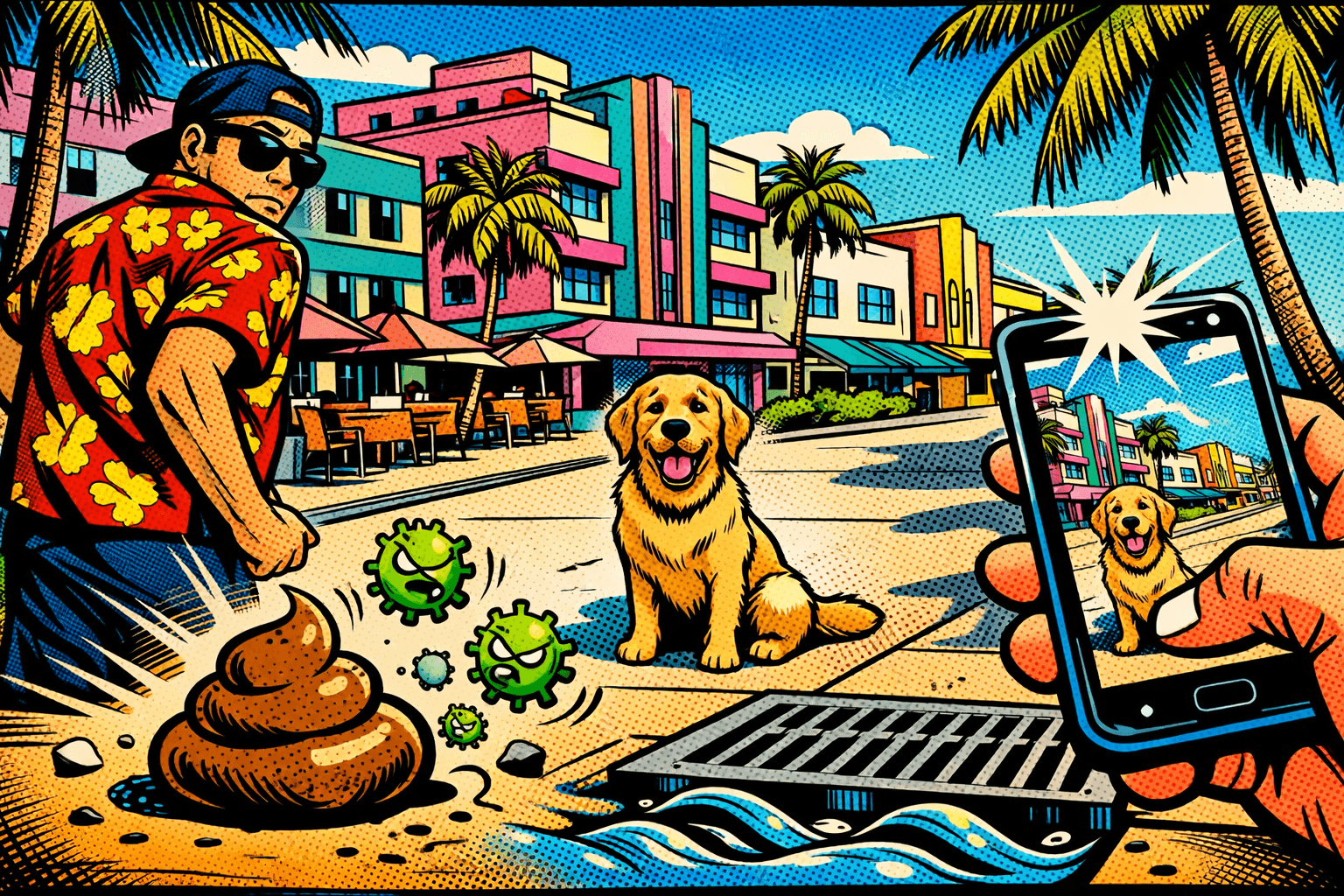
Somewhere in Miami Beach right now, a golden retriever is blissfully unaware that it just deposited what scientists would classify as a Class A environmental hazard on the sidewalk — and its owner is pretending to look at their phone. This is how a single dog becomes responsible for 7.82 billion fecal coliform bacteria entering the waterway system in a single day.
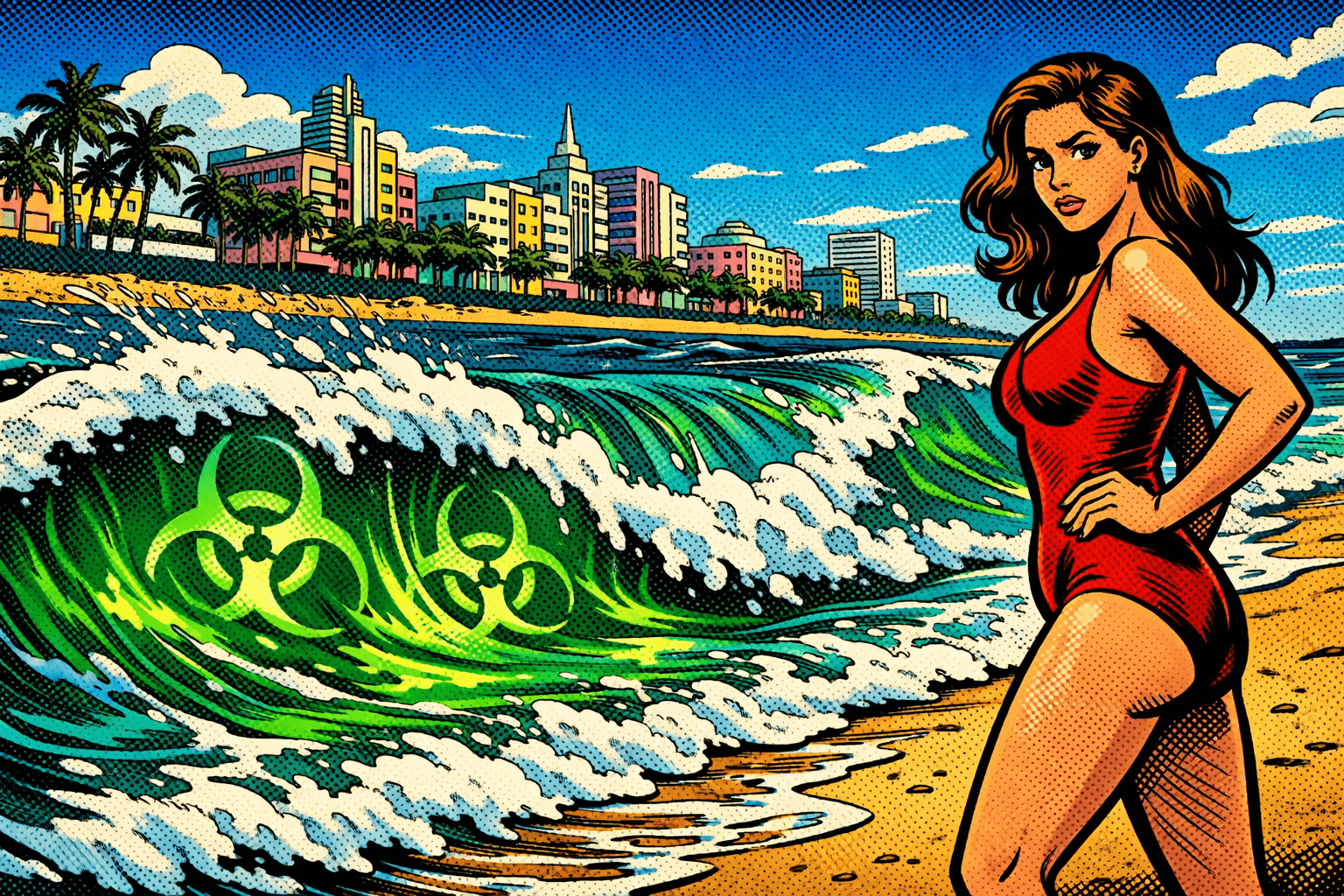
In our original Miami Beach water quality investigation, we documented the alarming bacteria levels in Miami's coastal waters. This follow-up names one of the biggest culprits — the one that weighs 60 pounds, answers to "Biscuit," and is completely innocent of understanding the consequences. Consider this the companion piece: pet waste as a quantified, DNA-confirmed, water-closing pollutant — and what every Miami resident can actually do about it today.
Myth-Bust: "One Little Pile Doesn't Matter"
It does. Profoundly.
The numbers are not intuitive, which is precisely why this myth persists. A single gram of dog waste contains approximately 23 million fecal coliform bacteria, according to data cited by Miami Beach Rising Above, a city-backed environmental resource. Extrapolated across a full day's output, that means one average dog produces 7.82 billion fecal coliform bacteria per day — enough contamination from a single animal to register as a measurable pollution event.
For context: dog waste carries twice the bacterial load of human waste, according to new research reported by DC Report in March 2025. We build multi-billion-dollar sewage treatment infrastructure to handle human waste. We largely leave dog waste to chance and good manners.
The EPA's math makes the stakes even clearer. Per Local 10's environmental coverage, just 2–3 days of unmanaged waste from only 100 dogs generates enough pollution to close 20 miles of Biscayne Bay to swimming and shellfishing. And a peer-reviewed study published in Applied and Environmental Microbiology found that one dog fecal event is equivalent to 6,940 bird fecal events in enterococci bacterial load — a ratio that reshapes how we think about "natural" waterway contamination.
One little pile matters enormously. Multiply it by the tens of thousands of dogs walked in Miami-Dade County daily, and you have a public health crisis hiding in plain sight.
The Miami Smoking Gun — DNA Evidence
Miami Beach didn't need a theory. It ran the test.
In 2020, the city commissioned DNA water testing on the polluted canal at Parkview Island Park — a residential stretch near 73rd Street where bacteria readings had been spiking consistently. The results were unambiguous: dog DNA was present in the water. Not bird DNA, not raccoon DNA — dog. The city officially classified pet waste as a "major source" of pollution at that site.
At peak contamination in October 2020, fecal bacteria levels reached up to 200 times the state-mandated safety standard. A no-contact advisory was kept in place indefinitely. The Miami Herald's investigation of the Parkview Island Park findings is essential reading.
The problem isn't confined to one canal. A 2024 NOAA technical report confirmed widespread fecal Enterococci and human-specific fecal Bacteroides — markers of sewage contamination — throughout Biscayne Bay, identifying the Miami River as a primary discharge point. The NOAA Government Cut Watershed Model report confirms that multiple fecal sources, including pet waste carried through stormwater systems, are collectively degrading the Bay.
Most Recent Data: 2025–2026
The contamination is not improving.
Miami Waterkeeper's February 2026 water quality update reported very high and unsafe fecal bacteria levels at multiple monitoring sites across Miami's waterways — a finding published directly to their Miami Waterkeeper Facebook page for public transparency.
Meanwhile, Miami Beach Rising Above ranks pet waste as the #3 pollutant affecting the city's water quality — a designation based on official city data, not advocacy estimates.
The science corroborates it at scale. A 2023 PLOS ONE study found that dog fecal contamination scores were consistently and significantly higher after rain events in urban streams — meaning every Miami thunderstorm acts as a bacteria delivery system, flushing pet waste from streets and lawns directly into the waterway network via storm drains. The full study is publicly available at PLOS ONE. A separate 2024 ScienceDirect study confirmed that urban storm sewer discharges consistently contain elevated E. coli from dog and other fecal sources — a direct indictment of what happens when pet waste on pavement meets a South Florida rainstorm.
The Laws — and Why They're Barely Working
Miami Beach has a law. It's called Chapter 10 of the City Code, and it requires all pet owners to immediately remove their animal's waste from any public or private property. Miami Beach Rising Above's pet waste page spells out the fine structure: $50 for a first offense, $100 for a second, $200 for a third.
Violations can be reported 24/7 to Miami Beach Parking & Code Compliance Dispatch at 305.604.CITY (2489). Miami-Dade County residents outside the Beach can report illegal dumping and water pollution via 311 or the 311 Direct app.
The uncomfortable truth: enforcement is largely symbolic. Axios reported in July 2025 that Miami-Dade's waste management infrastructure is "not actively monitoring" pet waste violations. The fine structure exists; meaningful enforcement largely does not. That same report noted that illegally dumping bagged waste into storm drains — more common than you'd expect — can carry fines up to $1,000 in Miami Beach.
The Public Shaming Question — Is It Legal to Post Offenders on Facebook?
Here is the tension every frustrated Miami resident has felt at least once. You're walking on the boardwalk, you watch someone's dog leave a deposit, you watch the owner walk away, and the first instinct in 2026 is to pull out a phone and post it to a neighborhood Facebook group. It is, as the current informal civic strategy goes, the public's preferred solution: shame.
So is it legal? Mostly yes — with real risk pockets that most people don't know about. This is general information, not legal advice; consult a Florida attorney before publishing anything targeted at an identified individual.
What Florida generally allows
Florida follows the established U.S. rule on public photography: a person in a public place has no reasonable expectation of privacy. You can photograph someone on a sidewalk, in a park, on the beach, or in the public areas of a condo property without their consent. Posting that photograph — including on Facebook community groups like "South Beach Residents" or "Miami Beach Unfiltered" — is generally protected First Amendment speech, provided what you say about the image is true. The Reporters Committee for Freedom of the Press maintains a Florida-specific guide to photographers' rights in public spaces.
Where it gets legally dangerous — five landmines
1. Defamation. If you caption a photo identifying someone — "this woman let her dog poop here and didn't pick it up" — and any part of that claim turns out to be wrong, you can be sued. Truth is an absolute defense in Florida defamation law, but the burden to prove it falls on you. A blurry photo taken from across the street is not evidence. Misidentifying the dog's owner, missing the moment they picked it up, or posting about the wrong person entirely is how these cases originate.
2. Florida cyberstalking law. Florida Statute 784.048 defines cyberstalking as a "course of conduct" — meaning a repeated pattern — of online communication directed at a specific person that causes "substantial emotional distress" and serves no legitimate purpose. One post about one incident is unlikely to qualify. Repeatedly posting about the same individual, encouraging a comment-section pile-on, tagging their employer, or re-sharing the photo across multiple groups can escalate into a first-degree misdemeanor punishable by up to one year in jail.
3. Florida is a two-party consent state for audio. This is the landmine almost no one knows about. Under Florida Statute 934.03, it is illegal to record someone's voice without their consent — even in public — and a violation is a third-degree felony punishable by up to five years in prison and a $5,000 fine. If your shaming video accidentally captures the owner's voice, you have committed a more serious crime than they did. The practical rule: record video with your phone's microphone muted, or take photographs instead.
4. Trespass. Photographing someone's yard from the public sidewalk is legal. Stepping onto their property to get the shot is not. Condo common areas, gated communities, and private beach clubs have their own rules; if a property manager asks you to stop photographing, you must comply.
5. Minors. Do not photograph a child for shaming purposes, even if they are the one walking the dog. Post the adult owner, or post nothing. Florida has heightened protections for minors and a harassment complaint can materialize quickly.
The brand risk no law captures
Even when your post is legally airtight, Miami neighborhood Facebook groups can turn into mob pile-ons within hours. National cases have established a consistent pattern:
Doxxing backfire. A commenter identifies the person, and it turns out to be the wrong person — now the original poster faces a defamation claim.
Retaliation. The shamed person shows up at the poster's door, damages their car, or files a reciprocal harassment complaint.
Employer involvement. Someone tags the offender's job, they get fired, and then they sue the original poster for tortious interference with a business relationship — a cause of action Florida recognizes.
The smarter accountability strategy
There is a version of public accountability that is legally bulletproof, actually drives policy change, and doesn't turn every neighborhood forum into a tribunal. It's the same framework investigative journalists use.
Photograph the waste, not the person. Geotag and timestamp the image. Build a location-based archive.
Document the infrastructure failures — broken pet waste stations, empty bag dispensers, missing signage. These are the conditions enabling the behavior.
Submit observations to Miami Waterkeeper's pollution reporting system where they become part of the scientific record.
File a Miami Beach Code Compliance report via 305.604.CITY (2489) — this creates an official paper trail that pressures enforcement.
Aggregate the data publicly. "Twelve uncollected piles documented on Ocean Drive this week" is a more devastating headline than any individual shaming post, and it redirects accountability where it actually belongs: at the City of Miami Beach's enforcement gap, not at one careless dog walker.
If you still want to post about an individual incident, the harm-minimizing playbook is: blur the face, withhold the name, don't tag anyone's employer, post once and don't re-share, and keep the audio muted. You keep the cultural signal that this behavior is unacceptable; you drop almost all of the legal exposure.
What Citizens Can Actually Do — Concrete Actions
The good news: this is one of the few environmental problems where individual action produces immediate, measurable results. Here's where to direct your energy.
Collect More Data
Miami Waterkeeper runs the 1,000 Eyes on the Water citizen science program — a trained volunteer network that monitors water quality across Miami's waterways. If you want your observations to count as scientific data, this is how.
Next training session: 1,000 Eyes on the Water Training at Tripping Animals Brewery — sign up and become a certified water quality monitor.
Year-round commitment: Apply for the Miami Waterkeeper Ambassador Program — a year-long adult leadership track.
High schoolers: The Junior Ambassador Program offers students a structured path into environmental advocacy with real scientific fieldwork.
Join Cleanups
Data matters. So does physically removing waste from the environment.
VolunteerCleanup.org coordinated more than 70 cleanups in 2025, mobilizing 3,200 volunteers who removed 26,000 pounds of debris in a single day. Check their upcoming event listings for the next Clean Miami Beach Sound Sweep Cleanup.
Clean Miami Beach organizes regular community cleanups on and around Miami Beach.
Debris Free Oceans runs the annual International Coastal Cleanup every September.
Report It
Miami Beach off-leash or uncleaned waste: 305.604.CITY (2489) — available 24/7.
Miami-Dade pollution or illegal dumping: 311 or the 311 Direct app.
Water quality concerns to Miami Waterkeeper directly: miamiwaterkeeper.org/get_involved.
What Every Dog Owner Can Do Today
No committee meetings, no funding cycles, no waiting for infrastructure upgrades. These actions take seconds and have real environmental impact.
Always bag it — on grass, on sidewalks, and especially in your own yard if a storm drain is nearby.
Double-bag on rainy or windy days before trash pickup — a single storm can carry exposed waste directly into Biscayne Bay.
Flush it at home — the safest disposal method per EPA guidance, because it routes waste to sewage treatment rather than a landfill or storm drain.
Never throw bags into storm drains, canals, or waterways — this is illegal in Miami Beach and defeats the entire purpose of bagging.
Avoid walking dogs near seawalls during king tide events — waste deposited near seawalls washes directly into the Bay with tidal surge.
Carry extra bags and offer them — most non-pickup incidents are forgetfulness, not malice.
Advocate for a pet waste station in your HOA, condo building, or neighborhood park if one doesn't exist.
Share the 23 million bacteria stat — it is the single most persuasive number for changing behavior. People don't visualize pollution; they do visualize 23 million of anything.
This One Is Actually in Your Hands
Miami's water quality problems include aging sewer infrastructure, stormwater system failures, industrial runoff, and the compounding effects of sea level rise. Most of those require billions of dollars and years of political will to fix.
This one does not.
Every time a Miami dog owner bends down with a bag, they are performing the most cost-effective, immediately impactful environmental intervention available to an individual citizen. No grant application. No city commission vote. No waiting. The Miami Waterkeeper data is collected by people just like you, and the citizen cleanup events are organized by your neighbors.
Biscayne Bay does not have a lobbying budget. It has us. Pick it up, share this article, and sign up for something — because the bacteria levels don't care about good intentions.
Your Dog Is Running a Bacteria Operation. Miami's Water Is the Victim.
Somewhere in Miami Beach right now, a golden retriever is blissfully unaware that it just deposited what scientists would classify as a Class A environmental hazard on the sidewalk — and its owner is pretending to look at their phone. This is how a single dog becomes responsible for 7.82 billion fecal coliform bacteria entering the waterway system in a single day.
In our original Miami Beach water quality investigation, we documented the alarming bacteria levels in Miami's coastal waters. This follow-up names one of the biggest culprits — the one that weighs 60 pounds, answers to "Biscuit," and is completely innocent of understanding the consequences. Consider this the companion piece: pet waste as a quantified, DNA-confirmed, water-closing pollutant — and what every Miami resident can actually do about it today.
Myth-Bust: "One Little Pile Doesn't Matter"
It does. Profoundly.
The numbers are not intuitive, which is precisely why this myth persists. A single gram of dog waste contains approximately 23 million fecal coliform bacteria, according to data cited by Miami Beach Rising Above, a city-backed environmental resource. Extrapolated across a full day's output, that means one average dog produces 7.82 billion fecal coliform bacteria per day — enough contamination from a single animal to register as a measurable pollution event.
For context: dog waste carries twice the bacterial load of human waste, according to new research reported by DC Report in March 2025. We build multi-billion-dollar sewage treatment infrastructure to handle human waste. We largely leave dog waste to chance and good manners.
The EPA's math makes the stakes even clearer. Per Local 10's environmental coverage, just 2–3 days of unmanaged waste from only 100 dogs generates enough pollution to close 20 miles of Biscayne Bay to swimming and shellfishing. And a peer-reviewed study published in Applied and Environmental Microbiology found that one dog fecal event is equivalent to 6,940 bird fecal events in enterococci bacterial load — a ratio that reshapes how we think about "natural" waterway contamination.
One little pile matters enormously. Multiply it by the tens of thousands of dogs walked in Miami-Dade County daily, and you have a public health crisis hiding in plain sight.
The Miami Smoking Gun — DNA Evidence
Miami Beach didn't need a theory. It ran the test.
In 2020, the city commissioned DNA water testing on the polluted canal at Parkview Island Park — a residential stretch near 73rd Street where bacteria readings had been spiking consistently. The results were unambiguous: dog DNA was present in the water. Not bird DNA, not raccoon DNA — dog. The city officially classified pet waste as a "major source" of pollution at that site.
At peak contamination in October 2020, fecal bacteria levels reached up to 200 times the state-mandated safety standard. A no-contact advisory was kept in place indefinitely. The Miami Herald's investigation of the Parkview Island Park findings is essential reading.
The problem isn't confined to one canal. A 2024 NOAA technical report confirmed widespread fecal Enterococci and human-specific fecal Bacteroides — markers of sewage contamination — throughout Biscayne Bay, identifying the Miami River as a primary discharge point. The NOAA Government Cut Watershed Model report confirms that multiple fecal sources, including pet waste carried through stormwater systems, are collectively degrading the Bay.
Most Recent Data: 2025–2026
The contamination is not improving.
Miami Waterkeeper's February 2026 water quality update reported very high and unsafe fecal bacteria levels at multiple monitoring sites across Miami's waterways — a finding published directly to their Miami Waterkeeper Facebook page for public transparency.
Meanwhile, Miami Beach Rising Above ranks pet waste as the #3 pollutant affecting the city's water quality — a designation based on official city data, not advocacy estimates.
The science corroborates it at scale. A 2023 PLOS ONE study found that dog fecal contamination scores were consistently and significantly higher after rain events in urban streams — meaning every Miami thunderstorm acts as a bacteria delivery system, flushing pet waste from streets and lawns directly into the waterway network via storm drains. The full study is publicly available at PLOS ONE. A separate 2024 ScienceDirect study confirmed that urban storm sewer discharges consistently contain elevated E. coli from dog and other fecal sources — a direct indictment of what happens when pet waste on pavement meets a South Florida rainstorm.
The Laws — and Why They're Barely Working
Miami Beach has a law. It's called Chapter 10 of the City Code, and it requires all pet owners to immediately remove their animal's waste from any public or private property. Miami Beach Rising Above's pet waste page spells out the fine structure: $50 for a first offense, $100 for a second, $200 for a third.
Violations can be reported 24/7 to Miami Beach Parking & Code Compliance Dispatch at 305.604.CITY (2489). Miami-Dade County residents outside the Beach can report illegal dumping and water pollution via 311 or the 311 Direct app.
The uncomfortable truth: enforcement is largely symbolic. Axios reported in July 2025 that Miami-Dade's waste management infrastructure is "not actively monitoring" pet waste violations. The fine structure exists; meaningful enforcement largely does not. That same report noted that illegally dumping bagged waste into storm drains — more common than you'd expect — can carry fines up to $1,000 in Miami Beach.
The Public Shaming Question — Is It Legal to Post Offenders on Facebook?
Here is the tension every frustrated Miami resident has felt at least once. You're walking on the boardwalk, you watch someone's dog leave a deposit, you watch the owner walk away, and the first instinct in 2026 is to pull out a phone and post it to a neighborhood Facebook group. It is, as the current informal civic strategy goes, the public's preferred solution: shame.
So is it legal? Mostly yes — with real risk pockets that most people don't know about. This is general information, not legal advice; consult a Florida attorney before publishing anything targeted at an identified individual.
What Florida generally allows
Florida follows the established U.S. rule on public photography: a person in a public place has no reasonable expectation of privacy. You can photograph someone on a sidewalk, in a park, on the beach, or in the public areas of a condo property without their consent. Posting that photograph — including on Facebook community groups like "South Beach Residents" or "Miami Beach Unfiltered" — is generally protected First Amendment speech, provided what you say about the image is true. The Reporters Committee for Freedom of the Press maintains a Florida-specific guide to photographers' rights in public spaces.
Where it gets legally dangerous — five landmines
1. Defamation. If you caption a photo identifying someone — "this woman let her dog poop here and didn't pick it up" — and any part of that claim turns out to be wrong, you can be sued. Truth is an absolute defense in Florida defamation law, but the burden to prove it falls on you. A blurry photo taken from across the street is not evidence. Misidentifying the dog's owner, missing the moment they picked it up, or posting about the wrong person entirely is how these cases originate.
2. Florida cyberstalking law. Florida Statute 784.048 defines cyberstalking as a "course of conduct" — meaning a repeated pattern — of online communication directed at a specific person that causes "substantial emotional distress" and serves no legitimate purpose. One post about one incident is unlikely to qualify. Repeatedly posting about the same individual, encouraging a comment-section pile-on, tagging their employer, or re-sharing the photo across multiple groups can escalate into a first-degree misdemeanor punishable by up to one year in jail.
3. Florida is a two-party consent state for audio. This is the landmine almost no one knows about. Under Florida Statute 934.03, it is illegal to record someone's voice without their consent — even in public — and a violation is a third-degree felony punishable by up to five years in prison and a $5,000 fine. If your shaming video accidentally captures the owner's voice, you have committed a more serious crime than they did. The practical rule: record video with your phone's microphone muted, or take photographs instead.
4. Trespass. Photographing someone's yard from the public sidewalk is legal. Stepping onto their property to get the shot is not. Condo common areas, gated communities, and private beach clubs have their own rules; if a property manager asks you to stop photographing, you must comply.
5. Minors. Do not photograph a child for shaming purposes, even if they are the one walking the dog. Post the adult owner, or post nothing. Florida has heightened protections for minors and a harassment complaint can materialize quickly.
The brand risk no law captures
Even when your post is legally airtight, Miami neighborhood Facebook groups can turn into mob pile-ons within hours. National cases have established a consistent pattern:
Doxxing backfire. A commenter identifies the person, and it turns out to be the wrong person — now the original poster faces a defamation claim.
Retaliation. The shamed person shows up at the poster's door, damages their car, or files a reciprocal harassment complaint.
Employer involvement. Someone tags the offender's job, they get fired, and then they sue the original poster for tortious interference with a business relationship — a cause of action Florida recognizes.
The smarter accountability strategy
There is a version of public accountability that is legally bulletproof, actually drives policy change, and doesn't turn every neighborhood forum into a tribunal. It's the same framework investigative journalists use.
Photograph the waste, not the person. Geotag and timestamp the image. Build a location-based archive.
Document the infrastructure failures — broken pet waste stations, empty bag dispensers, missing signage. These are the conditions enabling the behavior.
Submit observations to Miami Waterkeeper's pollution reporting system where they become part of the scientific record.
File a Miami Beach Code Compliance report via 305.604.CITY (2489) — this creates an official paper trail that pressures enforcement.
Aggregate the data publicly. "Twelve uncollected piles documented on Ocean Drive this week" is a more devastating headline than any individual shaming post, and it redirects accountability where it actually belongs: at the City of Miami Beach's enforcement gap, not at one careless dog walker.
If you still want to post about an individual incident, the harm-minimizing playbook is: blur the face, withhold the name, don't tag anyone's employer, post once and don't re-share, and keep the audio muted. You keep the cultural signal that this behavior is unacceptable; you drop almost all of the legal exposure.
What Citizens Can Actually Do — Concrete Actions
The good news: this is one of the few environmental problems where individual action produces immediate, measurable results. Here's where to direct your energy.
Collect More Data
Miami Waterkeeper runs the 1,000 Eyes on the Water citizen science program — a trained volunteer network that monitors water quality across Miami's waterways. If you want your observations to count as scientific data, this is how.
Next training session: 1,000 Eyes on the Water Training at Tripping Animals Brewery — sign up and become a certified water quality monitor.
Year-round commitment: Apply for the Miami Waterkeeper Ambassador Program — a year-long adult leadership track.
High schoolers: The Junior Ambassador Program offers students a structured path into environmental advocacy with real scientific fieldwork.
Join Cleanups
Data matters. So does physically removing waste from the environment.
VolunteerCleanup.org coordinated more than 70 cleanups in 2025, mobilizing 3,200 volunteers who removed 26,000 pounds of debris in a single day. Check their upcoming event listings for the next Clean Miami Beach Sound Sweep Cleanup.
Clean Miami Beach organizes regular community cleanups on and around Miami Beach.
Debris Free Oceans runs the annual International Coastal Cleanup every September.
Report It
Miami Beach off-leash or uncleaned waste: 305.604.CITY (2489) — available 24/7.
Miami-Dade pollution or illegal dumping: 311 or the 311 Direct app.
Water quality concerns to Miami Waterkeeper directly: miamiwaterkeeper.org/get_involved.
What Every Dog Owner Can Do Today
No committee meetings, no funding cycles, no waiting for infrastructure upgrades. These actions take seconds and have real environmental impact.
Always bag it — on grass, on sidewalks, and especially in your own yard if a storm drain is nearby.
Double-bag on rainy or windy days before trash pickup — a single storm can carry exposed waste directly into Biscayne Bay.
Flush it at home — the safest disposal method per EPA guidance, because it routes waste to sewage treatment rather than a landfill or storm drain.
Never throw bags into storm drains, canals, or waterways — this is illegal in Miami Beach and defeats the entire purpose of bagging.
Avoid walking dogs near seawalls during king tide events — waste deposited near seawalls washes directly into the Bay with tidal surge.
Carry extra bags and offer them — most non-pickup incidents are forgetfulness, not malice.
Advocate for a pet waste station in your HOA, condo building, or neighborhood park if one doesn't exist.
Share the 23 million bacteria stat — it is the single most persuasive number for changing behavior. People don't visualize pollution; they do visualize 23 million of anything.
This One Is Actually in Your Hands
Miami's water quality problems include aging sewer infrastructure, stormwater system failures, industrial runoff, and the compounding effects of sea level rise. Most of those require billions of dollars and years of political will to fix.
This one does not.
Every time a Miami dog owner bends down with a bag, they are performing the most cost-effective, immediately impactful environmental intervention available to an individual citizen. No grant application. No city commission vote. No waiting. The Miami Waterkeeper data is collected by people just like you, and the citizen cleanup events are organized by your neighbors.
Biscayne Bay does not have a lobbying budget. It has us. Pick it up, share this article, and sign up for something — because the bacteria levels don't care about good intentions.
STAY IN THE KNOW
The stories shaping culture, delivered straight to your inbox.
Get exclusive editorial coverage on the events, brands, and trends that matter most. No spam, just substance.
Related post
April 21, 2026
April 21, 2026