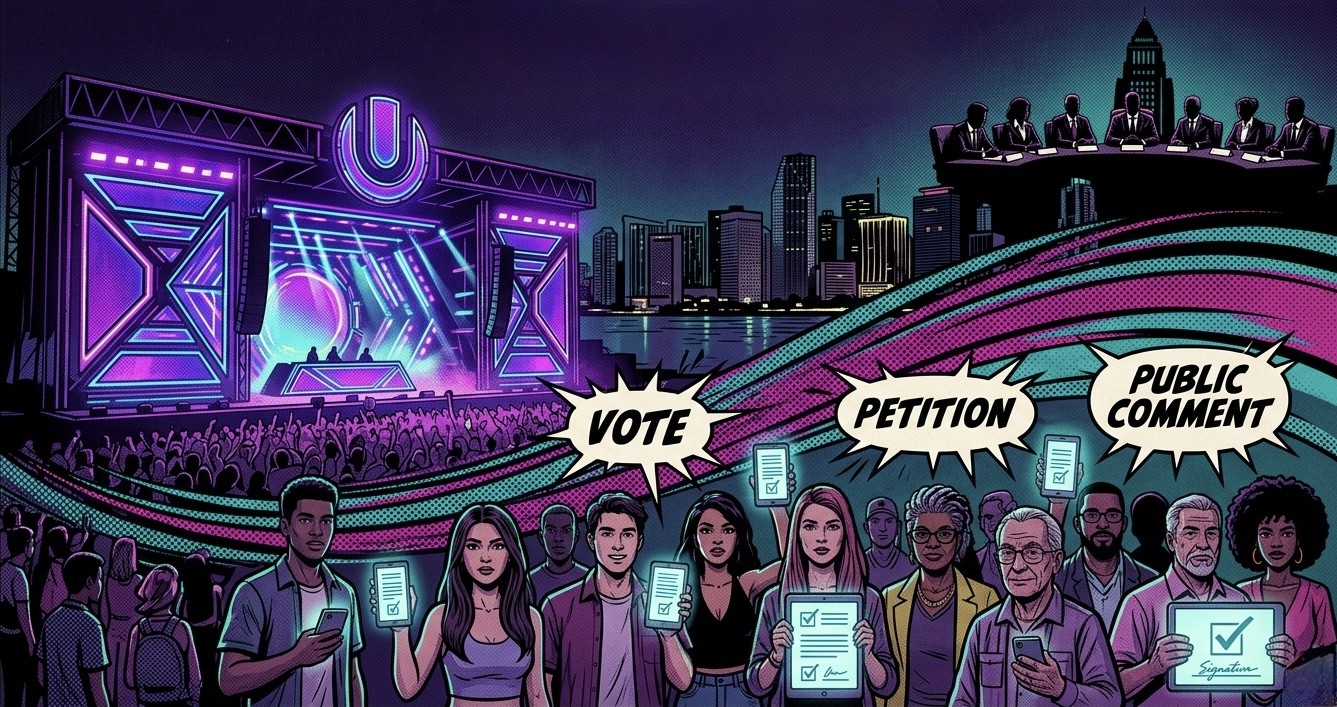

Most Miami residents interact with their local government the same way they interact with the weather: they complain about it, occasionally check the forecast, and assume there is nothing they can do to change it. But unlike a hurricane, the decisions being made at City Hall are not acts of nature. They are acts of commission, and commissioners respond to pressure the same way any elected official does. The question is whether residents know how to apply it. In a city where the Ultra Music Festival contract debate has awakened a sleeping giant of civic frustration, the timing has never been better to understand the tools that actually work.
Stronger Miami and the 20,000-Signature Wake-Up Call
The most significant civic action in Miami right now has nothing to do with Ultra. The Stronger Miami petition, backed by One Grove Alliance (onegrovealliance.org) and Engage Miami (engagemiami.org), has surpassed 20,000 signatures in its effort to fundamentally reshape the city commission. The initiative seeks to expand the number of voting districts from five to nine, move city elections to even years to boost turnout, and require that redistricting keeps neighborhoods intact and does not favor one political party. For a city of 487,000 residents represented by just five commissioners, the math alone tells a story of diluted representation. Miami Beach, with roughly 83,000 residents, has six commissioners. The Stronger Miami petition represents exactly the kind of civic engagement that transforms complaints into consequences. It is specific, actionable, and directed at the right decision makers. And it has teeth. Once the Miami-Dade County Supervisor of Elections verifies the signatures, the initiative could appear on the ballot for voters to decide directly.
The Petition Playbook: What Actually Works
Not all petitions are created equal. The ones that succeed share common traits, and understanding them is the difference between venting frustration and creating change. First, specificity matters. A petition that says we want less noise is easily ignored. A petition that demands enforceable decibel limits measured at residential buildings with independent monitoring is a policy proposal. Decision makers respond to proposals, not grievances. Second, constituent proof is everything. Change.org (change.org) now provides geographic data showing exactly how many signers live in a specific district. In a survey of elected officials conducted by the platform, petitions signed by registered voters within their district were among the top reasons officials cited for responding. Third, show up. Digital signatures open doors, but physical presence at commission meetings closes deals. When residents showed up in Napa, California to support a petition for a child development center, the city council voted unanimously in their favor. The petition got them in the room. Their presence sealed the outcome.
Beyond the Signature: Miami's Civic Infrastructure
Petitions are only one weapon in the civic arsenal. Miami has built a surprisingly robust infrastructure for resident engagement, even if most people do not know it exists. The City of Miami's EMPOWER60 program (miami.gov) is a four-hour civic training course that teaches residents how to develop individual engagement plans around public safety, neighborhood beautification, economic development, and government services. Graduates are invited to a virtual city commission meeting and recognized for their participation. Catalyst Miami (catalystmiami.org) works alongside frontline communities to build political power and achieve policy wins at the local and state level. The Miami Freedom Project (miamifreedomproject.org) has driven voter registration efforts in partnership with When We All Vote, the Hispanic Federation, and Engage Miami. And the Florida Civic Advance (floridacivicadvance.com) recently published a statewide civic health report documenting the gaps and opportunities in community participation across the state. The Downtown Neighbors Alliance (miamidna.org) has become the de facto voice of downtown residents, organizing around issues from Ultra's noise levels to development approvals that reshape the skyline. These organizations are not waiting for permission to participate. They are building the participation infrastructure themselves.
The Clock Is Ticking on Citizen Initiatives
There is an urgency to this conversation that extends beyond any single festival or contract vote. The Florida Senate is advancing legislation that would make it significantly harder for citizens to get constitutional amendments on the ballot. Since 1968, Florida voters have been able to amend the state constitution through ballot initiatives by gathering signatures equal to eight percent of the votes cast in the most recent presidential election, with signatures from at least half of the state's congressional districts. Amendments then require 60 percent voter approval to pass. The proposed bill would raise those thresholds, adding additional hurdles to a process that already demands massive organizational effort and financial resources. If the legislation passes, the window for citizen-initiated constitutional change in Florida will narrow considerably. That makes local civic engagement not just important but urgent. The tools available at the city and county level, from petition drives to commission testimony to neighborhood alliance organizing, may become the most accessible paths to meaningful change that Floridians have left.
Your Move, Miami
The Ultra debate woke something up in downtown Miami. But civic engagement cannot be seasonal, activated only when the bass gets too loud or the park gets fenced off. The Stronger Miami petition, the neighborhood alliances, the civic training programs, and the petition platforms are all available right now, year-round, to anyone willing to use them. The city commission meets regularly. Public comment periods exist for every agenda item. Your commissioner has an email address and a phone number listed on miami.gov. Change.org gives you a platform to organize and prove constituent support. And organizations like the Downtown Neighbors Alliance, Catalyst Miami, and Engage Miami will help you turn frustration into strategy. The only question left is whether you will use the tools or keep complaining about the weather. Miami is listening. But only to the people who show up.
STAY IN THE KNOW
The stories shaping culture, delivered straight to your inbox.
Get exclusive editorial coverage on the events, brands, and trends that matter most. No spam, just substance.