Tomorrow's Quiet Dog Beach Vote Could Have Loud Environmental Consequences
The Miami Beach City Commission is set to expand bark beach hours by 750% — on a 177-item bulk approval list, with no public comment. The vote is Wednesday, April 22, 2026. You have hours to act.
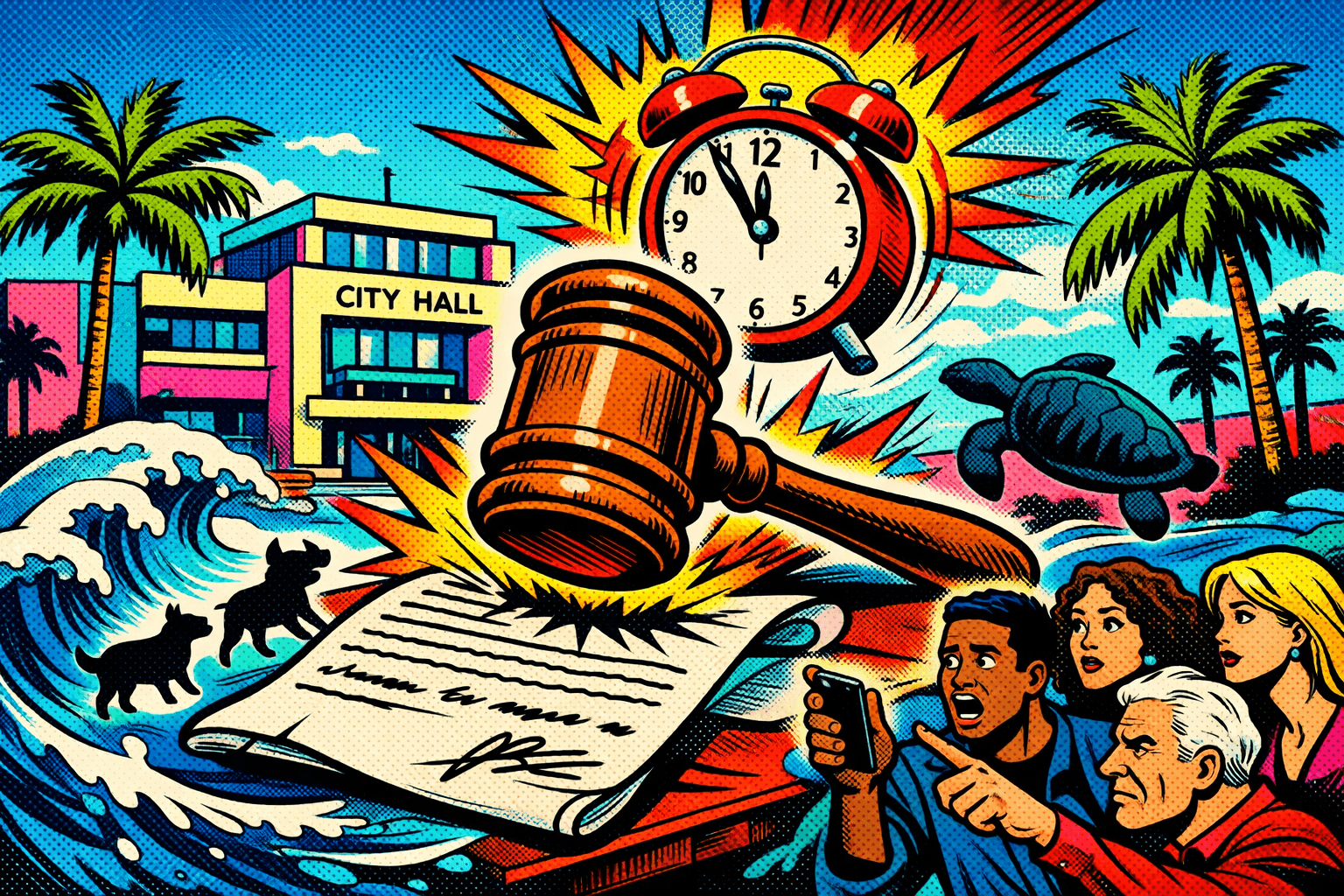
Picture this: It's a Tuesday evening. You're making dinner. Meanwhile, in a meeting room on the third floor of Miami Beach City Hall, a policy that triples the number of daily hours that unleashed dogs can run on three of Miami's public beaches — year-round, including sea turtle nesting season — is about to be approved in bulk, alongside 176 other agenda items, without a single minute of public discussion.
No environmental review. No neighborhood committee hearing. No data on water quality. No testimony. No debate.
Just: next item.
That vote is tomorrow — Wednesday, April 22, 2026 — and if you've never heard of it before this moment, that's precisely the point.
What's Actually Happening
Here's the proposal on the table at the Miami Beach City Commission meeting, April 22, 2026:
Bark beaches at three Miami Beach locations would be open from 7am to 10pm, daily, 365 days a year.
Those three locations are:
21st Street — South Beach Bark Beach
53rd Street
81st Street — North Beach Bark Beach
The item is sponsored by Commissioner David Suarez (Group 5). It sits inside a 177-item April 22 agenda on the Consent Agenda — a block of items scheduled for a single, no-discussion, bulk vote.
To understand the scale of what's being proposed, consider where we're starting. Right now, the South Beach Bark Beach at 21st Street is open just two hours a day: 7–9am from November through March, and 9–11am from April through October. The North Beach Bark Beach at 81st Street operates on weekends only — Friday, Saturday, and Sunday — for four hours per window depending on the season.
The proposed schedule would take the South Beach location from 2 hours per day to 15 hours per day, 7 days a week. That is a 7.5x expansion, accomplished without a single public hearing.
Why the Consent Agenda Move Is the Real Story
Let's be clear about what a Consent Agenda is and what it is not.
Consent Agendas exist for efficiency. They bundle routine, non-controversial administrative items — contract renewals, boilerplate approvals, housekeeping resolutions — so commissioners don't burn public meeting time on items everyone already agrees on. Any commissioner can "pull" an item for separate discussion, but the implicit norm is that these items are settled business.
The problem: a 7.5x expansion of operating hours across three public beaches, during a period that includes sea turtle nesting season, with no environmental impact study, no water quality data, and no prior community process, is not a routine administrative item. Substantive policy changes affecting coastal ecosystems belong in front of the public.
Community members have already raised the appropriate alternative: referral to the Neighborhoods Committee, where public testimony can be heard, data can be presented, and commissioners can engage in informed deliberation.
LASAI Press is not in the business of telling Miami Beach whether to expand bark beach hours. That's the community's decision. What we are in the business of is transparency and democratic process — and right now, neither is being served.
The Environmental Data That's Missing
There is no environmental impact study cited in this proposal. There is no water quality baseline. There is no sea turtle nesting analysis. Given what we already know about Miami Beach's waterways, that absence is not a minor oversight.
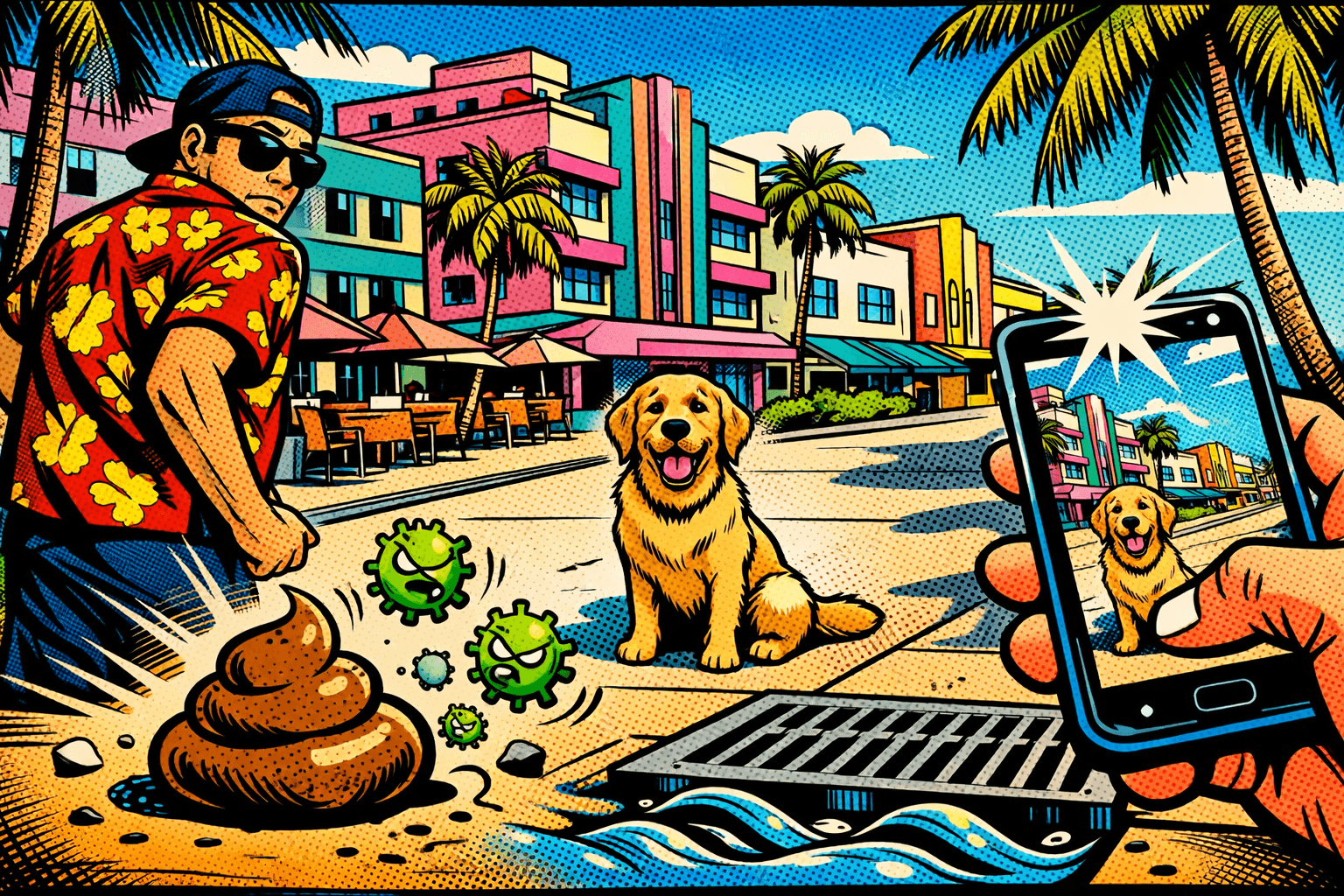
Start with the bacteria math. According to Miami Beach Rising Above, a single gram of dog waste contains approximately 23 million fecal coliform bacteria. The EPA's estimate, reported by Local 10 News, is even starker: just two to three days of waste from 100 dogs can generate enough bacterial contamination to close 20 miles of a bay to swimming and fishing.
Miami Beach's own environmental monitoring has already caught this in action. In 2020, DNA testing conducted at Parkview Island Park — part of Miami Beach's own water quality program — detected dog DNA in canal water with fecal bacteria levels 200 times above Florida's state standard, as reported by the Miami Herald. That data exists. It has been public for five years. It is not cited anywhere in the proposal before commissioners tomorrow.
Then there's the compliance problem. The EPA estimates that only about 60% of dog owners consistently pick up after their pets. That means in any group of beach visitors with dogs, roughly 40% of waste does not get collected — and on a beach, that waste does not stay on the beach.
Miami Beach knows this too. As Axios Miami reported in July 2025, the city does not actively enforce its pet waste ordinance. Expanding hours without addressing enforcement doesn't just kick that problem down the road — it multiplies it.
Finally, the timing. Sea turtle nesting season on Miami Beach runs approximately May 1 through October 31. The proposed bark beach schedule — 7am to 10pm, 365 days a year — covers the entirety of that window with 15 hours of daily off-leash dog access. This matters. The 2024 resolution that originally established bark beach programming at these locations explicitly stated that operating hours must "take into account sea turtle nesting". No documentation currently available in the April 22 proposal addresses how the new hours do — or don't — do that.
We covered the broader picture of what's happening to Miami's coastal water quality in our Miami Beach water quality investigation and followed it up with our deep-dive on how dog waste is contaminating Miami's water. The data in those pieces is precisely the kind of context that should be part of any legitimate public hearing on this expansion.
What You Can Do — Right Now, Before Tomorrow
This section is the whole point. Read it carefully.
Email the City Clerk — Tonight
The City Clerk can relay requests to commissioners before a meeting. Ask that the bark beach item be pulled from the Consent Agenda for separate consideration. The email address is: cityclerk@miamibeachfl.gov
Here is a copy-paste template. Modify it as you see fit — your own words will always carry more weight:
Subject: Request to Pull Bark Beach Item from April 22 Consent Agenda
Dear City Clerk,
I am writing to respectfully request that the proposed expansion of bark beach hours at the 21st Street, 53rd Street, and 81st Street locations be pulled from the April 22, 2026 Consent Agenda for separate discussion.
This item represents a 7.5x increase in daily operating hours across three beach locations, spanning the entirety of Miami Beach's sea turtle nesting season. As proposed, it moves forward without any public environmental review, water quality analysis, or community input. Given Miami Beach's documented history of dog-waste-related fecal contamination in its coastal waterways — including DNA testing results from Parkview Island Park showing bacteria levels 200 times the state standard — this decision warrants more than a bulk-approval vote.
I respectfully request that this item be referred to the Neighborhoods Committee for full public deliberation, environmental data review, and community input before any vote is taken. Miami Beach residents and its coastal ecosystem deserve that process.
Thank you for your time and your service to our community.
Contact Commissioner David Suarez Directly
As the item's sponsor, Commissioner David Suarez is the most direct point of contact:
Email: davidsuarez@miamibeachfl.gov
Phone: 305.673.7107
CC the Full Commission
Any commissioner can pull an item from the Consent Agenda. The full Miami Beach City Commission directory has contact information for every member. Copy them all.
Show Up or Tune In Tomorrow
The April 22 City Commission meeting is open to the public:
In person: Miami Beach City Hall, 1700 Convention Center Dr, 3rd Floor, Miami Beach, FL
Virtual (Zoom): Join the meeting online — Access ID: 81392857671#
By phone: 1.305.224.1968 or 888.475.4499
Become a Citizen Water Quality Monitor
If you want to do more than make calls, Miami Waterkeeper's 1,000 Eyes on the Water program trains volunteers to monitor local waterways. Your data becomes part of the scientific record. That record is what forces policy accountability.
A Reasonable Compromise Exists
This article is not a manifesto against dogs on beaches. Bark beaches serve a real community need, and expanded access — done thoughtfully — could be a genuine quality-of-life improvement for Miami Beach residents and their pets. The question is how you get there.
Commenters have already floated a data-informed starting point: morning and evening windows — say, 6–9am and 5–8pm — rather than a 15-hour continuous block. New York City's Central Park off-leash program has operated exactly this way for decades, balancing access with the needs of other park users and wildlife.
A reasonable framework might also include:
Modified hours during sea turtle nesting season (May–October), as the original 2024 resolution explicitly required
A measurable enforcement component — expanded hours without enforcement is a water quality gamble, not a policy
A defined review period with water quality data checkpoints before hours are made permanent
None of this is radical. All of it requires a public conversation — which isn't happening tomorrow unless someone pulls this item from the Consent Agenda.
The Stake
Miami Beach has a choice to make — not just about bark beach hours, but about what kind of city it wants to be.
A city where major policy decisions affecting coastal ecosystems get voted through in a 177-item bulk approval list, before 9am, while residents are making coffee, is a city that has quietly decided public input is an inconvenience. A city that pulls this item, refers it to committee, gathers actual data, holds an actual hearing, and then votes — that's a city that still believes democratic process is worth the extra Tuesday.
Miami Beach's beaches are worth fighting for. Its democratic process is worth the same effort.
The vote is tomorrow. The phone number is 305.673.7107. The email is cityclerk@miamibeachfl.gov.
You have until morning.
Tomorrow's Quiet Dog Beach Vote Could Have Loud Environmental Consequences
The Miami Beach City Commission is set to expand bark beach hours by 750% — on a 177-item bulk approval list, with no public comment. The vote is Wednesday, April 22, 2026. You have hours to act.
Picture this: It's a Tuesday evening. You're making dinner. Meanwhile, in a meeting room on the third floor of Miami Beach City Hall, a policy that triples the number of daily hours that unleashed dogs can run on three of Miami's public beaches — year-round, including sea turtle nesting season — is about to be approved in bulk, alongside 176 other agenda items, without a single minute of public discussion.
No environmental review. No neighborhood committee hearing. No data on water quality. No testimony. No debate.
Just: next item.
That vote is tomorrow — Wednesday, April 22, 2026 — and if you've never heard of it before this moment, that's precisely the point.
What's Actually Happening
Here's the proposal on the table at the Miami Beach City Commission meeting, April 22, 2026:
Bark beaches at three Miami Beach locations would be open from 7am to 10pm, daily, 365 days a year.
Those three locations are:
21st Street — South Beach Bark Beach
53rd Street
81st Street — North Beach Bark Beach
The item is sponsored by Commissioner David Suarez (Group 5). It sits inside a 177-item April 22 agenda on the Consent Agenda — a block of items scheduled for a single, no-discussion, bulk vote.
To understand the scale of what's being proposed, consider where we're starting. Right now, the South Beach Bark Beach at 21st Street is open just two hours a day: 7–9am from November through March, and 9–11am from April through October. The North Beach Bark Beach at 81st Street operates on weekends only — Friday, Saturday, and Sunday — for four hours per window depending on the season.
The proposed schedule would take the South Beach location from 2 hours per day to 15 hours per day, 7 days a week. That is a 7.5x expansion, accomplished without a single public hearing.
Why the Consent Agenda Move Is the Real Story
Let's be clear about what a Consent Agenda is and what it is not.
Consent Agendas exist for efficiency. They bundle routine, non-controversial administrative items — contract renewals, boilerplate approvals, housekeeping resolutions — so commissioners don't burn public meeting time on items everyone already agrees on. Any commissioner can "pull" an item for separate discussion, but the implicit norm is that these items are settled business.
The problem: a 7.5x expansion of operating hours across three public beaches, during a period that includes sea turtle nesting season, with no environmental impact study, no water quality data, and no prior community process, is not a routine administrative item. Substantive policy changes affecting coastal ecosystems belong in front of the public.
Community members have already raised the appropriate alternative: referral to the Neighborhoods Committee, where public testimony can be heard, data can be presented, and commissioners can engage in informed deliberation.
LASAI Press is not in the business of telling Miami Beach whether to expand bark beach hours. That's the community's decision. What we are in the business of is transparency and democratic process — and right now, neither is being served.
The Environmental Data That's Missing
There is no environmental impact study cited in this proposal. There is no water quality baseline. There is no sea turtle nesting analysis. Given what we already know about Miami Beach's waterways, that absence is not a minor oversight.
Start with the bacteria math. According to Miami Beach Rising Above, a single gram of dog waste contains approximately 23 million fecal coliform bacteria. The EPA's estimate, reported by Local 10 News, is even starker: just two to three days of waste from 100 dogs can generate enough bacterial contamination to close 20 miles of a bay to swimming and fishing.
Miami Beach's own environmental monitoring has already caught this in action. In 2020, DNA testing conducted at Parkview Island Park — part of Miami Beach's own water quality program — detected dog DNA in canal water with fecal bacteria levels 200 times above Florida's state standard, as reported by the Miami Herald. That data exists. It has been public for five years. It is not cited anywhere in the proposal before commissioners tomorrow.
Then there's the compliance problem. The EPA estimates that only about 60% of dog owners consistently pick up after their pets. That means in any group of beach visitors with dogs, roughly 40% of waste does not get collected — and on a beach, that waste does not stay on the beach.
Miami Beach knows this too. As Axios Miami reported in July 2025, the city does not actively enforce its pet waste ordinance. Expanding hours without addressing enforcement doesn't just kick that problem down the road — it multiplies it.
Finally, the timing. Sea turtle nesting season on Miami Beach runs approximately May 1 through October 31. The proposed bark beach schedule — 7am to 10pm, 365 days a year — covers the entirety of that window with 15 hours of daily off-leash dog access. This matters. The 2024 resolution that originally established bark beach programming at these locations explicitly stated that operating hours must "take into account sea turtle nesting". No documentation currently available in the April 22 proposal addresses how the new hours do — or don't — do that.
We covered the broader picture of what's happening to Miami's coastal water quality in our Miami Beach water quality investigation and followed it up with our deep-dive on how dog waste is contaminating Miami's water. The data in those pieces is precisely the kind of context that should be part of any legitimate public hearing on this expansion.
What You Can Do — Right Now, Before Tomorrow
This section is the whole point. Read it carefully.
Email the City Clerk — Tonight
The City Clerk can relay requests to commissioners before a meeting. Ask that the bark beach item be pulled from the Consent Agenda for separate consideration. The email address is: cityclerk@miamibeachfl.gov
Here is a copy-paste template. Modify it as you see fit — your own words will always carry more weight:
Subject: Request to Pull Bark Beach Item from April 22 Consent Agenda
Dear City Clerk,
I am writing to respectfully request that the proposed expansion of bark beach hours at the 21st Street, 53rd Street, and 81st Street locations be pulled from the April 22, 2026 Consent Agenda for separate discussion.
This item represents a 7.5x increase in daily operating hours across three beach locations, spanning the entirety of Miami Beach's sea turtle nesting season. As proposed, it moves forward without any public environmental review, water quality analysis, or community input. Given Miami Beach's documented history of dog-waste-related fecal contamination in its coastal waterways — including DNA testing results from Parkview Island Park showing bacteria levels 200 times the state standard — this decision warrants more than a bulk-approval vote.
I respectfully request that this item be referred to the Neighborhoods Committee for full public deliberation, environmental data review, and community input before any vote is taken. Miami Beach residents and its coastal ecosystem deserve that process.
Thank you for your time and your service to our community.
Contact Commissioner David Suarez Directly
As the item's sponsor, Commissioner David Suarez is the most direct point of contact:
Email: davidsuarez@miamibeachfl.gov
Phone: 305.673.7107
CC the Full Commission
Any commissioner can pull an item from the Consent Agenda. The full Miami Beach City Commission directory has contact information for every member. Copy them all.
Show Up or Tune In Tomorrow
The April 22 City Commission meeting is open to the public:
In person: Miami Beach City Hall, 1700 Convention Center Dr, 3rd Floor, Miami Beach, FL
Virtual (Zoom): Join the meeting online — Access ID: 81392857671#
By phone: 1.305.224.1968 or 888.475.4499
Become a Citizen Water Quality Monitor
If you want to do more than make calls, Miami Waterkeeper's 1,000 Eyes on the Water program trains volunteers to monitor local waterways. Your data becomes part of the scientific record. That record is what forces policy accountability.
A Reasonable Compromise Exists
This article is not a manifesto against dogs on beaches. Bark beaches serve a real community need, and expanded access — done thoughtfully — could be a genuine quality-of-life improvement for Miami Beach residents and their pets. The question is how you get there.
Commenters have already floated a data-informed starting point: morning and evening windows — say, 6–9am and 5–8pm — rather than a 15-hour continuous block. New York City's Central Park off-leash program has operated exactly this way for decades, balancing access with the needs of other park users and wildlife.
A reasonable framework might also include:
Modified hours during sea turtle nesting season (May–October), as the original 2024 resolution explicitly required
A measurable enforcement component — expanded hours without enforcement is a water quality gamble, not a policy
A defined review period with water quality data checkpoints before hours are made permanent
None of this is radical. All of it requires a public conversation — which isn't happening tomorrow unless someone pulls this item from the Consent Agenda.
The Stake
Miami Beach has a choice to make — not just about bark beach hours, but about what kind of city it wants to be.
A city where major policy decisions affecting coastal ecosystems get voted through in a 177-item bulk approval list, before 9am, while residents are making coffee, is a city that has quietly decided public input is an inconvenience. A city that pulls this item, refers it to committee, gathers actual data, holds an actual hearing, and then votes — that's a city that still believes democratic process is worth the extra Tuesday.
Miami Beach's beaches are worth fighting for. Its democratic process is worth the same effort.
The vote is tomorrow. The phone number is 305.673.7107. The email is cityclerk@miamibeachfl.gov.
You have until morning.
STAY IN THE KNOW
The stories shaping culture, delivered straight to your inbox.
Get exclusive editorial coverage on the events, brands, and trends that matter most. No spam, just substance.