
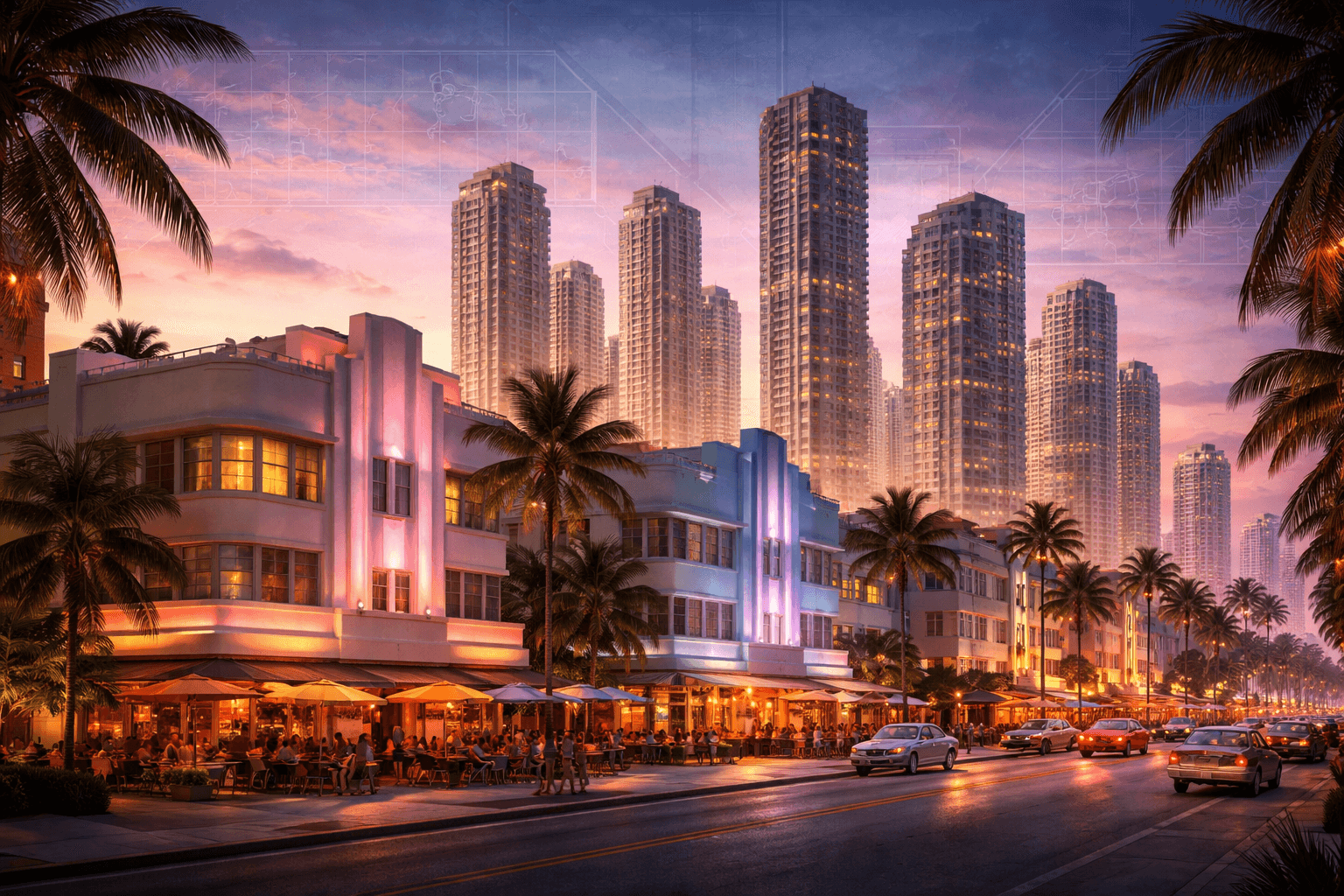
Miami Beach commissioners are considering a Transfer of Development Rights program that would let property owners anywhere in the city sell their unused building height to developers on Washington Avenue. The proposal, which has been moving through the Land Use and Sustainability Committee since late 2024, would raise the maximum height along Washington Avenue from 50 feet to as much as 100 feet. Floor area ratios would increase from 2.0 to 3.0, with density up to 150 units per acre.
The stated goal is revitalization. Washington Avenue between Fifth Street and Lincoln Road has struggled for years with vacant storefronts, turnover, and a reputation that keeps residential investment away. The commission wants taller buildings to bring more residents, more foot traffic, and more reason for businesses to stay. The mechanism they have chosen to get there is a marketplace where height is the commodity.
How TDR Works and Who It Benefits
A Transfer of Development Rights program creates two types of districts: sending areas where property owners can sell height they are not using, and receiving areas where developers can buy it. Historic districts like Flamingo Park and Ocean Beach would be the senders. Washington Avenue would be the receiver. The transaction is between private parties. The city facilitates it through zoning.
Supporters argue this protects historic buildings by giving their owners an economic incentive to keep them low while channeling growth to a corridor that can absorb it. Critics see it differently. Community members at public hearings have warned that the program amounts to selling the skyline, allowing developers to stack height on Washington Avenue while the commission frames it as preservation.
The concern is not hypothetical. Similar TDR programs in other cities have been criticized for concentrating density in ways that overwhelm infrastructure and displace existing businesses. Miami Beach's own resilience code already raised questions about how increased density interacts with flood risk, stormwater capacity, and traffic on an island with limited exit routes.
The Voter Question
Any increase in FAR on Washington Avenue technically requires voter approval under Miami Beach's charter. The commission's resilience code memo from 2023 acknowledged this. A draft ordinance was proposed for further study, with a sunset provision planned for 2032. But the question of whether voters will get a direct say on the height changes remains unanswered.
Washington Avenue needs investment. Nobody disputes that. But there is a difference between revitalizing a corridor and creating a market for building height that benefits property owners in historic districts and developers on Washington Avenue while residents absorb the consequences. If the commission is going to sell the skyline, the least it can do is put the price on the ballot.
Sources: City of Miami Beach Planning Department, Miami Beach City Charter, Miami Herald, The Real Deal Miami, Miami Beach Resilience Code Memo 2023, Florida Department of Economic Opportunity, National Trust for Historic Preservation.
Miami Beach commissioners are considering a Transfer of Development Rights program that would let property owners anywhere in the city sell their unused building height to developers on Washington Avenue. The proposal, which has been moving through the Land Use and Sustainability Committee since late 2024, would raise the maximum height along Washington Avenue from 50 feet to as much as 100 feet. Floor area ratios would increase from 2.0 to 3.0, with density up to 150 units per acre.
The stated goal is revitalization. Washington Avenue between Fifth Street and Lincoln Road has struggled for years with vacant storefronts, turnover, and a reputation that keeps residential investment away. The commission wants taller buildings to bring more residents, more foot traffic, and more reason for businesses to stay. The mechanism they have chosen to get there is a marketplace where height is the commodity.
How TDR Works and Who It Benefits
A Transfer of Development Rights program creates two types of districts: sending areas where property owners can sell height they are not using, and receiving areas where developers can buy it. Historic districts like Flamingo Park and Ocean Beach would be the senders. Washington Avenue would be the receiver. The transaction is between private parties. The city facilitates it through zoning.
Supporters argue this protects historic buildings by giving their owners an economic incentive to keep them low while channeling growth to a corridor that can absorb it. Critics see it differently. Community members at public hearings have warned that the program amounts to selling the skyline, allowing developers to stack height on Washington Avenue while the commission frames it as preservation.
The concern is not hypothetical. Similar TDR programs in other cities have been criticized for concentrating density in ways that overwhelm infrastructure and displace existing businesses. Miami Beach's own resilience code already raised questions about how increased density interacts with flood risk, stormwater capacity, and traffic on an island with limited exit routes.
The Voter Question
Any increase in FAR on Washington Avenue technically requires voter approval under Miami Beach's charter. The commission's resilience code memo from 2023 acknowledged this. A draft ordinance was proposed for further study, with a sunset provision planned for 2032. But the question of whether voters will get a direct say on the height changes remains unanswered.
Washington Avenue needs investment. Nobody disputes that. But there is a difference between revitalizing a corridor and creating a market for building height that benefits property owners in historic districts and developers on Washington Avenue while residents absorb the consequences. If the commission is going to sell the skyline, the least it can do is put the price on the ballot.
Sources: City of Miami Beach Planning Department, Miami Beach City Charter, Miami Herald, The Real Deal Miami, Miami Beach Resilience Code Memo 2023, Florida Department of Economic Opportunity, National Trust for Historic Preservation.
STAY IN THE KNOW
The stories shaping culture, delivered straight to your inbox.
Get exclusive editorial coverage on the events, brands, and trends that matter most. No spam, just substance.
Related post

April 21, 2026
April 21, 2026