

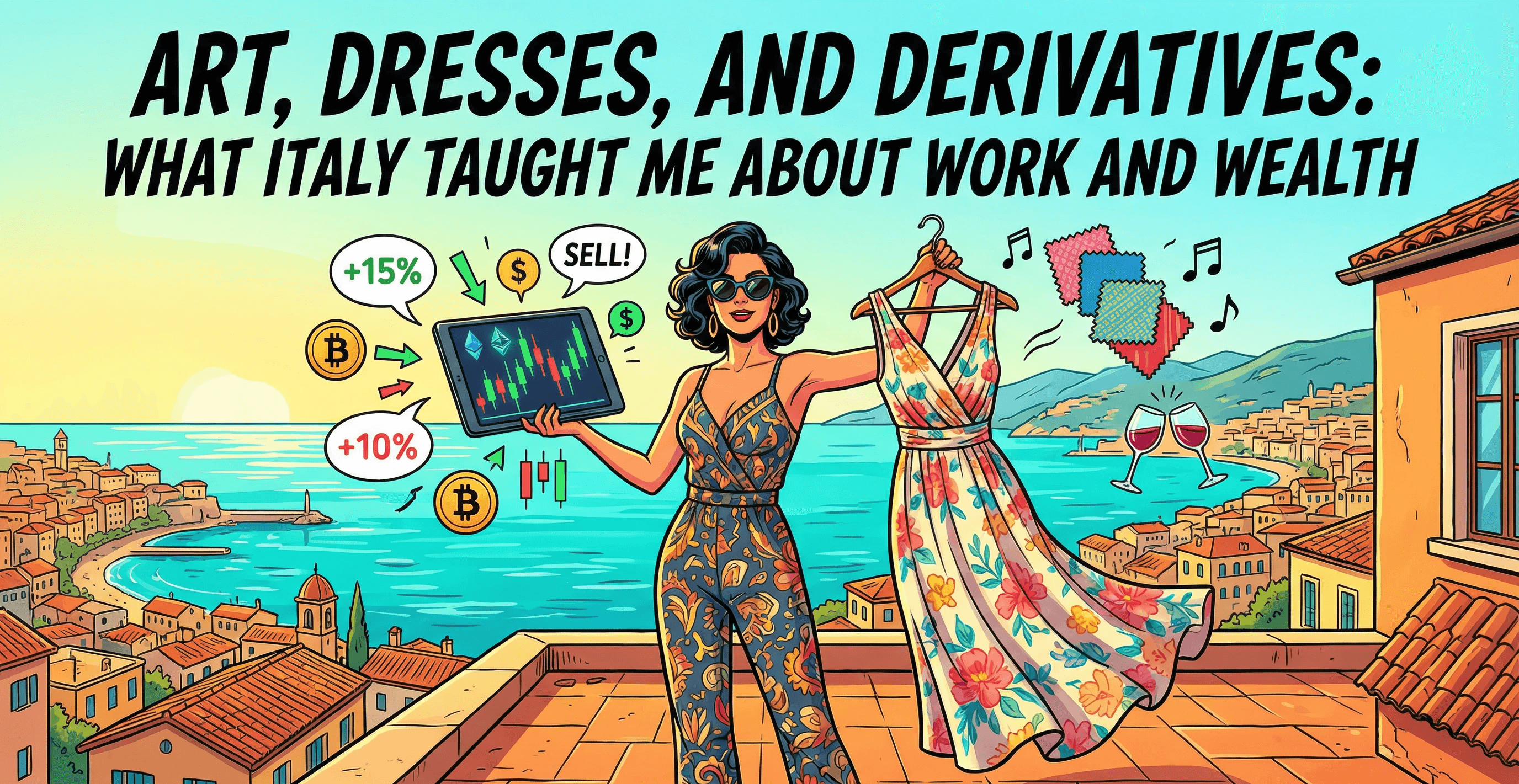
Art, Dresses, and Derivatives: What Italy Taught Me About Work and Wealth
I’m genuinely grateful I live in a world where you can sit at a laptop, learn a skill like trading, and turn that into rent money, flight money, “take a risk on yourself” money. That’s one of the things I love most about America: the idea that if you’re obsessed and disciplined enough, you can make a living out of almost anything—including staring at charts.
But the more time I spend looking at Italy’s tax system, and honestly just walking its streets, the more I feel a different kind of wisdom tapping me on the shoulder. On one side of my life there’s this American “screen as a job” reality—charts, platforms, automation. On the other, Italy quietly saying: come back to the things you build with your hands, your taste, your body. I’m starting to think I’m lucky to have both voices in my head.
How Italy divides “real work” and “speculation”
Once you zoom out, Italy’s system is very clear. There are two big buckets of income:
Creative / business income: fashion, art, music, consulting, services, small shops and freelancers.
Financial income: trading, crypto, capital gains, basically money making more money.
On the creative side, Italy offers real incentives. Small freelancers and businesses can use the regime forfettario, a simplified regime where qualifying activities pay a low flat rate—often around 5% in the early years, then roughly 15%—up to certain revenue limits. For wealthier new residents, there’s a separate flat‑tax regime where you pay a fixed amount on foreign‑source income each year instead of normal progressive rates. It’s a very Italian way of saying: if you’re bringing work, clients, or capital here, and you’re building something, we’ll roll out a softer landing.
On the financial side, the tone shifts. Capital gains from crypto and other investments sit in a category that gets taxed around 26% today, with changes and proposals pushing some situations higher. Beyond modest thresholds, your trading wins don’t get treated like the fruits of your craft; they get treated as speculative gains that the state is comfortable taxing hard.
You could see that as just numbers, but tax codes are quiet stories about what a country values. Italy’s story is: “We love when you make shoes, wine, music, and experiences here. We’re less excited about you living only through a screen.”
The case for treating trading as a job
From the inside, trading doesn’t feel like a slot machine to me. It feels like work:
Learning a language and then listening to that language scream at you all day.
Training your nervous system—can I wait, can I cut, can I not chase every move.
Hours of research, from macro headlines to charts, to who is over‑hyping what this week.
That’s not automatically noble, but it is labor. It’s also very close to entrepreneurship: you build a thesis, risk your capital and reputation, adapt when reality punches back, and try again.
So when a system labels that “speculation,” there’s a small sting. To me, this is part of my livelihood and discipline. To the state, it looks like volatile income from markets that should be clipped and controlled. I get why they do it, but I also know how much intention can sit behind a “trade.”
Why I kind of like Italy’s nudge
Here’s the part that surprised me: I actually appreciate Italy’s stance now. At first, hearing “26% on crypto gains, and maybe higher in some cases” felt like a punishment. But when I put it next to the love it shows small, creative, real‑world businesses, it started to feel more like guidance than judgment.
Italy is a country that still takes pride in things you can touch: tailoring, ceramics, architecture, food, live music, design. It makes sense that its tax code quietly says: we’d love you to keep making things people can taste, wear, walk through, and listen to.
I don’t experience that as “trading is bad.” I experience it as: don’t let the screen swallow your whole life. Let markets and charts support the life where your hands are in fabric, dough, instruments, flowers, or wood. Use your phone to enhance reality, not replace it.
Yes, crypto and other capital gains get taxed more heavily. Instead of seeing that only as a penalty, I’m starting to read it as a design choice: trading is a powerful tool—but maybe it’s healthiest when it’s not the center of who you are.
Grateful for what America taught me
I don’t want this to sound like “Italy good, America bad.” I honestly love that the American mindset told me: if you can learn it and sell it, it can be a job. That mindset gave me permission to treat social media, events, consulting, and yes, trading as real work. Without that, I might never have experimented this much or taken half the risks I’ve taken.
America is where I first saw people turn a laptop and Wi‑Fi into a life, and that possibility changed me. It made the idea of trading full‑time even thinkable. For that, I’m deeply grateful.
Building a life where creative work is the main engine
When I close my eyes and picture the life I’m actually aiming at, it’s not just me and a monitor. It’s silk‑linen‑lace designs hanging in a small shop. It’s a rail of dresses going into a boutique. It’s a table full of friends eating something we cooked, music we picked, candles we chose. It’s ocean air and sunlight hitting real objects I helped bring into the world.
The money that comes from those things feels different. Someone wears a dress on their birthday. A couple meets at an event you produced. A track plays during someone’s drive to the beach. That’s income attached to stories and memories, not just numbers.
Trade profits are cleaner. They don’t talk to you. They don’t send selfies. They are beautiful in their own way, but they’re silent. So I’m more and more comfortable letting creative work—things people can touch, wear, hear, experience—be the main engine. Trading can be the amplifier, not the identity.
Trading as a spiritual practice, not a personality
I’ve started to think of trading as a spiritual practice with a tax bill. It shows me where I’m impatient, greedy, scared, avoidant. It tests how I handle uncertainty and whether I can stick to my own rules.
If Italy is going to take around a quarter or more of what I make on winning trades, that automatically forces me to slow down. I find myself thinking: if I’m going to share this much upside with the state, this trade better be aligned with my bigger picture. It has to be worth my energy, my sleep, my nervous system—not just my P&L.bunq+2
That naturally pushes me toward fewer, higher‑conviction moves. I don’t want to live inside every tiny wiggle. I want trades that match who I am and what I’m building, not just my momentary FOMO. In that sense, the tax is weirdly supportive—it rewards patience and makes impulsiveness feel expensive.
Power, narrative, and what the system wants from you
Underneath all of this is the question of power and narrative. Governments don’t just influence behavior through speeches; they do it through structures—tax codes, incentives, paperwork, stories about what counts as “real work.”
Most of us underestimate how programmable we are. Change the tax rate and the story around an activity, and people move. They open companies, they close accounts, they lean into certain skills, they let others atrophy.
Reading Italy’s rules this way, I see a country that still wants physical culture—food, fashion, architecture, tourism, small businesses—to be at the center. It’s not anti‑technology; it’s just unwilling to let finance completely replace craft. Understanding that “psychology of the tax code” is part of understanding how power works in any place you might live.
Choosing your own story inside their system
I don’t get to write Italian law or American law. But I do get to choose how I respond to them. That’s where my freedom actually lives.
So here’s the story I’m choosing:
Trading is a sharp, useful tool I’m grateful I learned, thanks in part to America’s belief that almost anything can be a profession.
Italy is a reminder not to forget my hands, my body, my senses—the part of me that wants to sew, host, cook, curate, plant, design, and play.
I want my main power to come from art, fashion, experiences, and service—things that exist in the real world and outlast a Wi‑Fi outage. I want markets and automation to support that, not replace it.
The kind of wealth I want now
The wealth I’m aiming at looks simple on paper and rich in real life: a home by the sea, a small garden, a wardrobe with my own labels in it, a calendar full of projects I care about, a nervous system that isn’t constantly in fight‑or‑flight, enough cash flow to move freely.
So if Italy wants to tax my screen‑based speculation more heavily, I can live with that. I’ll still trade—just more intentionally, and as a complement, not a religion. The core of my wealth is going to be dresses, songs, dinners, spaces, and moments I helped create. Those are the things no government can fully price, and the part of my portfolio I want to grow the most.
If you’d like, I can now tighten this into a shorter LASAI “micro” version or break it into on‑screen text beats for a Reel.
Art, Dresses, and Derivatives: What Italy Taught Me About Work and Wealth
I’m genuinely grateful I live in a world where you can sit at a laptop, learn a skill like trading, and turn that into rent money, flight money, “take a risk on yourself” money. That’s one of the things I love most about America: the idea that if you’re obsessed and disciplined enough, you can make a living out of almost anything—including staring at charts.
But the more time I spend looking at Italy’s tax system, and honestly just walking its streets, the more I feel a different kind of wisdom tapping me on the shoulder. On one side of my life there’s this American “screen as a job” reality—charts, platforms, automation. On the other, Italy quietly saying: come back to the things you build with your hands, your taste, your body. I’m starting to think I’m lucky to have both voices in my head.
How Italy divides “real work” and “speculation”
Once you zoom out, Italy’s system is very clear. There are two big buckets of income:
Creative / business income: fashion, art, music, consulting, services, small shops and freelancers.
Financial income: trading, crypto, capital gains, basically money making more money.
On the creative side, Italy offers real incentives. Small freelancers and businesses can use the regime forfettario, a simplified regime where qualifying activities pay a low flat rate—often around 5% in the early years, then roughly 15%—up to certain revenue limits. For wealthier new residents, there’s a separate flat‑tax regime where you pay a fixed amount on foreign‑source income each year instead of normal progressive rates. It’s a very Italian way of saying: if you’re bringing work, clients, or capital here, and you’re building something, we’ll roll out a softer landing.
On the financial side, the tone shifts. Capital gains from crypto and other investments sit in a category that gets taxed around 26% today, with changes and proposals pushing some situations higher. Beyond modest thresholds, your trading wins don’t get treated like the fruits of your craft; they get treated as speculative gains that the state is comfortable taxing hard.
You could see that as just numbers, but tax codes are quiet stories about what a country values. Italy’s story is: “We love when you make shoes, wine, music, and experiences here. We’re less excited about you living only through a screen.”
The case for treating trading as a job
From the inside, trading doesn’t feel like a slot machine to me. It feels like work:
Learning a language and then listening to that language scream at you all day.
Training your nervous system—can I wait, can I cut, can I not chase every move.
Hours of research, from macro headlines to charts, to who is over‑hyping what this week.
That’s not automatically noble, but it is labor. It’s also very close to entrepreneurship: you build a thesis, risk your capital and reputation, adapt when reality punches back, and try again.
So when a system labels that “speculation,” there’s a small sting. To me, this is part of my livelihood and discipline. To the state, it looks like volatile income from markets that should be clipped and controlled. I get why they do it, but I also know how much intention can sit behind a “trade.”
Why I kind of like Italy’s nudge
Here’s the part that surprised me: I actually appreciate Italy’s stance now. At first, hearing “26% on crypto gains, and maybe higher in some cases” felt like a punishment. But when I put it next to the love it shows small, creative, real‑world businesses, it started to feel more like guidance than judgment.
Italy is a country that still takes pride in things you can touch: tailoring, ceramics, architecture, food, live music, design. It makes sense that its tax code quietly says: we’d love you to keep making things people can taste, wear, walk through, and listen to.
I don’t experience that as “trading is bad.” I experience it as: don’t let the screen swallow your whole life. Let markets and charts support the life where your hands are in fabric, dough, instruments, flowers, or wood. Use your phone to enhance reality, not replace it.
Yes, crypto and other capital gains get taxed more heavily. Instead of seeing that only as a penalty, I’m starting to read it as a design choice: trading is a powerful tool—but maybe it’s healthiest when it’s not the center of who you are.
Grateful for what America taught me
I don’t want this to sound like “Italy good, America bad.” I honestly love that the American mindset told me: if you can learn it and sell it, it can be a job. That mindset gave me permission to treat social media, events, consulting, and yes, trading as real work. Without that, I might never have experimented this much or taken half the risks I’ve taken.
America is where I first saw people turn a laptop and Wi‑Fi into a life, and that possibility changed me. It made the idea of trading full‑time even thinkable. For that, I’m deeply grateful.
Building a life where creative work is the main engine
When I close my eyes and picture the life I’m actually aiming at, it’s not just me and a monitor. It’s silk‑linen‑lace designs hanging in a small shop. It’s a rail of dresses going into a boutique. It’s a table full of friends eating something we cooked, music we picked, candles we chose. It’s ocean air and sunlight hitting real objects I helped bring into the world.
The money that comes from those things feels different. Someone wears a dress on their birthday. A couple meets at an event you produced. A track plays during someone’s drive to the beach. That’s income attached to stories and memories, not just numbers.
Trade profits are cleaner. They don’t talk to you. They don’t send selfies. They are beautiful in their own way, but they’re silent. So I’m more and more comfortable letting creative work—things people can touch, wear, hear, experience—be the main engine. Trading can be the amplifier, not the identity.
Trading as a spiritual practice, not a personality
I’ve started to think of trading as a spiritual practice with a tax bill. It shows me where I’m impatient, greedy, scared, avoidant. It tests how I handle uncertainty and whether I can stick to my own rules.
If Italy is going to take around a quarter or more of what I make on winning trades, that automatically forces me to slow down. I find myself thinking: if I’m going to share this much upside with the state, this trade better be aligned with my bigger picture. It has to be worth my energy, my sleep, my nervous system—not just my P&L.bunq+2
That naturally pushes me toward fewer, higher‑conviction moves. I don’t want to live inside every tiny wiggle. I want trades that match who I am and what I’m building, not just my momentary FOMO. In that sense, the tax is weirdly supportive—it rewards patience and makes impulsiveness feel expensive.
Power, narrative, and what the system wants from you
Underneath all of this is the question of power and narrative. Governments don’t just influence behavior through speeches; they do it through structures—tax codes, incentives, paperwork, stories about what counts as “real work.”
Most of us underestimate how programmable we are. Change the tax rate and the story around an activity, and people move. They open companies, they close accounts, they lean into certain skills, they let others atrophy.
Reading Italy’s rules this way, I see a country that still wants physical culture—food, fashion, architecture, tourism, small businesses—to be at the center. It’s not anti‑technology; it’s just unwilling to let finance completely replace craft. Understanding that “psychology of the tax code” is part of understanding how power works in any place you might live.
Choosing your own story inside their system
I don’t get to write Italian law or American law. But I do get to choose how I respond to them. That’s where my freedom actually lives.
So here’s the story I’m choosing:
Trading is a sharp, useful tool I’m grateful I learned, thanks in part to America’s belief that almost anything can be a profession.
Italy is a reminder not to forget my hands, my body, my senses—the part of me that wants to sew, host, cook, curate, plant, design, and play.
I want my main power to come from art, fashion, experiences, and service—things that exist in the real world and outlast a Wi‑Fi outage. I want markets and automation to support that, not replace it.
The kind of wealth I want now
The wealth I’m aiming at looks simple on paper and rich in real life: a home by the sea, a small garden, a wardrobe with my own labels in it, a calendar full of projects I care about, a nervous system that isn’t constantly in fight‑or‑flight, enough cash flow to move freely.
So if Italy wants to tax my screen‑based speculation more heavily, I can live with that. I’ll still trade—just more intentionally, and as a complement, not a religion. The core of my wealth is going to be dresses, songs, dinners, spaces, and moments I helped create. Those are the things no government can fully price, and the part of my portfolio I want to grow the most.
If you’d like, I can now tighten this into a shorter LASAI “micro” version or break it into on‑screen text beats for a Reel.
STAY IN THE KNOW
The stories shaping culture, delivered straight to your inbox.
Get exclusive editorial coverage on the events, brands, and trends that matter most. No spam, just substance.
Related post

March 29, 2026
March 29, 2026