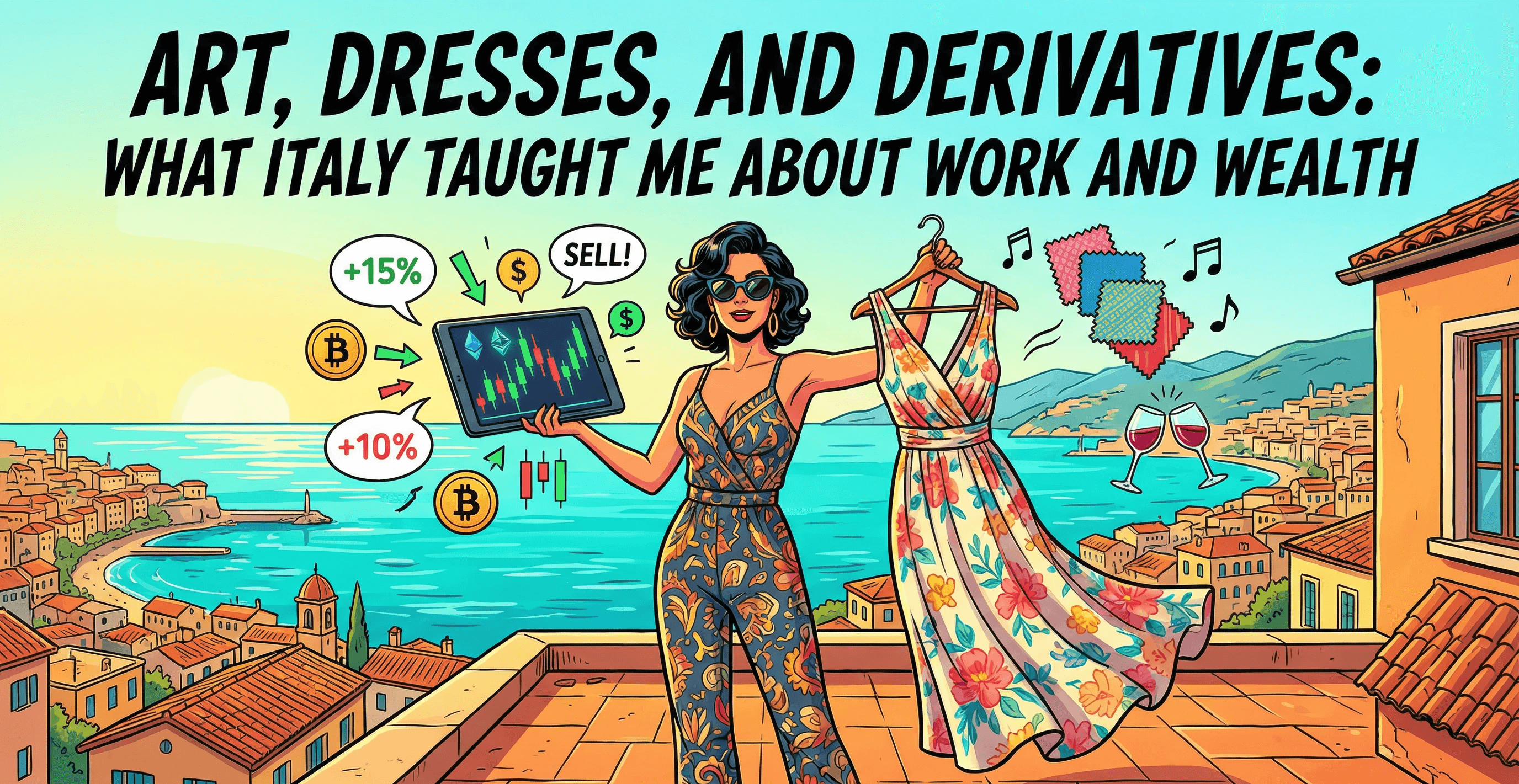
Art, Dresses, and Derivatives: What Italy Taught Me About Work and Wealth
I sit there staring at the chart like it’s a sewing pattern. Same focus, same tiny adjustments, same “if I get this wrong, I’m going to hate myself later.” To me, trading feels like work. Real work. The kind you’re sweaty‑tired from, even if you never left the couch.
So when I started looking at Italy’s tax rules and realized crypto trades get hit with a 26% capital‑gains tax (moving up toward 33% and even higher in some proposals) while small, creative businesses can slip into cute flat regimes, I had a moment. You’re telling me that if I make a dress or a track, the state smiles—but if I catch a move on Bitcoin, I’m suddenly a gambler? If trading is a job, why is it treated like a vice, while clothes and music get to be “good work”?
How Italy divides “real work” and “speculation”
Once you zoom out, Italy’s system is very clear—and kind of brutally honest. There are two big buckets:
Creative / business income: fashion, art, music, consulting, services, small boutiques, freelancing.
Financial income: trading, crypto, capital gains, all the stuff that looks like money making more
On the creative side, Italy offers you toys: for new freelancers and small businesses, there’s the regime forfettario, a simplified regime where certain professions can pay something like 5% tax for the first years, then around 15%, with thresholds on revenue. For wealthy new residents who bring their life here, there’s even a giant flat tax on foreign‑sourced income—pay a fixed number every year and keep the rest. It’s the state saying: if you’re making things, attracting clients, or importing wealth, welcome.
On the financial side, it’s a different voice. Capital gains on crypto are lumped into “miscellaneous income” and taxed at 26%, with laws pushing that rate up to the low 30s and proposals even higher for some brackets. Past a small threshold, your trading wins don’t get treated like the fruits of your craft; they get treated like speculation that needs to be clipped.
You could look at this as just numbers, but tax codes are basically moral stories. They tell you what a country wants you to do with your time.
The case for treating trading as a job
From the inside, trading doesn’t feel like “miscellaneous.” It feels like:
Learning a language and then having that language scream at you all day.
Emotional regulation reps: can I sit on my hands when I’m bored? Can I close when I’m scared?
Endless research, from macro news to chart structures, to who is lying on Twitter this week.
That is not a slot machine. It’s closer to entrepreneurship: you take risk, you create a thesis, you back it with capital and courage, and then you live with the outcome. It’s not morally better than running a café, but it’s not morally worse either.
So when a system stamps your work as “speculation,” there’s a little whiplash. To you, it’s part of your livelihood and your discipline. To the state, it’s in the same drawer as gambling and windfalls.
Why I kind of like Italy’s harsh view anyway
The more I sat with it, the more I started to like the rudeness. A 26–33% tax on trading gains is a punishment if you think the universe owes you tax‑free upside. But if you read it as a signal, it gets more interesting.
Italy is basically saying:
“We’re happy if you build something here—clothes, experiences, music, food, communities. We’re less excited about you sitting in a room compounding money with more money.”
So I started flipping it in my head. What if the high tax is a nudge to keep trading as a side amplifier of wealth, not the core of my identity or my freedom? What if it’s the system’s way of saying: you are allowed to be smart with charts, but please also make something people can touch, wear, hear, or eat?
It doesn’t make the tax “fair.” But it does make it legible.
Building a life where creative work is the main engine
When I picture the life I actually want, it’s not just me and a screen. It’s silk‑linen‑lace designs hanging in a boutique, a rack of dresses at a trunk show, a table full of friends eating something we made, someone messaging me that a song played in their car on the way to the beach.
There is a different feeling when money comes from those things. Income from creative work comes with stories attached: “I wore this on my birthday.” “We met at your event.” “That track got me through a breakup.” It’s money plus impact.
Trade profits don’t talk to you like that. They’re clean numbers. Gorgeous, yes. But they don’t hug you back. So centering my life around things people can touch and experience—dresses, music, food, ocean moments—suddenly feels like the main engine. Trading can be the booster rocket, not the ship.
Trading as a spiritual practice, not a personality
I’ve started thinking of trading less as my “career” and more as a spiritual practice with a tax bill attached. It’s a mirror for my nervous system: where I grip, where I panic, where I get greedy, where I can’t wait.
If the state is going to take around a third of what I make on a good trade, that forces a new level of intentionality. I catch myself thinking:bunq+2
“If I’m going to give the government this percentage, this trade had better be worth my energy, my cortisol, my attention.”
Suddenly, you don’t want to be in every little wiggle. You want fewer, higher‑conviction moves that line up with your life, not just your FOMO. Trading becomes one more way to practice patience, detachment, and humility—not the full definition of who you are.
Power, narrative, and what the system wants from you
Underneath all of this is the thing I care about most: power and narrative. We talk about “the system” like it’s abstract, but it’s incredibly practical. It shapes behavior through:
Tax codes
Stories about what is “real work”
Fear of audits, poverty, or exclusion
Most people have no idea how programmable they are. If you change the tax rate and the story around an activity, people move. They open an LLC. They close a wallet. They pivot into “respectable” work. Or they go underground and risk more.
Understanding the psychology of Italy’s tax code—the way it rewards creating and punishes pure financial play—is part of understanding how power works. It’s not random. It’s a script.
Choosing your own story inside their system
I don’t control Rome. I don’t get to write the budget law. What I do control is the role I choose to play inside that script.
So here’s my choice:
Let trading be the casino that owns my nervous system, or
Let it be a small, sharp tool in a larger life built on art, fashion, service, and ocean air.
I’m picking the second one. Not because I’m holy, but because it fits my values: beauty, freedom, la dolce vita, depth, and actually being useful to other humans. I want my main power to come from the things I can design, host, cook, write, and perform—not from how fast I can hit “sell.”
The kind of wealth I want
At the end of the day, the wealth I’m aiming at looks like this: a garden, a home by the sea, a closet of pieces I designed myself, a stable nervous system, creative work I’m proud of, and enough cash flow to roam without asking permission.
If Italy wants to tax my speculation like a sin, fine. I’ll still trade when it matters. But I’m going to make my real life out of dresses, songs, and dinners—things no government can ever fully price.
STAY IN THE KNOW
The stories shaping culture, delivered straight to your inbox.
Get exclusive editorial coverage on the events, brands, and trends that matter most. No spam, just substance.