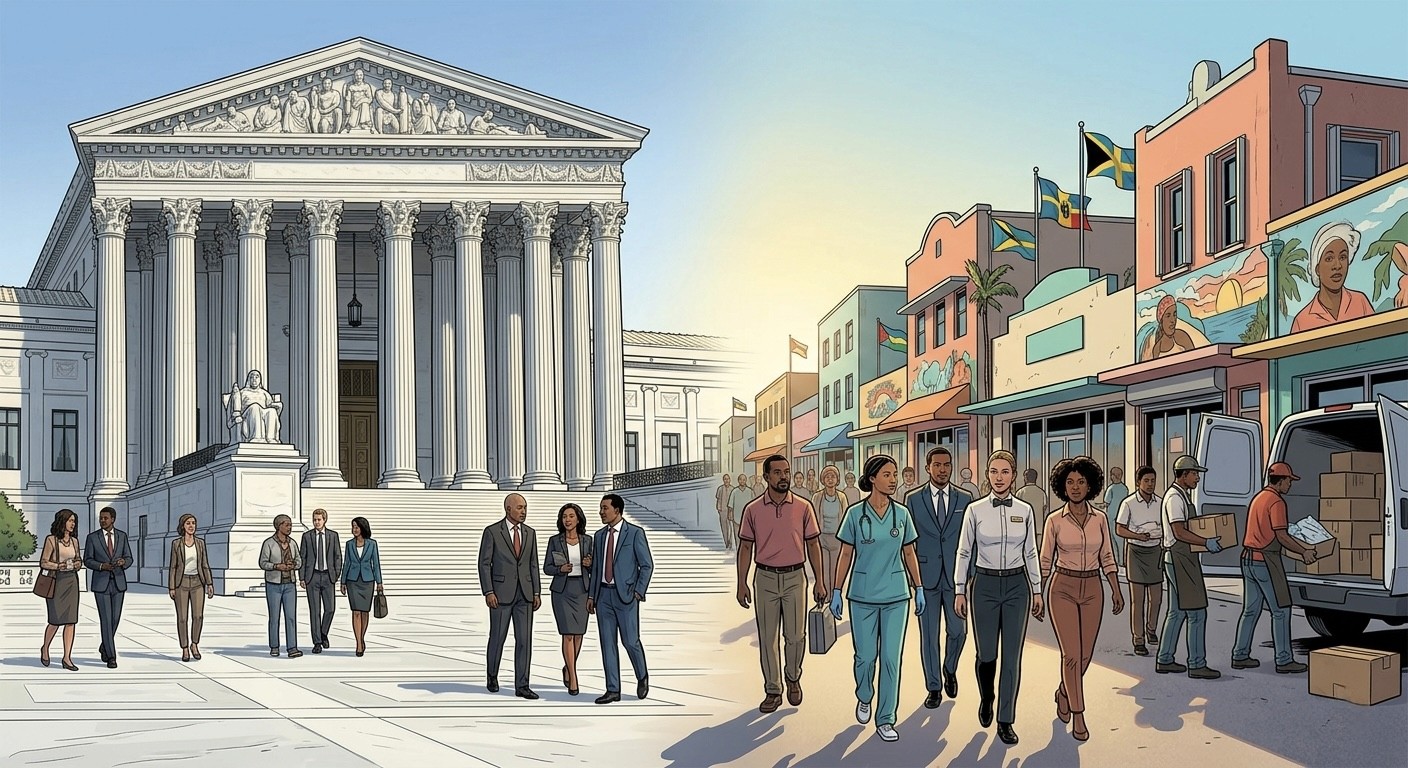
On Thursday, the United States Supreme Court issued a 6-3 ruling that cleared the way for the Trump administration to end Temporary Protected Status for approximately 350,000 Haitian nationals living and working legally in the United States. The decision also affects roughly 7,000 Syrians and strips lower courts of the ability to review TPS decisions on non-constitutional grounds — a ruling that immigration attorneys say fundamentally redraw the legal map for any future challenges.
In Miami, a city where the Haitian diaspora is not just culturally significant but economically essential, the response was immediate, grief-stricken, and determined.
"My People, They Can't Go Back"
Tessa Petit, executive director of the Florida Immigrant Coalition and herself Haitian-born, was outside Miami City Hall as the ruling landed. She didn't reach for diplomatic language. "My people, they can't go back. It is real. The reality in Haiti is real. Unsafe conditions in Haiti are real," she said, pointing to what remains on the ground: active gang violence targeting children, collapsed school infrastructure, and near-total healthcare breakdown across large parts of the country.
"There are no grounds for terminating Haiti TPS based on the country conditions inside Haiti," added another advocate at the protest. "This is absolutely absurd."
Petit has been among the most consistent and data-driven voices on this issue throughout the legal fight — and her case has never been purely humanitarian. It has always been anchored in numbers. Over 113,000 Haitian TPS holders are currently in Florida's workforce. They contribute $1.3 billion in state and local taxes annually. The 63,000 who own homes in Florida add $19 billion to housing values statewide.
"Essential workers, small business owners, and caregivers," she described them earlier this year when a lower court had temporarily blocked the termination. "By preventing the abrupt loss of work authorization, this decision safeguards billions in economic activity, helps stabilize key industries facing labor shortages, and allows businesses and families alike to plan for the future instead of bracing for chaos."
That chaos is now the operative scenario.
The 32-Day Window
Miami immigration attorney Ira Kurzban, whose firm represents the Haitian plaintiffs, confirmed that TPS protections technically remain in place for up to 32 days — the window before the Supreme Court issues its mandate to lower courts. Within that window, a constitutional challenge remains theoretically possible, since Thursday's ruling specifically preserved judicial review for constitutional claims. But the clock is running.
Petit's message to TPS holders was immediate and practical: "There are steps you need to take. You need to protect your families. You need to protect your assets. You need to identify people who will take care of your children if the need exists — but you also need to fight for yourselves."
And then: "The battle is not over."
The Economy Behind the Ruling
South Florida's hospitality, healthcare, construction, and domestic service sectors have all been built in significant part on the labor of Haitian TPS holders — a fact that rarely enters mainstream business coverage but is central to understanding the regional consequences of this decision.
Miami's hotel industry, its restaurant ecosystem, its home care networks, its building trades — all face direct labor disruption if TPS termination proceeds at the pace the administration has signaled. For the luxury hospitality sector specifically, which depends on a stable, experienced, and legally authorized workforce to maintain the service standards that high-end guests expect, the downstream effects are not abstract. They arrive on the scheduling sheet, in the staffing pipeline, in the institutional knowledge carried by long-term employees who now face an impossible choice between remaining without legal status or returning to conditions the international community has repeatedly documented as a humanitarian emergency.
Little Haiti is not separate from Miami's luxury economy. It is part of the foundation that economy rests on. The restaurants, the care workers, the hospitality professionals, the construction crews who built and maintain the infrastructure of this city's most premium experiences — these communities are interconnected in ways that the city's business leadership rarely acknowledges publicly and can no longer afford to ignore.
What Comes Next
Legal advocates are mapping constitutional grounds for a fresh challenge. Community organizations are running know-your-rights sessions and emergency family planning workshops. Employers who rely on TPS workers are facing questions about workforce continuity they have no clear answers to yet.
The Supreme Court has spoken on what the law permits the executive branch to do. The harder question — what Miami does with the 32-day window, and what the city's business community says publicly about the workforce it depends on — is one that will define the character of South Florida's response to this moment.
Tessa Petit's final line at Thursday's protest was not a legal strategy. It was a declaration of intent that carries weight beyond the courthouse: "The battle is not over."
On Thursday, the United States Supreme Court issued a 6-3 ruling that cleared the way for the Trump administration to end Temporary Protected Status for approximately 350,000 Haitian nationals living and working legally in the United States. The decision also affects roughly 7,000 Syrians and strips lower courts of the ability to review TPS decisions on non-constitutional grounds — a ruling that immigration attorneys say fundamentally redraw the legal map for any future challenges.
In Miami, a city where the Haitian diaspora is not just culturally significant but economically essential, the response was immediate, grief-stricken, and determined.
"My People, They Can't Go Back"
Tessa Petit, executive director of the Florida Immigrant Coalition and herself Haitian-born, was outside Miami City Hall as the ruling landed. She didn't reach for diplomatic language. "My people, they can't go back. It is real. The reality in Haiti is real. Unsafe conditions in Haiti are real," she said, pointing to what remains on the ground: active gang violence targeting children, collapsed school infrastructure, and near-total healthcare breakdown across large parts of the country.
"There are no grounds for terminating Haiti TPS based on the country conditions inside Haiti," added another advocate at the protest. "This is absolutely absurd."
Petit has been among the most consistent and data-driven voices on this issue throughout the legal fight — and her case has never been purely humanitarian. It has always been anchored in numbers. Over 113,000 Haitian TPS holders are currently in Florida's workforce. They contribute $1.3 billion in state and local taxes annually. The 63,000 who own homes in Florida add $19 billion to housing values statewide.
"Essential workers, small business owners, and caregivers," she described them earlier this year when a lower court had temporarily blocked the termination. "By preventing the abrupt loss of work authorization, this decision safeguards billions in economic activity, helps stabilize key industries facing labor shortages, and allows businesses and families alike to plan for the future instead of bracing for chaos."
That chaos is now the operative scenario.
The 32-Day Window
Miami immigration attorney Ira Kurzban, whose firm represents the Haitian plaintiffs, confirmed that TPS protections technically remain in place for up to 32 days — the window before the Supreme Court issues its mandate to lower courts. Within that window, a constitutional challenge remains theoretically possible, since Thursday's ruling specifically preserved judicial review for constitutional claims. But the clock is running.
Petit's message to TPS holders was immediate and practical: "There are steps you need to take. You need to protect your families. You need to protect your assets. You need to identify people who will take care of your children if the need exists — but you also need to fight for yourselves."
And then: "The battle is not over."
The Economy Behind the Ruling
South Florida's hospitality, healthcare, construction, and domestic service sectors have all been built in significant part on the labor of Haitian TPS holders — a fact that rarely enters mainstream business coverage but is central to understanding the regional consequences of this decision.
Miami's hotel industry, its restaurant ecosystem, its home care networks, its building trades — all face direct labor disruption if TPS termination proceeds at the pace the administration has signaled. For the luxury hospitality sector specifically, which depends on a stable, experienced, and legally authorized workforce to maintain the service standards that high-end guests expect, the downstream effects are not abstract. They arrive on the scheduling sheet, in the staffing pipeline, in the institutional knowledge carried by long-term employees who now face an impossible choice between remaining without legal status or returning to conditions the international community has repeatedly documented as a humanitarian emergency.
Little Haiti is not separate from Miami's luxury economy. It is part of the foundation that economy rests on. The restaurants, the care workers, the hospitality professionals, the construction crews who built and maintain the infrastructure of this city's most premium experiences — these communities are interconnected in ways that the city's business leadership rarely acknowledges publicly and can no longer afford to ignore.
What Comes Next
Legal advocates are mapping constitutional grounds for a fresh challenge. Community organizations are running know-your-rights sessions and emergency family planning workshops. Employers who rely on TPS workers are facing questions about workforce continuity they have no clear answers to yet.
The Supreme Court has spoken on what the law permits the executive branch to do. The harder question — what Miami does with the 32-day window, and what the city's business community says publicly about the workforce it depends on — is one that will define the character of South Florida's response to this moment.
Tessa Petit's final line at Thursday's protest was not a legal strategy. It was a declaration of intent that carries weight beyond the courthouse: "The battle is not over."
STAY IN THE KNOW
The stories shaping culture, delivered straight to your inbox.
Get exclusive editorial coverage on the events, brands, and trends that matter most. No spam, just substance.
Related post


July 28, 2026
July 28, 2026

July 22, 2026
July 22, 2026