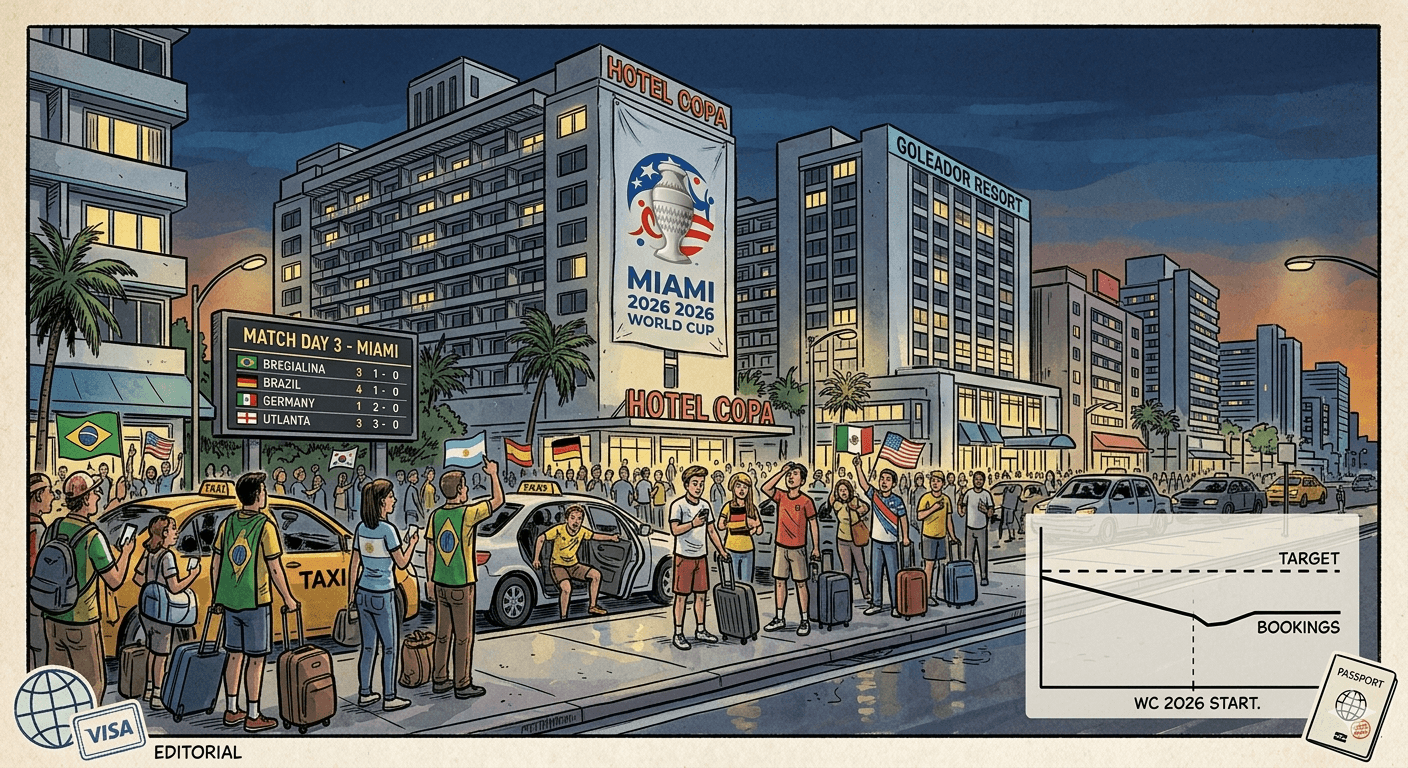
The World Cup was sold to Miami as a 45‑day Super Bowl: stadium matches, a Bayfront Park fan festival, and a projected 1.3 billion dollars in economic impact for South Florida. But a recent survey of hotel owners shows a quieter reality: bookings are tracking below expectations in all 11 U.S. host cities, and Miami is only “leading” because other markets are doing worse. This LASAI Press piece lays out the facts on those softer‑than‑expected bookings, unpacks how inflation and immigration anxiety are shaping who shows up, and maps the moves Miami still has if it wants to get closer to the numbers it has been promised.
For the other sides of the ledger—the 58.5 million dollars in local public money behind the fan festival and the actual STR/hotel dynamics—see our reporting on World Cup 2026, Miami real estate, Airbnb, and short‑term rentals and on summer in Miami 2026 not being as “dead” as advertised.
In an American Hotel & Lodging Association survey of hotel owners in the 11 U.S. World Cup host cities, every city reported bookings below what they expected heading into the tournament. In cities like Kansas City, nearly 90 percent of hotel operators told surveyors their bookings were below expectations. In San Francisco and Philadelphia, around 75 percent of owners said they were under‑performing their early booking forecasts.
Miami sits at the “best” end of a bad spectrum. The AHLA data and subsequent coverage identify Miami as one of the few markets where fewer than half of hotel owners—about 45 percent—report bookings below expectations, while cities like Kansas City, San Francisco, and Philadelphia report much higher levels of concern. That still means almost half the local industry is looking at a summer that underdelivers on the hype. It also means Miami is the least‑worried of the worried cities, buoyed by a mix of existing tourism demand, event stacking, and the region’s baseline appeal.
The numbers behind that survey don’t point to a single villain. They point to layers of friction.
One layer is inflation and high travel costs. The run‑up to this World Cup has coincided with global inflation and elevated fuel prices, which raise the cost of long‑haul flights and on‑the‑ground spending in a high‑cost city like Miami. World Cup trips stack expensive line items—airfare, hotels or short‑term rentals priced up for the event window, food and drink, local transport, and match‑week surcharges—so higher baseline prices make some fans more cautious. Tourism analysts cited in the AHLA report and related coverage say those costs are pushing some travelers to choose closer or cheaper host cities, or to stay home and watch on screens they already paid for.
Another layer is visa delays and immigration anxiety, which is where Miami’s “capital of Latin America” brand collides with U.S. policy and Florida politics. The hotel‑industry coverage notes that current U.S. immigration procedures and visa delays may be discouraging international travel to host cities, especially from parts of Latin America and the Middle East, markets that normally matter for Miami. Civil‑rights organizations and advocacy groups have issued travel advisories for Florida warning that immigrants and people of color may face higher risks of detention or discriminatory treatment, a message that tends to spread quickly among communities already wary of U.S. immigration enforcement. For potential visitors who once treated Miami as a “home away from home,” the combination of long visa timelines, headline‑driven fears about detention, and the cost of a long‑haul trip can be enough to push them toward a different host city—or out of the travel market entirely.
There is also a perception drag. Analysis of World Cup host‑city politics has placed Miami’s tournament inside a broader U.S. cycle in which immigration, border enforcement, and protest policing are front‑page issues. Florida’s own policy and rhetoric—from immigration crackdowns to state‑level culture‑war campaigns—amplify those fears for some would‑be visitors. Coverage of host‑city security has raised concerns about how arrangements such as delays in federal security funding and the presence of high‑profile political figures near event zones can signal risk to people who already feel scrutinized at borders and checkpoints. Put simply: some of the people Miami built its “global city” brand on are still doing the math on whether they feel welcome or safe enough to come this year.
All of this is happening against a very optimistic public narrative. Economic‑impact work for South Florida using Oxford Economics’ Tourism Economics Event Impact Calculator estimates more than 650 million dollars in direct new spending from the seven World Cup matches at Hard Rock Stadium, reported locally as roughly 657 million dollars. That is about half of the 1.3‑billion‑dollar total impact figure that FIFA and local officials have promoted for South Florida once indirect and induced effects are counted. Local leaders have described the event as a “Super Bowl for 45 days straight”, with the Bayfront Park fan festival as the free, public‑facing symbol of that scale.
At the same time, City and County budgets show 58.5 million dollars in local public money committed to the World Cup: 46 million dollars from Miami‑Dade County and 12.5 million dollars from the City of Miami, including a 5‑million‑dollar City grant for Bayfront Park activations and a large share of the County’s 21‑million‑dollar events budget flowing toward the fan festival and other programming. The AHLA survey and related analyses suggest that occupancy and rate are not universally blowing past expectations, and that many hotel operators are revising their internal revenue forecasts downward as bookings pace closer to typical seasonal levels than to a once‑in‑a‑generation spike.
That gap—between modeled impact and early booking reality—is not uniquely Miami’s; Newsweek and other outlets have flagged similar concerns across host cities. But in Miami, it lands in a city that has already front‑loaded tens of millions in public spending and is layering the World Cup on top of existing issues: housing pressure, climate risk, water quality, and a political environment that makes some visitors hesitate.
The policy and business analysis does not end at worry. It also lays out what could still help if Miami wants to get closer to the numbers on the impact slides. One category is actually speaking to the audiences the city claims. Tourism researchers and local economists argue for more aggressive, Spanish‑language and multilingual World Cup marketing in key source markets, not just generic English‑language campaigns. That means destination campaigns coordinated between tourism boards, airlines, and hotels that address cost and safety concerns directly, rather than pretending they are not there. For a city that brands itself as bilingual, this remains a lever that can still be pulled while the tournament is underway.
Another category is making the math work in an inflation year. Analysts talk about bundled offers, value‑added packages, and partnerships between hotels, restaurants, and attractions to create more predictable price points for fans and families who are budget‑sensitive. In practice, that looks like inclusive transit‑plus‑food‑plus‑fan‑fest experiences and neighborhood passes, not just dynamic pricing on rooms and tickets. It also matches what the short‑term rental data has already been saying: in markets like Miami, listings that kept rates realistic have been the ones that actually booked.
A third lever is spreading the benefits beyond the stadium and Bayfront. The same survey data that shows softness also suggests that hotels closest to major event nodes are performing differently from those farther out. Business and tourism experts argue for campaigns and travel packages that drive visitors into local neighborhoods, cultural attractions, culinary and sustainable tourism experiences in addition to the games—Little Haiti, Allapattah, inland parks—so World Cup spending does not stop at the waterfront and club districts. That takes coordination and storytelling, not just a map of bars near the fan zone.
The final lever is lowering the temperature on safety and immigration fears. Analysts suggest that hospitality and tourism institutions can help by prioritizing transparent, multilingual safety and immigration communication: clear information on airport procedures, documents required, visa expectations, and where security lines are actually drawn. The goal is not to spin Florida policy; it is to close the gap between rumor and reality enough that people who want to come feel they can do so with eyes open. That is not a job City Hall can solve alone, but it is one where universities, business groups, and civic organizations can decide whether they will act like hosts or bystanders.
An honest read of the numbers looks like this. Yes, Miami is facing softer‑than‑expected bookings, and roughly 45 percent of hotel owners saying “below expectations” is not a small red flag. Yes, inflation, visa delays, and immigration anxiety are real constraints on who shows up and how long they stay. Yes, the city and county have already put 58.5 million dollars in local public money on the line based on impact models that assume fuller planes and fuller rooms than some operators are seeing.
But Miami is also the least‑worried of the worried cities, sitting closer to its targets than peers like Kansas City, San Francisco, and Philadelphia, and it still has live levers it can pull—language, pricing, neighborhood programming, transparent safety communication—if it wants to chase something closer to the economic outcome it was sold. The fearful version of this story ends at “the boom may not show up.” The honest version ends somewhere more uncomfortable: if the boom does not show up evenly, it will not just be because of wars, fuel prices, and FIFA. It will also be because of the choices Miami makes, or doesn’t make, in the few weeks when the world is actually looking this way.
The World Cup was sold to Miami as a 45‑day Super Bowl: stadium matches, a Bayfront Park fan festival, and a projected 1.3 billion dollars in economic impact for South Florida. But a recent survey of hotel owners shows a quieter reality: bookings are tracking below expectations in all 11 U.S. host cities, and Miami is only “leading” because other markets are doing worse. This LASAI Press piece lays out the facts on those softer‑than‑expected bookings, unpacks how inflation and immigration anxiety are shaping who shows up, and maps the moves Miami still has if it wants to get closer to the numbers it has been promised.
For the other sides of the ledger—the 58.5 million dollars in local public money behind the fan festival and the actual STR/hotel dynamics—see our reporting on World Cup 2026, Miami real estate, Airbnb, and short‑term rentals and on summer in Miami 2026 not being as “dead” as advertised.
In an American Hotel & Lodging Association survey of hotel owners in the 11 U.S. World Cup host cities, every city reported bookings below what they expected heading into the tournament. In cities like Kansas City, nearly 90 percent of hotel operators told surveyors their bookings were below expectations. In San Francisco and Philadelphia, around 75 percent of owners said they were under‑performing their early booking forecasts.
Miami sits at the “best” end of a bad spectrum. The AHLA data and subsequent coverage identify Miami as one of the few markets where fewer than half of hotel owners—about 45 percent—report bookings below expectations, while cities like Kansas City, San Francisco, and Philadelphia report much higher levels of concern. That still means almost half the local industry is looking at a summer that underdelivers on the hype. It also means Miami is the least‑worried of the worried cities, buoyed by a mix of existing tourism demand, event stacking, and the region’s baseline appeal.
The numbers behind that survey don’t point to a single villain. They point to layers of friction.
One layer is inflation and high travel costs. The run‑up to this World Cup has coincided with global inflation and elevated fuel prices, which raise the cost of long‑haul flights and on‑the‑ground spending in a high‑cost city like Miami. World Cup trips stack expensive line items—airfare, hotels or short‑term rentals priced up for the event window, food and drink, local transport, and match‑week surcharges—so higher baseline prices make some fans more cautious. Tourism analysts cited in the AHLA report and related coverage say those costs are pushing some travelers to choose closer or cheaper host cities, or to stay home and watch on screens they already paid for.
Another layer is visa delays and immigration anxiety, which is where Miami’s “capital of Latin America” brand collides with U.S. policy and Florida politics. The hotel‑industry coverage notes that current U.S. immigration procedures and visa delays may be discouraging international travel to host cities, especially from parts of Latin America and the Middle East, markets that normally matter for Miami. Civil‑rights organizations and advocacy groups have issued travel advisories for Florida warning that immigrants and people of color may face higher risks of detention or discriminatory treatment, a message that tends to spread quickly among communities already wary of U.S. immigration enforcement. For potential visitors who once treated Miami as a “home away from home,” the combination of long visa timelines, headline‑driven fears about detention, and the cost of a long‑haul trip can be enough to push them toward a different host city—or out of the travel market entirely.
There is also a perception drag. Analysis of World Cup host‑city politics has placed Miami’s tournament inside a broader U.S. cycle in which immigration, border enforcement, and protest policing are front‑page issues. Florida’s own policy and rhetoric—from immigration crackdowns to state‑level culture‑war campaigns—amplify those fears for some would‑be visitors. Coverage of host‑city security has raised concerns about how arrangements such as delays in federal security funding and the presence of high‑profile political figures near event zones can signal risk to people who already feel scrutinized at borders and checkpoints. Put simply: some of the people Miami built its “global city” brand on are still doing the math on whether they feel welcome or safe enough to come this year.
All of this is happening against a very optimistic public narrative. Economic‑impact work for South Florida using Oxford Economics’ Tourism Economics Event Impact Calculator estimates more than 650 million dollars in direct new spending from the seven World Cup matches at Hard Rock Stadium, reported locally as roughly 657 million dollars. That is about half of the 1.3‑billion‑dollar total impact figure that FIFA and local officials have promoted for South Florida once indirect and induced effects are counted. Local leaders have described the event as a “Super Bowl for 45 days straight”, with the Bayfront Park fan festival as the free, public‑facing symbol of that scale.
At the same time, City and County budgets show 58.5 million dollars in local public money committed to the World Cup: 46 million dollars from Miami‑Dade County and 12.5 million dollars from the City of Miami, including a 5‑million‑dollar City grant for Bayfront Park activations and a large share of the County’s 21‑million‑dollar events budget flowing toward the fan festival and other programming. The AHLA survey and related analyses suggest that occupancy and rate are not universally blowing past expectations, and that many hotel operators are revising their internal revenue forecasts downward as bookings pace closer to typical seasonal levels than to a once‑in‑a‑generation spike.
That gap—between modeled impact and early booking reality—is not uniquely Miami’s; Newsweek and other outlets have flagged similar concerns across host cities. But in Miami, it lands in a city that has already front‑loaded tens of millions in public spending and is layering the World Cup on top of existing issues: housing pressure, climate risk, water quality, and a political environment that makes some visitors hesitate.
The policy and business analysis does not end at worry. It also lays out what could still help if Miami wants to get closer to the numbers on the impact slides. One category is actually speaking to the audiences the city claims. Tourism researchers and local economists argue for more aggressive, Spanish‑language and multilingual World Cup marketing in key source markets, not just generic English‑language campaigns. That means destination campaigns coordinated between tourism boards, airlines, and hotels that address cost and safety concerns directly, rather than pretending they are not there. For a city that brands itself as bilingual, this remains a lever that can still be pulled while the tournament is underway.
Another category is making the math work in an inflation year. Analysts talk about bundled offers, value‑added packages, and partnerships between hotels, restaurants, and attractions to create more predictable price points for fans and families who are budget‑sensitive. In practice, that looks like inclusive transit‑plus‑food‑plus‑fan‑fest experiences and neighborhood passes, not just dynamic pricing on rooms and tickets. It also matches what the short‑term rental data has already been saying: in markets like Miami, listings that kept rates realistic have been the ones that actually booked.
A third lever is spreading the benefits beyond the stadium and Bayfront. The same survey data that shows softness also suggests that hotels closest to major event nodes are performing differently from those farther out. Business and tourism experts argue for campaigns and travel packages that drive visitors into local neighborhoods, cultural attractions, culinary and sustainable tourism experiences in addition to the games—Little Haiti, Allapattah, inland parks—so World Cup spending does not stop at the waterfront and club districts. That takes coordination and storytelling, not just a map of bars near the fan zone.
The final lever is lowering the temperature on safety and immigration fears. Analysts suggest that hospitality and tourism institutions can help by prioritizing transparent, multilingual safety and immigration communication: clear information on airport procedures, documents required, visa expectations, and where security lines are actually drawn. The goal is not to spin Florida policy; it is to close the gap between rumor and reality enough that people who want to come feel they can do so with eyes open. That is not a job City Hall can solve alone, but it is one where universities, business groups, and civic organizations can decide whether they will act like hosts or bystanders.
An honest read of the numbers looks like this. Yes, Miami is facing softer‑than‑expected bookings, and roughly 45 percent of hotel owners saying “below expectations” is not a small red flag. Yes, inflation, visa delays, and immigration anxiety are real constraints on who shows up and how long they stay. Yes, the city and county have already put 58.5 million dollars in local public money on the line based on impact models that assume fuller planes and fuller rooms than some operators are seeing.
But Miami is also the least‑worried of the worried cities, sitting closer to its targets than peers like Kansas City, San Francisco, and Philadelphia, and it still has live levers it can pull—language, pricing, neighborhood programming, transparent safety communication—if it wants to chase something closer to the economic outcome it was sold. The fearful version of this story ends at “the boom may not show up.” The honest version ends somewhere more uncomfortable: if the boom does not show up evenly, it will not just be because of wars, fuel prices, and FIFA. It will also be because of the choices Miami makes, or doesn’t make, in the few weeks when the world is actually looking this way.
STAY IN THE KNOW
The stories shaping culture, delivered straight to your inbox.
Get exclusive editorial coverage on the events, brands, and trends that matter most. No spam, just substance.


