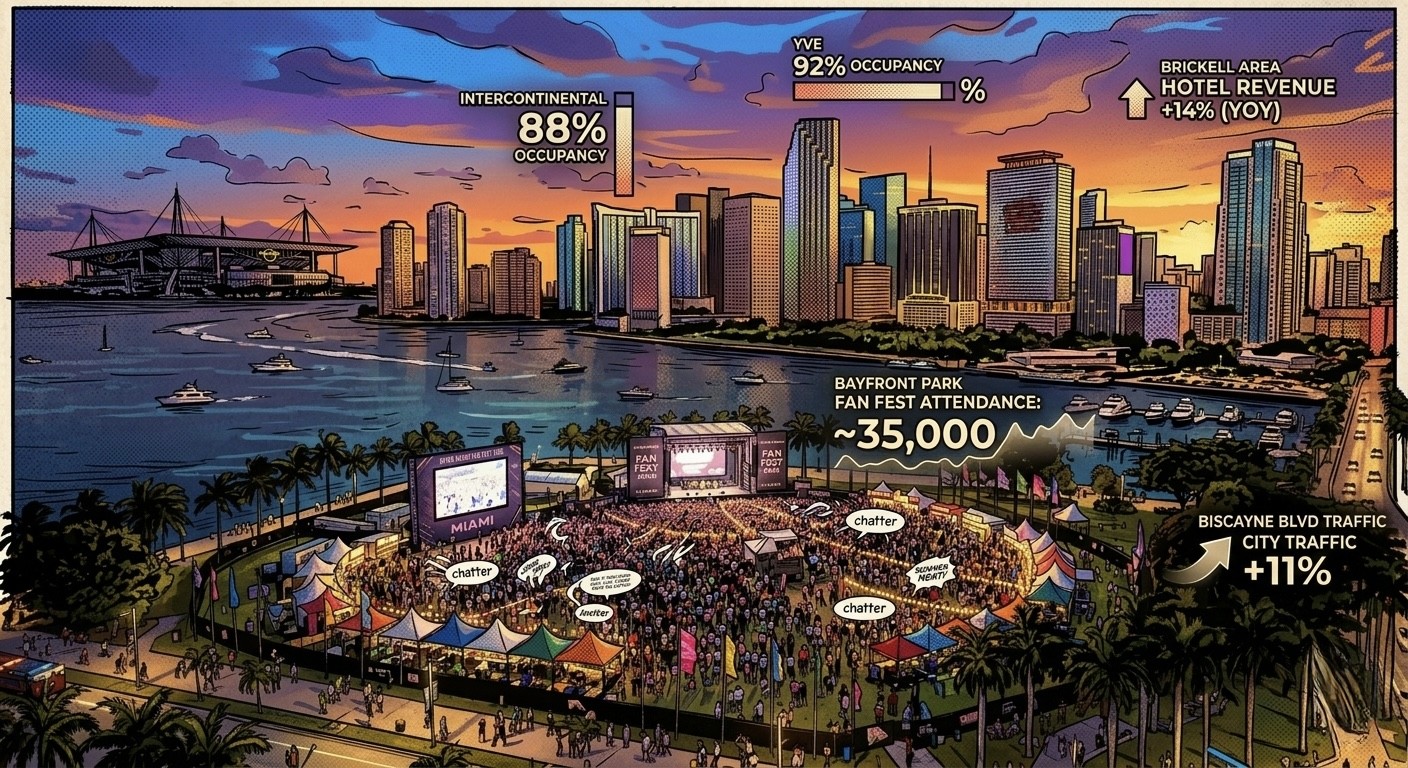
Summer in Miami gets called “dead” so often it feels like a seasonal setting: too hot, too empty, too off‑season to matter. Summer 2026 is not one of those years. LASAI Press reported this piece to do one simple thing: put hard numbers behind the slogans about FIFA World Cup 2026, the FIFA Fan Festival at Bayfront Park, “Super Bowl for 45 days straight” rhetoric, and claims that hotel demand is either collapsing or exploding—so people who live and work here can see where this summer actually sits.
If you want the deeper dives on specific pieces of this story, we’ve already mapped out World Cup 2026’s real‑estate and Airbnb reality in Miami, the 58.5 million dollars in local public money behind Bayfront’s fan festival, and the way icons like the Delano Miami Beach are reopening into this World Cup window.
The starting point is simple: Miami is not just a backdrop; it is an official host city with seven matches at Hard Rock Stadium and a three‑week fan festival on the downtown waterfront. The FIFA Fan Festival™ Miami at Bayfront Park runs June 13–July 5, turning the park into a free “second stadium” with daily match broadcasts, concerts, and sponsor activations. City marketing leans on that fan zone, the stadium games, and a projected 1.3 billion dollars in World Cup‑related economic impact for South Florida as proof that this is not a sleepy off‑season.
Underneath that, the data on travel demand and hotel performance paints a picture that is busy and uneven rather than dead or universally booming. A Booking.com analysis of search activity ahead of the tournament, echoed in local business coverage, found Miami near the top of U.S. host markets, with accommodation searches for summer 2026 up sharply year‑over‑year—around the 40‑plus percent range compared with the previous summer, outpacing many non‑host cities. A hospitality forecast cited by the Miami Herald pegged hotel occupancy in the Miami metro at roughly 73.2 percent in June and 71.5 percent in July, up 3.5 percentage points and 3.2 percentage points respectively from the same months a year earlier.
Those are not numbers you see in a dead season. They are also not evidence of a guaranteed windfall for everyone. Early reporting on availability has pointed out that major properties still had World Cup‑period rooms open as of early May, with nightly rates in the hundreds of dollars—higher than a typical June, but not entirely sold out. Industry analysis from CoStar and the American Hotel & Lodging Association suggests that, across U.S. host markets, World Cup 2026 is likely to drive higher average daily rates and a mid‑teens percentage lift in revenue per available room (RevPAR) for host cities, with a more modest boost in occupancy and a “negligible” impact on the broader national hotel market.
Summer also looks alive because public money is working hard behind the scenes to make it that way. As we’ve detailed, Miami‑Dade County and the City of Miami together have committed 58.5 million dollars in local public funding to South Florida’s World Cup hosting package. That includes 46 million dollars from the County, with 21 million dollars in cash for events and services and 25 million dollars for security and public safety, and 12.5 million dollars from the City, including a 5‑million‑dollar grant specifically for Bayfront Park activations and the fan‑fest grounds.
That spending underwrites a lot of what makes summer feel busy even before private demand kicks in: a waterfront fan festival that is “free” to enter, enhanced security and services around stadium days, and city‑wide activations designed to pull people into downtown when they might otherwise stay in air‑conditioned rooms. Economic‑impact modeling using Oxford Economics’ Tourism Economics Event Impact Calculator estimates that the seven matches at Hard Rock Stadium will generate about 657 million dollars in direct new spending in South Florida, with up to 1.3 billion dollars in total economic impact once indirect and induced effects are counted.
In practice, that means this summer’s “not dead” feeling is part natural demand, part taxpayer‑funded staging.
The mix gets more complicated when you look at who is coming and who is not. On one hand, a World Cup host‑city guide for Miami notes that group‑stage occupancy rates for Miami hotels are up triple digits in percentage terms versus the same point a year earlier, with match‑date occupancy pacing well ahead of 2025. Miami Beach’s own World Cup briefing projects 85–95 percent occupancy for many Beach properties during the tournament and average daily rates in the 350–550 dollar range, with luxury hotels pushing higher.
On the other hand, national and industry surveys show that hotel bookings across host cities are still tracking below initial forecasts, that domestic travelers are outpacing international visitors, and that factors like inflation, high fuel prices, visa hurdles, and geopolitical concerns are suppressing what might have been an even larger wave of international travel. For Miami specifically, analysts have flagged that visa delays and immigration procedures may be discouraging would‑be visitors from Latin America and the Middle East, the very regions the city often counts as extended family.
So you end up with a summer that is far from dead—but also not as globally oversubscribed as the “World Cup will fix everything” version of the story implied.
Inside the city, this summer is also a test of what kind of luxury and hospitality Miami Beach wants to project in a year when global events are already pushing up prices. The Delano Miami Beach—a 1947 oceanfront tower named after Franklin Delano Roosevelt and long sold as the “living room of Miami”—reopened in June 2026 after being closed since early 2020. It returns as part of a small Delano‑branded portfolio that includes Paris and Dubai, re‑entering a market where Miami‑Dade and Miami Beach have posted 80‑percent‑plus occupancy and Beach room rates above 400 dollars in early 2026, even before the World Cup matches arrive.
That reopening lands in the middle of a broader wave of new luxury inventory—branded residences, private terminals, high‑end hotels—as well as in the middle of a World Cup that is already putting stress on housing and wages. It’s one more reason this summer feels like a live experiment rather than a quiet shoulder season.
When you put these threads together, summer 2026 in Miami looks less like a binary and more like a set of overlapping truths:
Demand is up. Search data, flight‑booking stats, and hotel forecasts all point to stronger summer demand than last year, with occupancy and rates climbing in the Miami metro and especially in Miami Beach.
The “alive” feeling is subsidized. Tens of millions of public dollars are underwriting free fan experiences, security, and services that make the city feel active even before purely private demand arrives.
The benefits are uneven. Hotels and STRs near key nodes are best positioned; others are closer to a normal summer. Some international visitors are staying away because of cost, visas, and politics, even as domestic demand and regional drive markets help fill some of the gap.
So no, summer in Miami is not dead in 2026. It is loud, curated, and contested: a season where Bayfront Park becomes a World Cup living room, properties like the Delano turn their lights back on, and the city uses public money and global events to make sure the off‑season feels as staged as everything else. The open question is whether, when the screens and stages come down, the people who actually live here will feel like this was a summer that worked for them—or a preview of how much effort it now takes to keep “dead season” from showing through.
Summer in Miami gets called “dead” so often it feels like a seasonal setting: too hot, too empty, too off‑season to matter. Summer 2026 is not one of those years. LASAI Press reported this piece to do one simple thing: put hard numbers behind the slogans about FIFA World Cup 2026, the FIFA Fan Festival at Bayfront Park, “Super Bowl for 45 days straight” rhetoric, and claims that hotel demand is either collapsing or exploding—so people who live and work here can see where this summer actually sits.
If you want the deeper dives on specific pieces of this story, we’ve already mapped out World Cup 2026’s real‑estate and Airbnb reality in Miami, the 58.5 million dollars in local public money behind Bayfront’s fan festival, and the way icons like the Delano Miami Beach are reopening into this World Cup window.
The starting point is simple: Miami is not just a backdrop; it is an official host city with seven matches at Hard Rock Stadium and a three‑week fan festival on the downtown waterfront. The FIFA Fan Festival™ Miami at Bayfront Park runs June 13–July 5, turning the park into a free “second stadium” with daily match broadcasts, concerts, and sponsor activations. City marketing leans on that fan zone, the stadium games, and a projected 1.3 billion dollars in World Cup‑related economic impact for South Florida as proof that this is not a sleepy off‑season.
Underneath that, the data on travel demand and hotel performance paints a picture that is busy and uneven rather than dead or universally booming. A Booking.com analysis of search activity ahead of the tournament, echoed in local business coverage, found Miami near the top of U.S. host markets, with accommodation searches for summer 2026 up sharply year‑over‑year—around the 40‑plus percent range compared with the previous summer, outpacing many non‑host cities. A hospitality forecast cited by the Miami Herald pegged hotel occupancy in the Miami metro at roughly 73.2 percent in June and 71.5 percent in July, up 3.5 percentage points and 3.2 percentage points respectively from the same months a year earlier.
Those are not numbers you see in a dead season. They are also not evidence of a guaranteed windfall for everyone. Early reporting on availability has pointed out that major properties still had World Cup‑period rooms open as of early May, with nightly rates in the hundreds of dollars—higher than a typical June, but not entirely sold out. Industry analysis from CoStar and the American Hotel & Lodging Association suggests that, across U.S. host markets, World Cup 2026 is likely to drive higher average daily rates and a mid‑teens percentage lift in revenue per available room (RevPAR) for host cities, with a more modest boost in occupancy and a “negligible” impact on the broader national hotel market.
Summer also looks alive because public money is working hard behind the scenes to make it that way. As we’ve detailed, Miami‑Dade County and the City of Miami together have committed 58.5 million dollars in local public funding to South Florida’s World Cup hosting package. That includes 46 million dollars from the County, with 21 million dollars in cash for events and services and 25 million dollars for security and public safety, and 12.5 million dollars from the City, including a 5‑million‑dollar grant specifically for Bayfront Park activations and the fan‑fest grounds.
That spending underwrites a lot of what makes summer feel busy even before private demand kicks in: a waterfront fan festival that is “free” to enter, enhanced security and services around stadium days, and city‑wide activations designed to pull people into downtown when they might otherwise stay in air‑conditioned rooms. Economic‑impact modeling using Oxford Economics’ Tourism Economics Event Impact Calculator estimates that the seven matches at Hard Rock Stadium will generate about 657 million dollars in direct new spending in South Florida, with up to 1.3 billion dollars in total economic impact once indirect and induced effects are counted.
In practice, that means this summer’s “not dead” feeling is part natural demand, part taxpayer‑funded staging.
The mix gets more complicated when you look at who is coming and who is not. On one hand, a World Cup host‑city guide for Miami notes that group‑stage occupancy rates for Miami hotels are up triple digits in percentage terms versus the same point a year earlier, with match‑date occupancy pacing well ahead of 2025. Miami Beach’s own World Cup briefing projects 85–95 percent occupancy for many Beach properties during the tournament and average daily rates in the 350–550 dollar range, with luxury hotels pushing higher.
On the other hand, national and industry surveys show that hotel bookings across host cities are still tracking below initial forecasts, that domestic travelers are outpacing international visitors, and that factors like inflation, high fuel prices, visa hurdles, and geopolitical concerns are suppressing what might have been an even larger wave of international travel. For Miami specifically, analysts have flagged that visa delays and immigration procedures may be discouraging would‑be visitors from Latin America and the Middle East, the very regions the city often counts as extended family.
So you end up with a summer that is far from dead—but also not as globally oversubscribed as the “World Cup will fix everything” version of the story implied.
Inside the city, this summer is also a test of what kind of luxury and hospitality Miami Beach wants to project in a year when global events are already pushing up prices. The Delano Miami Beach—a 1947 oceanfront tower named after Franklin Delano Roosevelt and long sold as the “living room of Miami”—reopened in June 2026 after being closed since early 2020. It returns as part of a small Delano‑branded portfolio that includes Paris and Dubai, re‑entering a market where Miami‑Dade and Miami Beach have posted 80‑percent‑plus occupancy and Beach room rates above 400 dollars in early 2026, even before the World Cup matches arrive.
That reopening lands in the middle of a broader wave of new luxury inventory—branded residences, private terminals, high‑end hotels—as well as in the middle of a World Cup that is already putting stress on housing and wages. It’s one more reason this summer feels like a live experiment rather than a quiet shoulder season.
When you put these threads together, summer 2026 in Miami looks less like a binary and more like a set of overlapping truths:
Demand is up. Search data, flight‑booking stats, and hotel forecasts all point to stronger summer demand than last year, with occupancy and rates climbing in the Miami metro and especially in Miami Beach.
The “alive” feeling is subsidized. Tens of millions of public dollars are underwriting free fan experiences, security, and services that make the city feel active even before purely private demand arrives.
The benefits are uneven. Hotels and STRs near key nodes are best positioned; others are closer to a normal summer. Some international visitors are staying away because of cost, visas, and politics, even as domestic demand and regional drive markets help fill some of the gap.
So no, summer in Miami is not dead in 2026. It is loud, curated, and contested: a season where Bayfront Park becomes a World Cup living room, properties like the Delano turn their lights back on, and the city uses public money and global events to make sure the off‑season feels as staged as everything else. The open question is whether, when the screens and stages come down, the people who actually live here will feel like this was a summer that worked for them—or a preview of how much effort it now takes to keep “dead season” from showing through.
STAY IN THE KNOW
The stories shaping culture, delivered straight to your inbox.
Get exclusive editorial coverage on the events, brands, and trends that matter most. No spam, just substance.


